
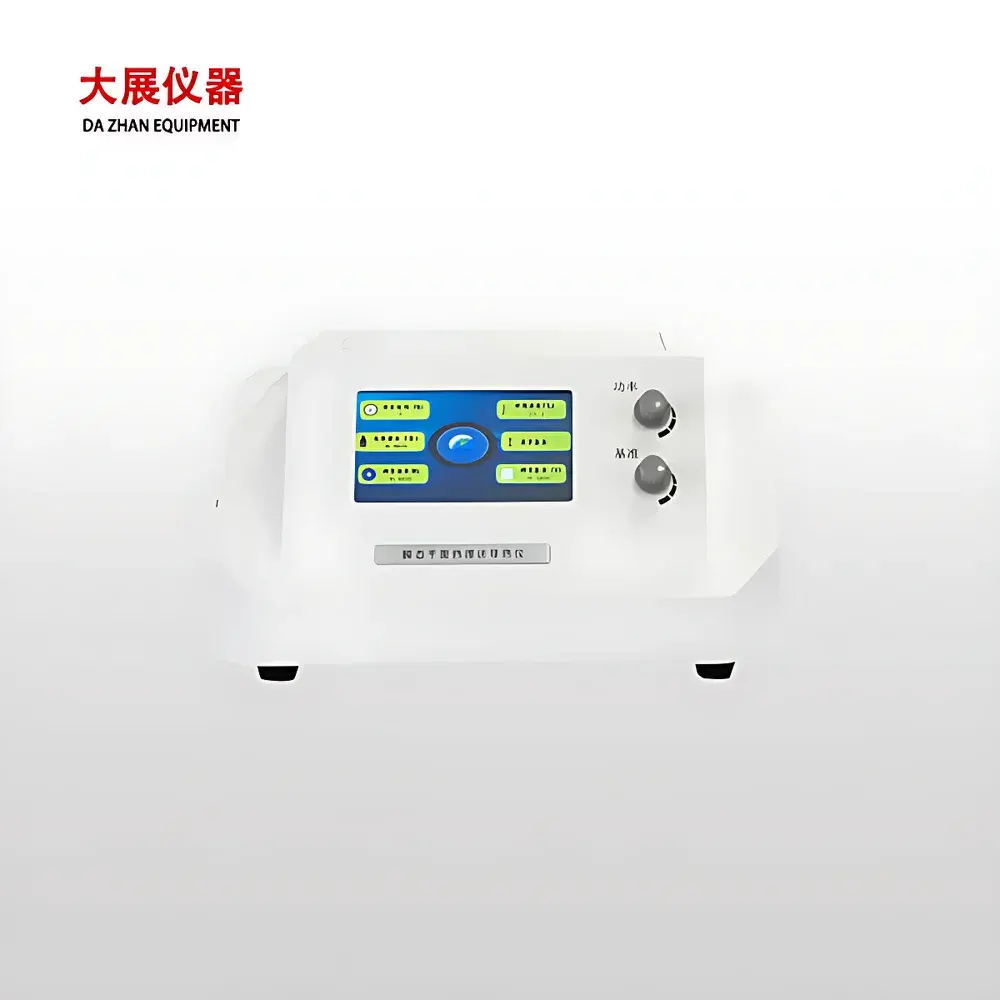
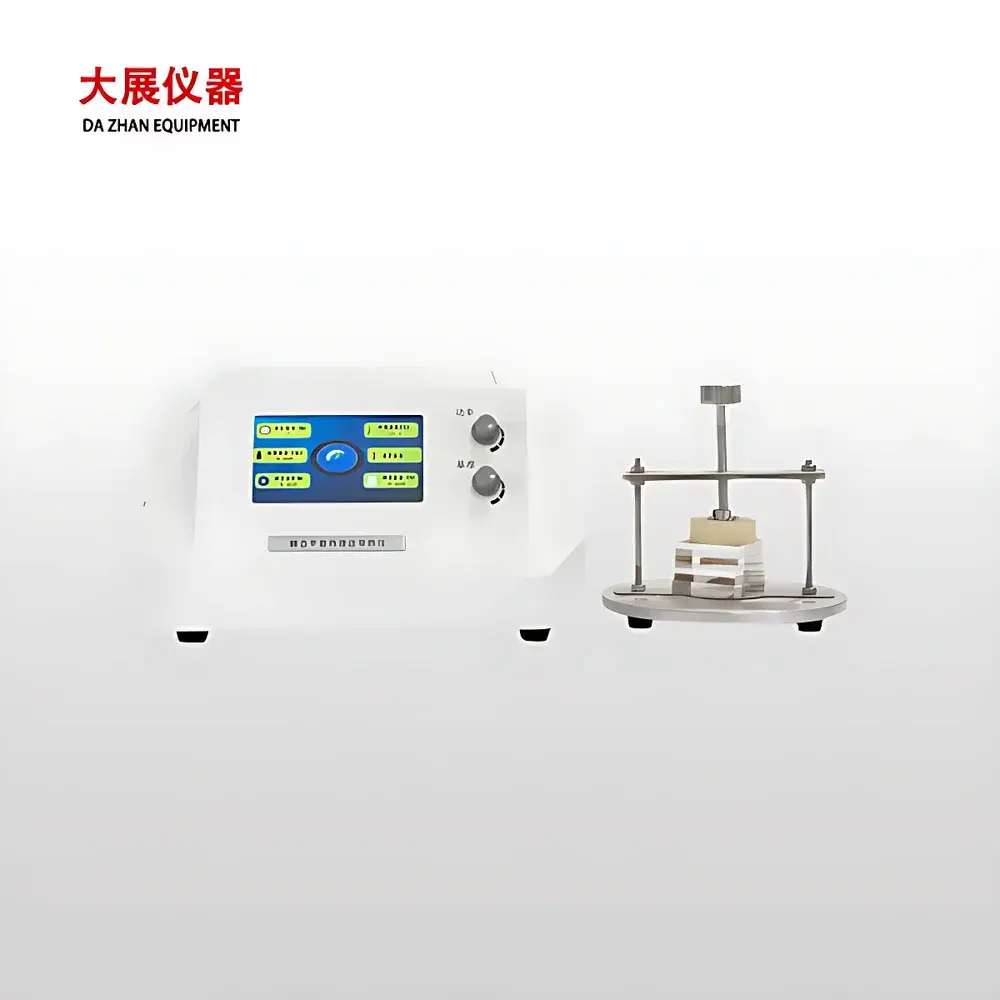
Nanjing Dazhan DZDR-S Transient Plane Source Thermal Conductivity Analyzer
| Brand | Nanjing Dazhan |
|---|---|
| Origin | Jiangsu, China |
| Manufacturer Type | Direct Manufacturer |
| Country of Origin | China |
| Model | DZDR-S |
| Instrument Principle | Transient Plane Source (TPS) Method |
| Sample Throughput | Single sample per test |
| Test Environment | Ambient pressure |
| Thermal Conductivity Range | 0.001–300 W/(m·K) |
| Accuracy | ±3% |
Overview
The Nanjing Dazhan DZDR-S Transient Plane Source Thermal Conductivity Analyzer is a precision instrument engineered for rapid, non-destructive measurement of thermal conductivity across a broad spectrum of solid, liquid, powder, and composite materials. It operates on the well-established transient plane source (TPS) principle—where a thin, double-spiral sensor acts simultaneously as both heater and temperature sensor. Upon application of a constant electrical current, the sensor generates a controlled heat pulse; the resulting temperature rise over time is recorded with high temporal resolution. Thermal conductivity is derived from the slope of the log(temperature rise) versus log(time) curve in the early-time regime, enabling robust physical modeling without assumptions about sample geometry or boundary conditions. Designed for laboratory-based quality control, R&D validation, and material certification workflows, the DZDR-S delivers repeatable results under ambient-pressure conditions and requires no vacuum chamber or complex sample preparation.
Key Features
- Transient Plane Source (TPS) measurement method compliant with ISO 22007-2 and ASTM D5470 standards for thermal conductivity determination.
- Wide dynamic range: measures thermal conductivity from 0.001 W/(m·K) (e.g., aerogels, polymer foams) up to 300 W/(m·K) (e.g., copper alloys, graphite composites), supporting diverse material classes in a single platform.
- Integrated dual-function sensor with platinum trace elements ensures high signal-to-noise ratio and long-term calibration stability.
- ±3% accuracy across the full range, validated against NIST-traceable reference materials including SRM 1450c (fiberglass board) and SRM 1470 (polyethylene).
- Compact benchtop architecture with active thermal shielding minimizes environmental drift during extended testing sessions.
- No requirement for contact pressure optimization or interfacial grease—ideal for soft, fragile, or anisotropic samples where traditional guarded-hot-plate or laser-flash methods introduce uncertainty.
Sample Compatibility & Compliance
The DZDR-S accommodates disk-shaped, slab, or irregularly cut specimens with thicknesses from 1 mm to 25 mm and diameters/widths ≥ 25 mm. Compatible sample types include polymers, ceramics, metals, phase-change materials (PCMs), thermal interface materials (TIMs), battery electrode coatings, and geological cores. All measurements are performed at atmospheric pressure and ambient temperature (20–25°C), eliminating need for environmental chambers. The system supports GLP-compliant operation through user-accessible audit trails, electronic signatures, and test parameter locking—fully aligned with FDA 21 CFR Part 11 requirements when integrated with validated LIMS environments. Documentation packages include IQ/OQ protocols and calibration certificates traceable to national metrology institutes.
Software & Data Management
The proprietary DZDR Control Suite (v4.2+) provides intuitive workflow-driven operation via Windows-based GUI. Real-time monitoring displays raw voltage vs. time curves, normalized temperature response, and iterative curve-fitting residuals. Each test generates a structured XML report containing metadata (operator ID, timestamp, ambient T/P), raw acquisition data, fitted parameters, uncertainty budget breakdown, and compliance flags. Export options include CSV, PDF, and ASTM E2927-compliant thermal property datasets. Software supports multi-user role management (admin, technician, reviewer), automatic backup to network drives, and optional integration with enterprise MES systems via OPC UA interface.
Applications
- Thermal interface material (TIM) qualification for electronics packaging and EV battery module design.
- Quality assurance of insulating ceramics in aerospace thermal protection systems.
- R&D screening of nanocomposite polymers for enhanced heat dissipation in LED substrates.
- Validation of thermal homogeneity in additive-manufactured metal parts prior to fatigue testing.
- Regulatory submission support for medical device thermal safety assessments (ISO 10993-12).
- Educational use in materials science laboratories for hands-on instruction in heat transfer fundamentals and uncertainty analysis.
FAQ
What standards does the DZDR-S comply with?
It adheres to ISO 22007-2 (Plastics — Determination of thermal conductivity and thermal diffusivity — Part 2: Transient plane source (hot disc) method) and ASTM D5470 (Standard Test Method for Thermal Transmission Properties of Thermally Conductive Electrical Insulation Materials).
Can the instrument measure anisotropic materials?
Yes—by orienting the sensor parallel or perpendicular to expected thermal gradients, users can determine in-plane vs. through-plane conductivity in layered composites and fiber-reinforced polymers.
Is calibration verification required between tests?
A daily reference check using the included stainless-steel calibration standard is recommended; full recalibration is advised every 6 months or after 500 test cycles.
Does the system support automated batch testing?
No—the DZDR-S is optimized for single-sample, high-fidelity characterization; it does not feature robotic sample handling or unattended sequencing.
What training and documentation are provided?
Nanjing Dazhan supplies comprehensive operator manuals, SOP templates, IQ/OQ validation guides, and remote video-based technical onboarding covering measurement theory, troubleshooting, and regulatory reporting workflows.



