
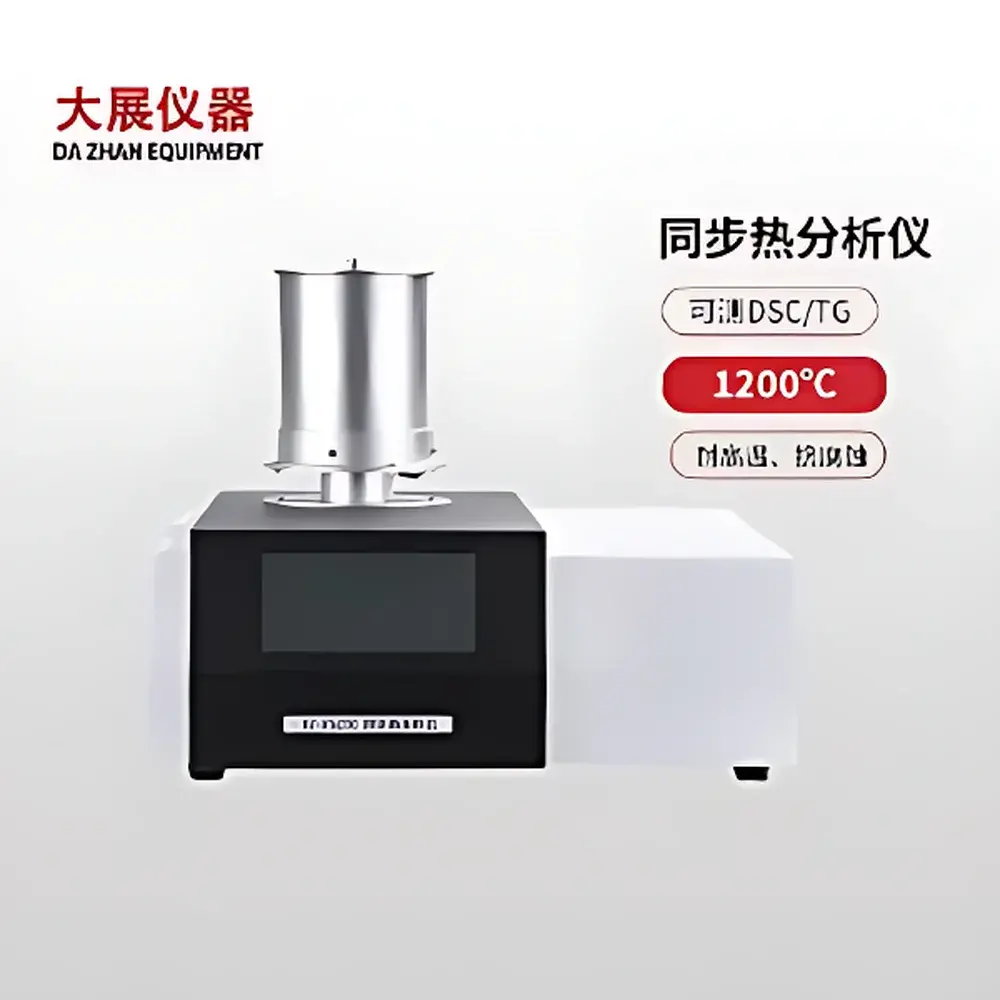
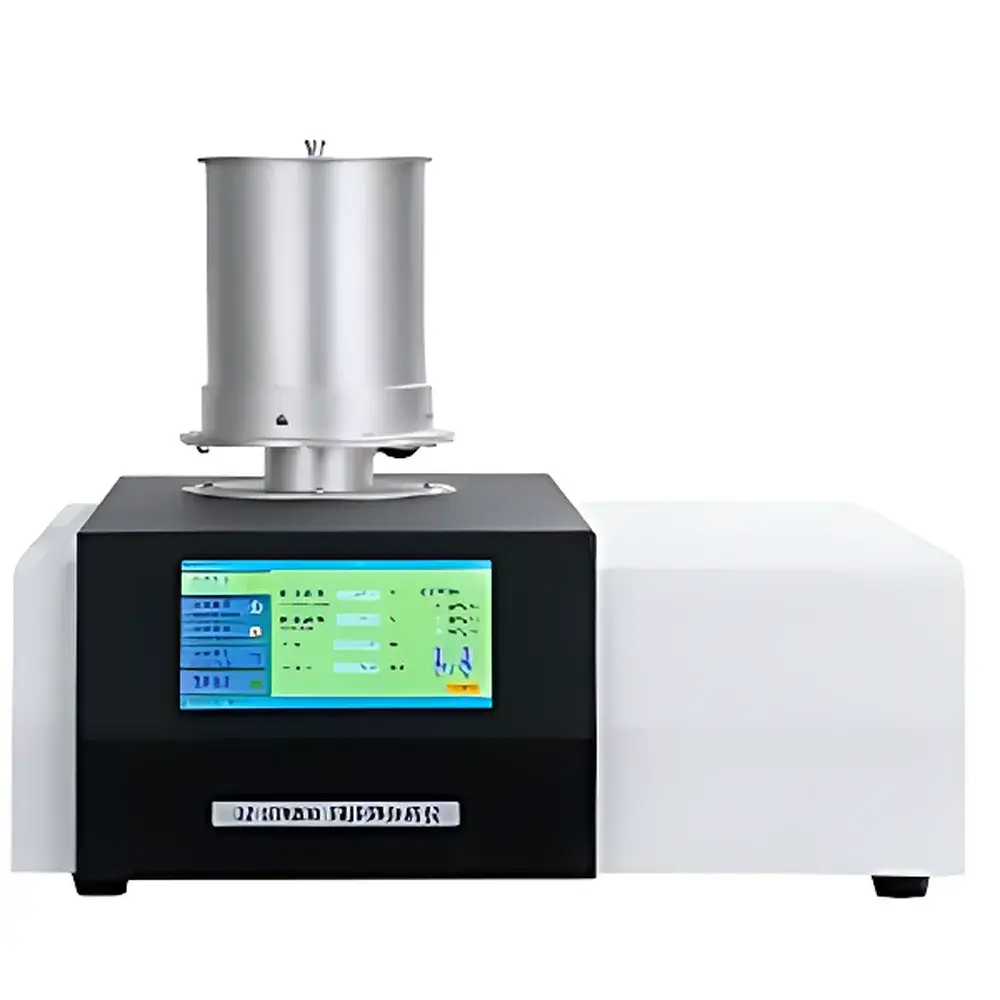
Nanjing Dazhan STA 200 Simultaneous Thermal Analyzer (TG-DSC)
| Brand | Nanjing Dazhan |
|---|---|
| Origin | Jiangsu, China |
| Manufacturer Type | Direct Manufacturer |
| Model | STA 200 |
| Temperature Range | Ambient to 1200°C |
| Heating Rate | 0.1–100°C/min |
| Max Sample Mass | 5 g |
| Atmosphere Options | Inert, Oxidizing, Reducing |
| TG Resolution | 0.1 µg |
| DSC Resolution | 0.1 µW |
| DSC Accuracy | ±0.01 mW |
| Temperature Accuracy | ±0.1°C |
| Temperature Resolution | 0.01°C |
| Cooling Time (1000°C → 100°C) | ≤15 min |
| Data Interface | USB |
| Display | 7-inch 24-bit LCD Touchscreen |
Overview
The Nanjing Dazhan STA 200 Simultaneous Thermal Analyzer is an integrated thermal analysis platform engineered for precision measurement of mass change (thermogravimetry, TG) and heat flow (differential scanning calorimetry, DSC) on a single sample under identical experimental conditions. Operating on the principle of simultaneous thermogravimetric–calorimetric detection, the instrument enables real-time correlation between weight loss/gain events and endothermic/exothermic transitions—critical for elucidating decomposition mechanisms, phase transformations, reaction kinetics, and compositional stability. Designed for rigorous laboratory environments, the STA 200 supports temperature programming from ambient to 1200°C with high thermal uniformity and reproducibility, making it suitable for materials research in academia, polymer science, pharmaceutical development, ceramics, and advanced composites.
Key Features
- High-stability dual-row platinum-rhodium alloy furnace with optimized thermal gradient control, ensuring minimal thermal interference and extended service life at elevated temperatures.
- Ceramic rod–based microbalance suspension system offering exceptional resistance to oxidation, corrosion, and thermal creep up to 1200°C.
- Physically isolated power supply and forced-air cooling module—mounted separately from the main chassis—to eliminate mechanical vibration and thermal crosstalk to the ultra-sensitive microbalance.
- Top-opening furnace design with ergonomic access for rapid sample loading, crucible exchange, and routine maintenance without realignment.
- Multi-layer passive thermal shielding between the furnace chamber and instrument housing minimizes conductive and radiative heat transfer to the balance and electronics.
- Modular furnace architecture allows field-replacement with alternative configurations (e.g., low-temperature or high-sensitivity variants) to accommodate evolving application requirements.
Sample Compatibility & Compliance
The STA 200 accommodates standard ceramic, aluminum, and platinum crucibles (including hermetic and vented variants), supporting both solid powders and thin-film samples up to 5 g. Its programmable dual-gas manifold—with integrated mass flow controllers and automated switching—enables precise atmosphere control across inert (N₂, Ar), oxidizing (air, O₂), and reducing (H₂/N₂ mixtures) environments, either static or dynamic (up to 200 mL/min). The system complies with ASTM E1131, ISO 11358, and USP for thermal analysis methodology validation. Data acquisition and reporting support audit-trail functionality aligned with GLP and GMP documentation standards, including time-stamped metadata, user authentication logs, and electronic signature readiness per FDA 21 CFR Part 11 guidelines.
Software & Data Management
The embedded intelligent software suite provides full control over temperature programs (ramp, hold, step, and multi-segment profiles), real-time visualization of TG, DTG, DSC, and derivative curves, and post-acquisition processing—including baseline correction, peak integration, kinetic modeling (e.g., Kissinger, Ozawa-Flynn-Wall), and component quantification (e.g., moisture, ash, organic residue). Export formats include CSV, Excel (.xlsx), and publication-ready PDF reports with customizable templates. All raw and processed data are stored with embedded calibration history, instrument configuration snapshots, and environmental metadata. USB 2.0 interface ensures seamless integration into existing lab networks and LIMS environments.
Applications
- Pharmaceutical solid-state characterization: polymorph screening, hydrate/dehydrate behavior, excipient compatibility, and thermal stability assessment per ICH Q1A–Q1E guidelines.
- Polymer degradation kinetics: onset temperature determination, activation energy calculation, and filler–matrix interaction analysis under oxidative aging conditions.
- Inorganic material development: sintering behavior, phase evolution in oxides and nitrides, and stoichiometric verification via mass-loss stoichiometry.
- Battery materials: cathode/anode thermal runaway profiling, SEI layer formation studies, and electrolyte decomposition thresholds.
- Geochemical and metallurgical samples: mineral dehydration, carbonate decomposition, and redox-driven phase transitions under controlled atmospheres.
FAQ
What types of crucibles are compatible with the STA 200?
Standard alumina, aluminum, and platinum crucibles are supported; custom geometries and sealed variants can be integrated upon request.
Does the system support automatic calibration routines?
Yes—the software includes multi-point temperature and enthalpy calibration using certified reference materials (e.g., indium, zinc, alumina) traceable to NIST standards.
Can the instrument operate unattended overnight?
Absolutely—programmable holds up to 72 hours and scheduled shutdown ensure robust long-duration experiments with minimal supervision.
Is remote monitoring or control possible?
While native remote operation is not enabled, exported data files and real-time USB streaming allow integration with third-party SCADA or lab automation platforms.
How is compliance with regulatory data integrity requirements addressed?
All data files contain immutable timestamps, operator ID, instrument serial number, and version-controlled method parameters—fully auditable for FDA, EMA, and MHRA inspections.



