
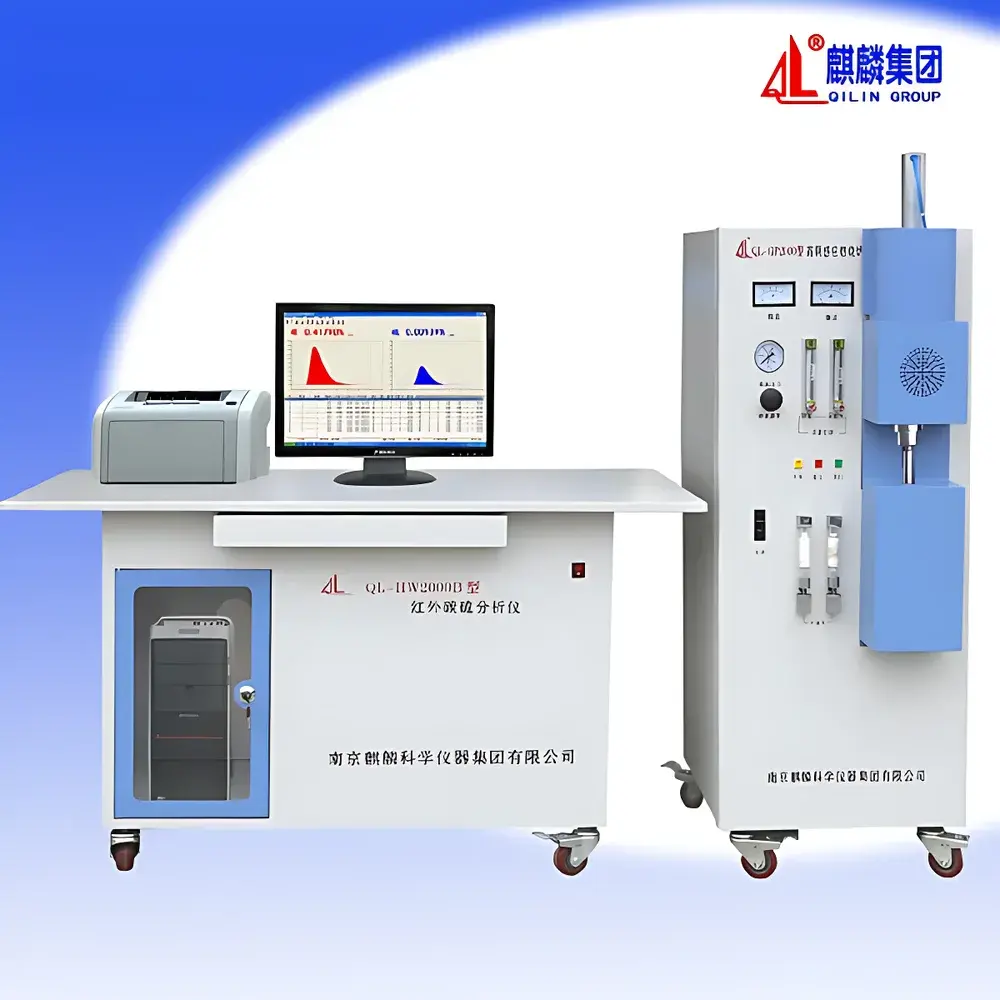
Nanjing Qilin QL-HW2000 High-Frequency Infrared Carbon-Sulfur Analyzer
| Brand | Qilin / QL |
|---|---|
| Origin | Jiangsu, China |
| Manufacturer Type | Authorized Distributor |
| Product Origin | Domestic (China) |
| Model | QL-HW2000 |
| Price Range | USD 7,000–14,000 (FOB) |
| Measurement Principle | Non-Dispersive Infrared (NDIR) Absorption |
| Combustion Source | 2.5 kVA High-Frequency Induction Furnace (18–20 MHz) |
| Carbon Range | 0.00001–10.0000 wt% (extendable to 99.999 wt%) |
| Sulfur Range | 0.00001–0.5000 wt% (extendable to 99.999 wt%) |
| Sensitivity | 0.1 ppm (minimum display resolution) |
| Precision | Carbon RSD ≤ 0.5%, Sulfur RSD ≤ 1.0% |
| Analysis Time | 25–60 s (user-adjustable) |
| Compliance | GB/T 20123–2006, ISO 15350:2000 |
| Sample Weighing Accuracy | 0.0001 g (via integrated analytical balance interface) |
| Optical Detection | High-stability pyroelectric infrared detectors with narrow-band interference filters |
| Gas Handling | Precision mass flow control |
| Mechanical Drive | Aerospace-grade synchronous motor in IR absorption cell (rated >100,000 h MTBF) |
Overview
The Nanjing Qilin QL-HW2000 High-Frequency Infrared Carbon-Sulfur Analyzer is a fully integrated combustion-infrared instrumentation system engineered for precise, routine quantification of total carbon (C) and total sulfur (S) in solid inorganic and organic matrices. It operates on the principle of non-dispersive infrared (NDIR) spectroscopy: samples are combusted quantitatively in a high-frequency induction furnace under controlled oxygen flow, converting carbon and sulfur into CO₂ and SO₂ gases, respectively. These gaseous oxides pass through dedicated optical cells where their characteristic infrared absorption bands (4.26 µm for CO₂, 7.35 µm for SO₂) are measured by thermally stable pyroelectric detectors. The system employs dual-channel, temperature- and pressure-compensated signal processing to deliver trace-level sensitivity and macro-range linearity without manual calibration interpolation.
Key Features
- High-frequency induction furnace (2.5 kVA, 18–20 MHz) with RF-controlled thermal ramping ensures reproducible, complete sample oxidation—critical for heterogeneous materials such as cast iron, ferroalloys, and refractory ceramics.
- Narrow-band optical filtering isolates target absorption wavelengths, eliminating spectral overlap between CO₂ and SO₂ and mitigating interferences from high-carbon matrices during low-sulfur analysis.
- Pyroelectric infrared detectors provide long-term baseline stability and sub-ppm resolution, supporting both ultra-trace sulfur detection (e.g., in high-purity metals) and high-concentration carbon measurement (up to 99.999 wt%).
- IR absorption cell driven by aerospace-grade synchronous motor guarantees mechanical consistency over extended operational life (>100,000 hours mean time between failures).
- Modular electronic architecture with real-time temperature, pressure, and mass flow compensation corrects for environmental drift and gas density variations—enhancing day-to-day and lab-to-lab result comparability.
- Industrial-grade pneumatic subsystem featuring Airtac solenoid valves (rated for ≥100,000 actuation cycles) and precision laminar-flow mass controllers ensures repeatable carrier gas delivery and zero carryover between analyses.
Sample Compatibility & Compliance
The QL-HW2000 is validated for use across metallurgical, geological, energy, and advanced materials sectors. It accommodates solid samples ranging from ferrous alloys (carbon steel, stainless steel, cast iron, ductile iron), non-ferrous metals (copper, aluminum, nickel-based superalloys), mineralogical specimens (iron ore, limestone, slag, coal, coke, catalysts), and industrial ceramics or foundry sands. All measurements adhere to internationally recognized standard test methods: GB/T 20123–2006 (equivalent to ISO 15350:2000) for combustion-infrared determination of total carbon and total sulfur. While not inherently 21 CFR Part 11 compliant out-of-the-box, the instrument’s digital output supports integration with LIMS platforms that implement audit trail, electronic signature, and data integrity controls per GLP/GMP requirements.
Software & Data Management
The analyzer interfaces with Windows-based acquisition software supporting method configuration, real-time spectral monitoring, automatic peak integration, and multi-point calibration curve generation. Raw absorbance data, combustion parameters (furnace power, O₂ flow rate, duration), and environmental compensation values are logged with timestamps. Export formats include CSV and XML for traceability and external statistical review. The software permits user-defined reporting templates aligned with internal QA protocols or customer-specific certificate-of-analysis (CoA) formats. Optional RS-232/USB/Ethernet connectivity enables centralized instrument management in multi-unit laboratories.
Applications
- Quality control of incoming raw materials (scrap metal, ferroalloys, fluxes) in steelmaking and foundry operations.
- Verification of carbon equivalency (CE) and hardenability indices in heat-treated alloy steels.
- Sulfur speciation screening in desulfurized coals and flue gas desulfurization (FGD) byproducts.
- Compliance testing of low-sulfur stainless grades per ASTM A240/A276 and EN 10088 standards.
- Research-grade quantification of C/S stoichiometry in metal carbides (e.g., WC, TiC), sulfides (MoS₂, Ni₃S₂), and battery cathode precursors.
- Geochemical assay of carbonates and sulfide minerals in exploration core samples.
FAQ
What sample mass is required for accurate analysis?
Typical sample weights range from 0.2 g to 1.0 g, depending on expected C/S concentration and matrix volatility. The system integrates with analytical balances (0.0001 g readability) via RS-232 to auto-import tare and gross mass.
Can the QL-HW2000 analyze liquid or powder samples directly?
No. It is designed exclusively for solid samples. Powders must be pelletized or mixed with tungsten or tin flux; volatile organics require encapsulation in pure iron or copper foil to ensure complete combustion and prevent splattering.
Is routine maintenance of the infrared cells required?
The sealed optical path and synchronous-motor-driven cell design eliminate need for periodic alignment or mirror cleaning. Annual verification of detector responsivity and filter transmission using certified reference materials (CRMs) is recommended.
How does the system handle high-sulfur samples that may saturate the SO₂ channel?
The firmware implements dynamic range switching and optional dilution gas injection (O₂ bypass) to extend linear response. Users may also select lower-gain detector modes or reduce sample mass to maintain signal integrity within calibrated bounds.
Does the instrument support automated sample introduction?
Not natively. The QL-HW2000 features manual crucible loading. However, its communication protocol (Modbus RTU over RS-485 optional) allows third-party robotic autosamplers to be integrated at the system level with custom PLC logic.
Related Products




