
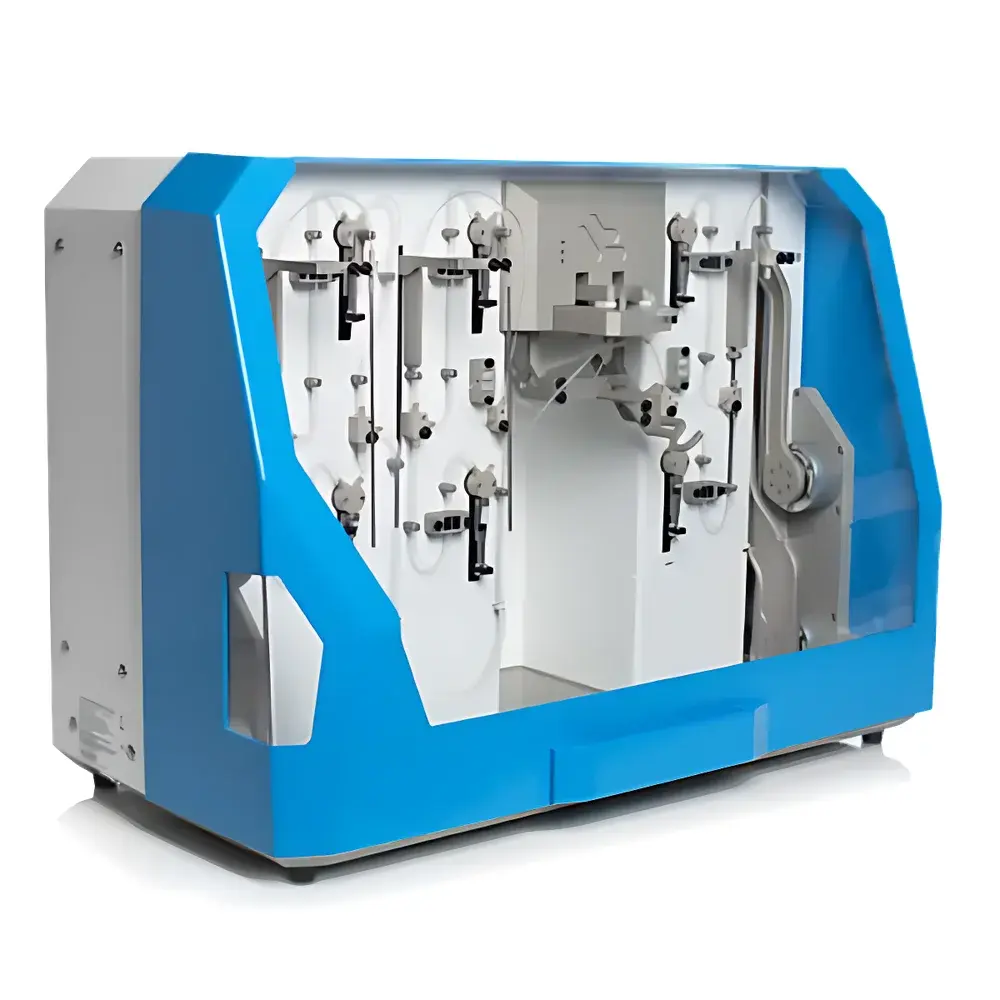
NanoAssemblr™ Blaze™ Nanoparticle Formulation System
| Brand | Cytiva |
|---|---|
| Origin | Switzerland |
| Model | NanoAssemblr™ Blaze™ System |
| Volume Range | 1 L (Blaze™) / up to 10 L (Blaze+™) |
| System Architecture | Closed, single-use, GMP-ready process development platform |
| Core Technology | NxGen™ microfluidic mixing |
| Regulatory Alignment | Supports FDA 21 CFR Part 11–compliant data integrity, GLP/GMP process transfer readiness |
| Disposable Components | NxGen™ single-use chips (with/without inline dilution), sterile tubing kits for external vessel integration |
| Downstream Compatibility | Integrated TFF, sterile filtration, and fill-finish workflow support |
| Scalability Pathway | Direct CPP/CQA transfer from Blaze™ → Blaze+™ → NanoAssemblr™ Production System |
Overview
The NanoAssemblr™ Blaze™ Nanoparticle Formulation System is a closed, scalable, and GMP-aligned microfluidic platform engineered for robust lipid nanoparticle (LNP) process development in nanomedicine. Built upon Cytiva’s proprietary NxGen™ mixing architecture, the system leverages precisely controlled hydrodynamic focusing within an integrated annular microchannel to achieve reproducible, high-fidelity nanoprecipitation under laminar flow conditions. This principle ensures consistent nucleation kinetics, critical for maintaining particle size distribution, polydispersity index (PDI), encapsulation efficiency, and colloidal stability across development stages—from preclinical proof-of-concept to clinical manufacturing readiness. Designed specifically for mRNA, saRNA, and other nucleic acid payloads, the Blaze™ system enables end-to-end process validation including upstream formulation, tangential flow filtration (TFF), sterile filtration, and fill-finish operations—within a single, validated hardware environment.
Key Features
- NxGen™ microfluidic mixing technology delivering deterministic, shear-controlled nanoprecipitation with sub-second mixing times and minimal residence time variability
- Closed-system architecture compatible with ISO Class 5 environments; supports seamless integration of external bioreactors, buffer reservoirs, and collection vessels via sterile tubing kits
- Modular scalability: Blaze™ configuration supports 1 L batch volumes for early-stage toxicity and PK/PD studies; Blaze+™ extends capacity to 10 L for large-animal pharmacology and pivotal efficacy models
- Single-use disposable components—including NxGen™ chips (available with or without integrated inline dilution)—eliminate cross-contamination risk and reduce cleaning validation burden
- Full traceability of critical process parameters (CPPs) including flow rate ratios, total flow rates, temperature, and pressure; all logged with electronic audit trail per 21 CFR Part 11 requirements
- Pre-qualified hardware and consumables aligned with ICH Q5A, Q5B, and USP guidance for nucleic acid-based therapeutics
Sample Compatibility & Compliance
The NanoAssemblr™ Blaze™ system accommodates a broad range of nucleic acid modalities—including mRNA, self-amplifying RNA (saRNA), siRNA, and CRISPR ribonucleoprotein complexes—across diverse lipid formulations (e.g., ionizable lipids, PEGylated lipids, cholesterol analogs). All wetted surfaces contact only USP Class VI-certified materials. The system meets ISO 13485:2016 design control requirements and supports qualification protocols compliant with ASTM E2500-13 (Good Practice for Specification and Verification of Pharmaceutical Manufacturing Equipment). Process data generated on Blaze™ systems are structured to satisfy GLP documentation standards and serve as foundational evidence for regulatory submissions under FDA IND/IMPD pathways.
Software & Data Management
The embedded control software provides real-time monitoring of flow dynamics, temperature stabilization, and pressure feedback loops. All operational logs—including chip lot numbers, calibration timestamps, user authentication events, and parameter setpoints—are cryptographically timestamped and stored in an encrypted local database. Exportable CSV and PDF reports include full metadata required for audit readiness. Optional integration with laboratory information management systems (LIMS) and electronic lab notebooks (ELN) enables automated data ingestion into enterprise quality management systems (QMS). Software updates follow a formal change control process per ISO 14971:2019 risk management standards.
Applications
- CMC process development for LNP-based vaccines and therapeutics, including DOE-driven optimization of lipid:mRNA ratios, ethanol concentration, and buffer exchange conditions
- Comparative evaluation of physicochemical attributes (size, PDI, zeta potential, encapsulation %) across scale points—from Ignite+™ (benchtop) to Blaze™ (preclinical) to Production System (cGMP)
- In vivo pharmacology studies requiring consistent LNP batches across dose-ranging experiments in murine, non-human primate, and porcine models
- Downstream processing validation: integration with TFF modules for buffer exchange and concentration, followed by 0.22 µm sterile filtration and aseptic filling simulation
- Stability assessment under accelerated and real-time storage conditions per ICH Q1 guidelines
FAQ
What regulatory standards does the NanoAssemblr™ Blaze™ system support for clinical manufacturing transfer?
The system is designed to generate data compliant with FDA 21 CFR Part 11, EU Annex 11, and ICH Q5A/Q5B. Its documented CPP-to-CQA linkage enables direct tech transfer to cGMP facilities using identical NxGen™ chip geometries.
Can the same NxGen™ chip be used across different NanoAssemblr™ platforms?
Yes—NxGen™ chips share identical microchannel architecture across Ignite+™, Blaze™, Blaze+™, and the Production System, ensuring direct scalability of mixing kinetics and particle characteristics.
Is offline dilution required when using the standard NxGen™ chip?
No—the optional inline dilution chip integrates post-mixing buffer addition directly within the disposable fluid path, eliminating manual handling and variability associated with secondary dilution steps.
How is sterility assurance maintained during operation?
All fluid paths are single-use and gamma-irradiated (25 kGy); the system supports aseptic connection protocols validated per ISO 13408-1 and includes pressure decay leak testing prior to run initiation.
Does the system support PAT (Process Analytical Technology) integration?
Yes—RS-485 and Ethernet/IP interfaces allow synchronization with in-line UV-Vis spectrophotometers, dynamic light scattering (DLS) probes, and conductivity sensors for real-time quality attribute monitoring.



