
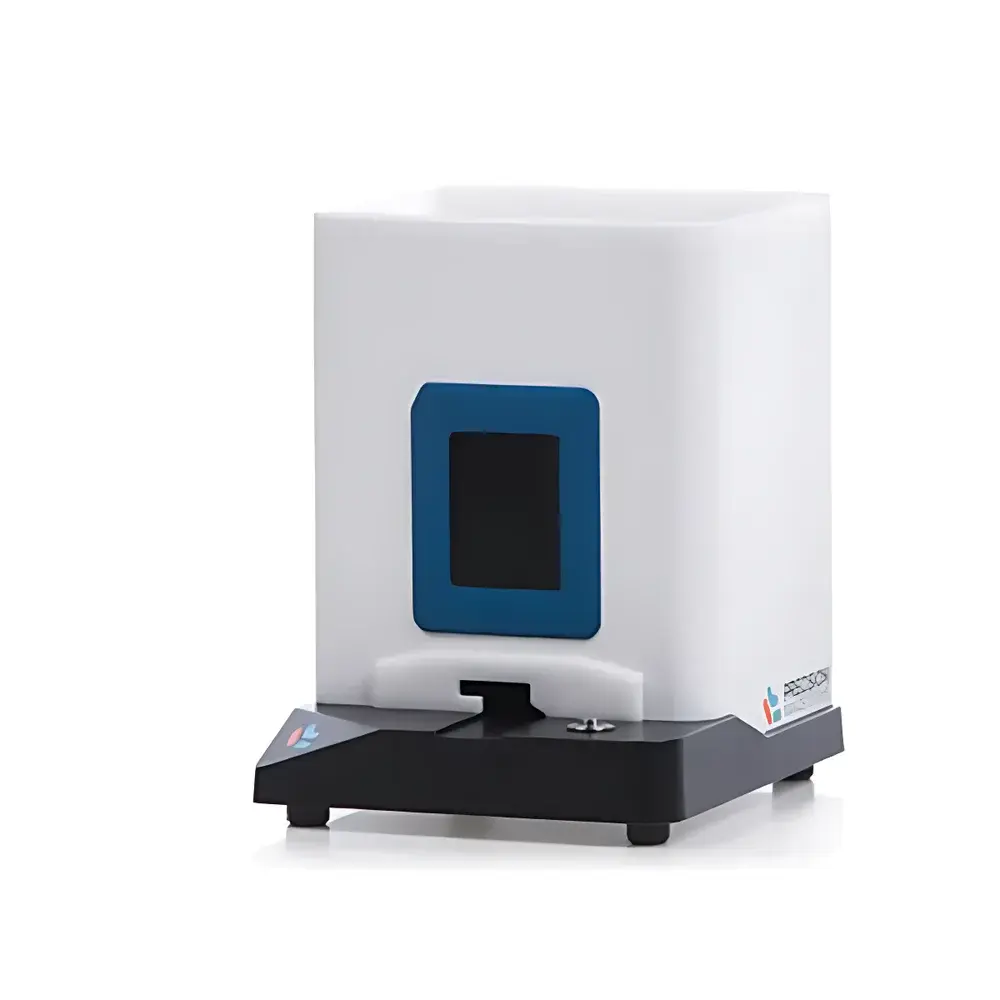
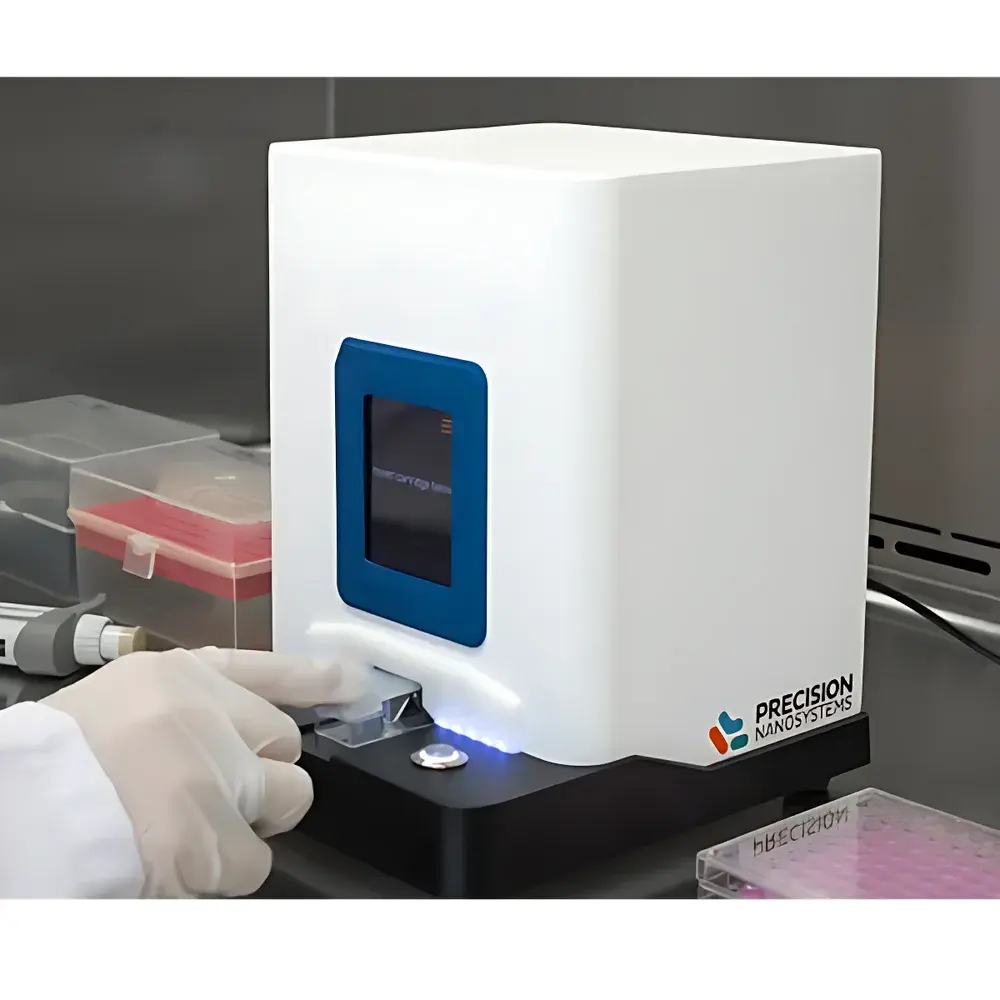
NanoAssemblr™ Spark™ Nanoparticle Formulation System
| Brand | Cytiva |
|---|---|
| Origin | Switzerland |
| Model | NanoAssemblr™ Spark™ Instrument |
| Sample Volume Range | 25–250 µL |
| Mixing Technology | NxGen™ Microfluidic Vortex Mixing |
| Sterility Design | BSC-Compatible, Aseptic Operation Ready |
| Chip Type | Single-Use, Gamma-Irradiated Cartridge |
| Scalability Pathway | Seamless Transition to NanoAssemblr™ Ignite™ and NxGen™ Production Platforms |
| Regulatory Context | Designed for GLP-compliant early-stage development, supports 21 CFR Part 11–ready software integration (optional) |
Overview
The NanoAssemblr™ Spark™ Nanoparticle Formulation System is a benchtop microfluidic platform engineered for precise, reproducible, and scalable formulation of lipid nanoparticles (LNPs) and other nucleic acid delivery vehicles at microliter-scale volumes. Leveraging Cytiva’s proprietary NxGen™ vortex mixing technology, the system enables rapid self-assembly of RNA–LNP complexes under controlled laminar flow conditions—where fluid dynamics govern particle size, polydispersity, and encapsulation efficiency. Unlike passive diffusion-based methods, NxGen™ achieves millisecond-level mixing kinetics via hydrodynamic focusing and chaotic advection within a single-use, gamma-sterilized cartridge. This principle ensures high batch-to-batch consistency and minimal operator-induced variability—critical for discovery-phase screening of scarce, high-value therapeutic nucleic acids (e.g., mRNA, siRNA, saRNA) and novel lipid libraries. The Spark™ system operates without external pumps or syringe drivers; instead, it uses integrated pressure-controlled actuation to deliver precise volumetric flow rates across the full 25–250 µL range. Its compact footprint and Class II biological safety cabinet (BSC)-compatible design allow direct integration into sterile cell culture workflows—including transfection of primary human T cells and CD34+ hematopoietic stem cells (HSCs)—without compromising biosafety or process integrity.
Key Features
- Microscale Formulation: Supports reproducible LNP synthesis in volumes from 25 µL to 250 µL—ideal for conserving expensive nucleic acid payloads and novel lipids during lead optimization.
- NxGen™ Mixing Core: Patented microfluidic architecture delivers sub-100 ms mixing times, enabling tight control over particle size distribution (PDI 90% for mRNA under optimized conditions).
- Single-Use, Pre-Sterilized Cartridges: Gamma-irradiated, ready-to-load chips eliminate cleaning validation, cross-contamination risk, and downtime—fully compliant with ISO 13485 and ICH Q5A requirements for early-phase bioprocess development.
- BSC-Integrated Workflow: Designed for operation inside laminar flow hoods or Class II cabinets; includes low-profile housing, glove-compatible controls, and no external tubing or reservoirs requiring external venting.
- Scalability-First Architecture: Identical fluidic principles and formulation parameters translate directly to NanoAssemblr™ Ignite™ (benchtop scale-up) and NxGen™ Production systems (GMP-ready, 1–10 L batches), minimizing re-development effort.
- Real-Time Process Feedback: Integrated pressure sensors and flow diagnostics provide traceable operational data—supporting root cause analysis and protocol refinement without interrupting runs.
Sample Compatibility & Compliance
The Spark™ system is validated for formulation of ionizable lipid–mRNA, siRNA, and CRISPR RNP complexes using clinically relevant lipid compositions (e.g., DLin-MC3-DMA, SM-102, ALC-0315). It accommodates aqueous and organic phase inputs with viscosities up to 20 cP and surface tensions compatible with standard LNP formulations. All disposable components meet USP and cytotoxicity standards. The platform supports documentation practices aligned with FDA Guidance for Industry: Bioanalytical Method Validation (2018) and EMA Guideline on Quality of RNA-Based Therapeutics (2023). When paired with optional audit-trail-enabled software, the system meets ALCOA+ data integrity criteria and facilitates compliance with 21 CFR Part 11 for electronic records and signatures in regulated environments.
Software & Data Management
The NanoAssemblr™ Spark™ operates via an intuitive touchscreen interface with embedded method storage (up to 50 protocols), user access levels (operator, supervisor, administrator), and timestamped run logs. Optional Cytiva Formulation Insight™ software adds CSV export, trend analysis for particle size vs. flow rate, and automated report generation (PDF/Excel) compliant with GLP Annex 11 and ISO/IEC 17025 documentation standards. All raw sensor data—including inlet pressure, cartridge temperature, and actuation timing—is stored locally with SHA-256 hash verification to ensure data provenance. No cloud upload occurs by default; data residency remains fully on-device unless explicitly configured per institutional IT policy.
Applications
- mRNA-LNP formulation for T cell and CD34+ HSC transfection studies—validated with GenVoy-ILM™ T Cell and Cytiva CD34+ HSC LNP Kits.
- High-throughput screening of lipid libraries (≥100 formulations/day) in drug discovery pipelines targeting oncology, rare disease, and vaccine development.
- Preclinical LNP process definition—including DoE studies on N/P ratio, total flow rate, and aqueous:organic phase ratio—to establish design space per ICH Q5 and Q8 guidelines.
- In-process characterization support: Direct coupling with dynamic light scattering (DLS), nanoparticle tracking analysis (NTA), and cryo-TEM sample prep workflows.
- Academic and CRO-based gene therapy vector development where material scarcity, sterility assurance, and regulatory traceability are non-negotiable.
FAQ
Is the NanoAssemblr™ Spark™ system suitable for GMP manufacturing?
No—the Spark™ is intended for research use only (RUO) and early preclinical development. For clinical-grade production, Cytiva recommends transitioning to the NanoAssemblr™ Ignite™ or NxGen™ Production platforms, which include full GMP documentation packages and IQ/OQ/PQ support.
Can I reuse the microfluidic cartridges?
No—cartridges are strictly single-use, gamma-irradiated, and certified endotoxin-free (<0.03 EU/mL). Reuse invalidates sterility claims and compromises mixing fidelity due to potential lipid residue buildup.
What validation documentation is provided with the system?
Each shipment includes Certificate of Conformance, Certificate of Sterility (gamma dose report), and Installation Qualification (IQ) checklist. Operational Qualification (OQ) protocols and Performance Qualification (PQ) templates are available upon request for GLP-aligned labs.
Does the system require external compressed air or vacuum sources?
No—it integrates an internal pressure regulation module with dual independent channels, eliminating dependency on facility utilities and enabling portable deployment in BSCs or mobile labs.
How does NxGen™ mixing differ from conventional T-junction or staggered herringbone mixers?
NxGen™ employs multi-layered vortex induction within a 3D microchannel geometry, generating transient turbulence without Reynolds number escalation—enabling consistent mixing across variable flow rates and viscosities, unlike passive geometries that exhibit strong shear-rate dependence.





