
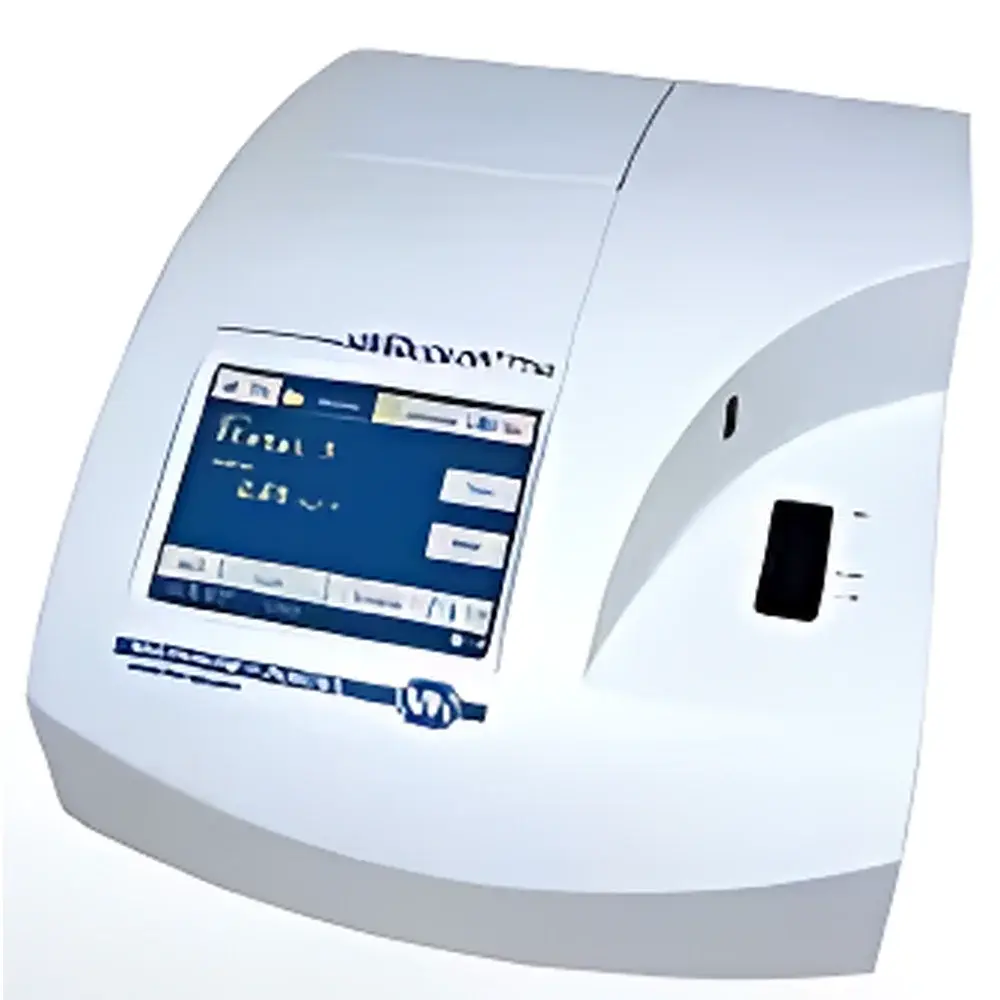
NANOCOLOR® UV/VIS Spectrophotometer by Macherey-Nagel
| Brand | Macherey-Nagel |
|---|---|
| Origin | Germany |
| Model | NANOCOLOR® UV/VIS Spectrophotometer with Reference Detection Technology (RDT) |
| Wavelength Range | 190–1100 nm |
| Light Sources | Tungsten-halogen lamp (vis) and deuterium lamp (uv) |
| Optical System | Single-beam stabilized optics |
| Wavelength Accuracy | ±1 nm |
| Wavelength Resolution | 0.3 nm |
| Spectral Bandwidth | <4 nm |
| Absorbance Range | ±3.0 E (200–900 nm) |
| Absorbance Accuracy | ±0.005 E (0.0–0.5 E) |
| Absorbance Linearity | <0.5% at 2.0 E |
| Stray Light | <0.05% |
| Measurement Modes | Predefined test methods, absorbance, transmittance, factor, multi-wavelength, kinetics, full-spectrum scan, turbidity |
| Cuvette Compatibility | Round tubes (Ø16 mm outer / Ø14 mm inner), rectangular cuvettes (10, 20, 50 mm pathlength) |
| Data Storage | 1000 GLP-compliant measurements with audit trail |
| Display | Color backlit LCD touchscreen |
| Interface | 1× USB, 2× RS-232 (bidirectional) |
| Environmental Operating Conditions | 10–40 °C, ≤80% RH (non-condensing) |
| Power Supply | 110–240 V AC, 50/60 Hz, 60 VA |
| Dimensions (L×W×H) | 390 × 285 × 155 mm |
| Weight | 6.5 kg |
| Compliance | CE-marked per Low Voltage Directive 73/23/EEC and EMC Directive 89/336/EEC (incl. 92/31/EEC) |
Overview
The NANOCOLOR® UV/VIS Spectrophotometer by Macherey-Nagel is a benchtop dual-lamp spectrophotometer engineered for precision, reproducibility, and operational simplicity in routine water, wastewater, and process quality control laboratories. It operates on the principle of ultraviolet–visible absorption spectroscopy, measuring analyte concentration via Beer–Lambert law-based quantification across a continuous spectral range from 190 nm to 1100 nm. Its optical architecture integrates a deuterium lamp for deep-UV performance and a tungsten-halogen lamp for stable visible-light output, coupled with a single-beam stabilized optical system that ensures low drift and high photometric fidelity. Central to its design is Reference Detection Technology (RDT), a proprietary method enabling real-time reference signal normalization during measurement—eliminating baseline instability caused by lamp aging or environmental fluctuations. This technology underpins consistent calibration integrity across extended operational cycles without manual recalibration. The instrument is purpose-built for compliance-driven environments, supporting Good Laboratory Practice (GLP) through embedded audit trails, user-accessible timestamps, and secure data logging.
Key Features
- Reference Detection Technology (RDT) for automatic real-time signal referencing and long-term photometric stability
- Integrated barcode scanner for fully automated method selection, wavelength assignment, and result calculation—no keypad input required
- Open-sample compartment design with ambient-light immunity, enabling direct tube or cuvette insertion without lid closure
- Color backlit LCD touchscreen interface with intuitive graphical workflow guidance and multilingual support
- Preloaded library of over 100 validated test methods and 200 analytical protocols optimized for water, wastewater, food, and beverage applications
- Comprehensive photometric functionality: absorbance, transmittance, concentration factor, multi-point calibration, kinetic assays, full-spectrum scanning (≤60 s), and turbidity measurement
- Robust mechanical construction (6.5 kg mass, compact footprint: 390 × 285 × 155 mm) suitable for shared lab benches and mobile QA stations
Sample Compatibility & Compliance
The NANOCOLOR® UV/VIS accommodates standard sample vessels used in regulatory and industrial testing: round glass or plastic tubes (16 mm outer diameter, 14 mm inner diameter) and rectangular quartz or glass cuvettes with 10 mm, 20 mm, or 50 mm optical path lengths. Optional quartz cuvettes (order codes 919120 and 919121) extend UV transparency for low-wavelength applications such as nitrate or organic contaminant analysis. All measurements adhere to ISO 7027 (turbidity), ISO 6060 (COD), and ASTM D1253 (residual chlorine), and the instrument’s data structure conforms to GLP requirements—including operator ID tagging, method version tracking, and immutable timestamped records. CE marking confirms compliance with EU Low Voltage Directive 73/23/EEC and Electromagnetic Compatibility Directive 89/336/EEC (as amended), ensuring safe integration into regulated laboratory infrastructures.
Software & Data Management
Data acquisition and reporting are governed by embedded firmware compliant with FDA 21 CFR Part 11 principles—supporting electronic signatures, role-based access control, and tamper-evident audit logs. Up to 1000 measurement records—including spectra, calibration curves, and raw absorbance values—are stored internally with full GLP metadata. Export is supported via USB mass storage mode or RS-232 serial transmission to LIMS or spreadsheet software. Firmware updates are performed locally using supplied CD or remotely via internet-connected PC. No proprietary runtime environment is required: exported CSV files retain wavelength-absorbance pairs, method identifiers, and operator annotations for traceable reprocessing.
Applications
This spectrophotometer serves as a primary analytical tool in municipal water treatment plants (for ammonia, phosphate, nitrate, iron, manganese, and total chlorine), industrial effluent monitoring (COD, TOC surrogates, heavy metals), and food/beverage QA labs (color index, sulfite, vitamin C, and preservative quantification). Its RDT-enabled stability makes it especially suited for unattended batch analysis in 24/7 operations, while the open-compartment geometry supports rapid throughput in high-volume screening workflows. In research settings, its full-spectrum scan capability (0.3 nm resolution, <4 nm bandwidth) enables qualitative spectral profiling of unknown chromophores—complementing identification workflows prior to HPLC or GC-MS analysis.
FAQ
Does the NANOCOLOR® UV/VIS support external calibration verification with NIST-traceable standards?
Yes—its absorbance linearity and wavelength accuracy are verifiable using certified neutral-density filters and holmium oxide reference standards per ISO/IEC 17025 guidelines.
Can custom test methods be programmed and validated internally?
Yes—up to 100 user-defined methods may be configured via touchscreen interface, including equation-based calculations, multi-point calibrations, and pass/fail thresholds aligned with internal SOPs.
Is the instrument compatible with networked LIMS environments?
It supports ASCII-based RS-232 output with configurable delimiters and header formats, enabling direct ingestion into most LIMS platforms without middleware.
What maintenance is required beyond routine cleaning and lamp replacement?
No optical alignment or internal adjustment is needed; lamp replacement intervals are ~2000 hours (deuterium) and ~5000 hours (tungsten-halogen), with automatic usage logging and predictive alerts.
How is data security enforced during remote firmware updates?
Firmware packages are digitally signed; the instrument validates signature integrity before installation, rejecting unsigned or tampered binaries.





