
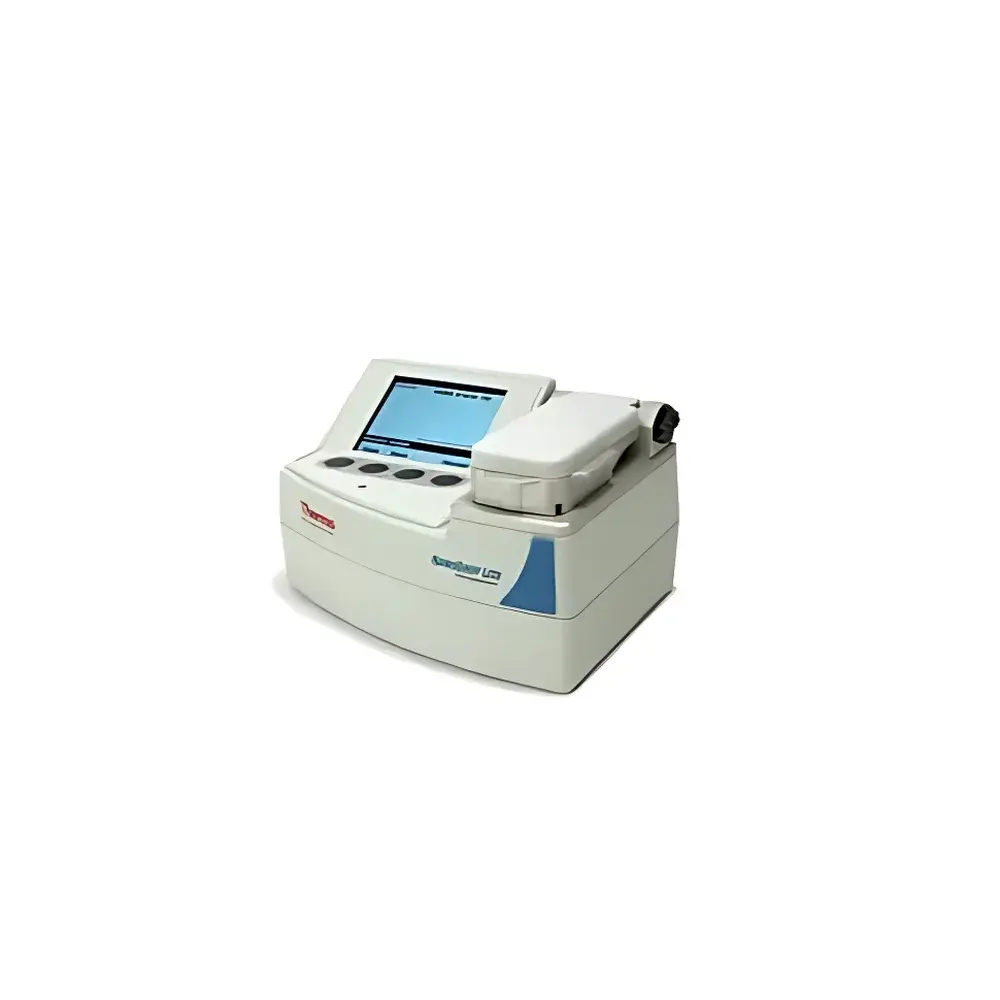
NanoDrop Lite UV-Vis Spectrophotometer
| Origin | USA |
|---|---|
| Manufacturer Type | Authorized Distributor |
| Origin Category | Imported Instrument |
| Model | NanoDrop Lite |
| Optical Design | Dual-Beam |
| Detector | Photodiode Array |
| Wavelength Range | 260–280 nm |
| Wavelength Automation | Automatic |
| Spectral Bandwidth | 0.5 nm |
| Wavelength Accuracy | ±0.2% T |
| Stray Light | 0.01% T |
Overview
The NanoDrop Lite UV-Vis Spectrophotometer is a compact, self-contained microvolume spectrophotometer engineered for rapid, accurate quantification and purity assessment of nucleic acids and proteins in laboratory settings where bench space, sample volume, and operational simplicity are critical constraints. Unlike conventional cuvette-based UV-Vis instruments, the NanoDrop Lite employs surface tension-mediated sample retention—eliminating the need for capillaries or cuvettes—and measures absorbance directly on a quartz pedestal using a dual-beam optical architecture. This design enables reliable analysis of 0.5–2.0 µL samples without dilution, leveraging fixed-wavelength measurements at 260 nm and 280 nm to calculate concentration (via established extinction coefficients) and assess purity (e.g., A260/A280 ratios). Its photodiode array detector ensures stable signal acquisition across the specified 260–280 nm range, with a narrow spectral bandwidth of 0.5 nm supporting high-resolution discrimination between closely absorbing species.
Key Features
- Microvolume capability: Analyzes 0.5–2.0 µL samples without dilution or consumables
- Dual-beam optical path: Compensates for lamp drift and environmental fluctuations, enhancing measurement reproducibility
- Integrated control system: Fully standalone operation—no external computer required; all functions managed via built-in software interface
- Quick-clean optical surface: Sample deposition and removal performed directly on the quartz pedestal using standard pipette tips; cleaning completed with lint-free laboratory wipes
- Precision optics: 0.5 nm spectral bandwidth and ±0.2% T wavelength accuracy ensure compliance with routine QC requirements for nucleic acid and protein analysis
- Low stray light performance: 0.01% T stray light level minimizes baseline distortion in low-transmittance measurements, critical for high-concentration or turbid samples
Sample Compatibility & Compliance
The NanoDrop Lite is validated for direct quantification of dsDNA, ssDNA, RNA, and purified proteins using preconfigured methods based on Beer–Lambert law calculations. It supports standard purity assessments including A260/A280 (nucleic acid purity), A260/A230 (contaminant detection), and A280-based protein concentration estimation. While not designed for full-spectrum scanning, its fixed-wavelength configuration aligns with widely adopted protocols defined in ISO 17025-accredited laboratories for routine molecular biology workflows. The instrument meets general electrical safety standards (IEC 61010-1) and electromagnetic compatibility (EMC) requirements per EN 61326-1. Data integrity is maintained through non-volatile internal memory with timestamped result storage, suitable for GLP-compliant documentation when paired with optional thermal printer support for cold-room environments.
Software & Data Management
The embedded firmware provides intuitive, menu-driven operation with preloaded nucleic acid and protein assay templates. All measurements—including absorbance values, calculated concentrations, purity ratios, and method metadata—are stored locally in non-volatile memory with automatic time/date stamping. Export is supported via USB flash drive (FAT32 formatted) in CSV format for downstream analysis in Excel or LIMS integration. Audit trail functionality is limited to basic session logging; for full 21 CFR Part 11 compliance, users must implement external validation protocols and supplementary electronic record controls. No cloud connectivity or remote diagnostics are included—consistent with secure, air-gapped lab environments.
Applications
- Routine quantification of PCR products, plasmid preps, and RNA isolates prior to sequencing or transfection
- Verification of protein purification yield and buffer exchange efficiency
- Quick-check assessment of sample integrity after freeze-thaw cycles or long-term storage
- QC screening in core facilities, teaching labs, and resource-limited research environments
- Supporting ISO/IEC 17025 method validation where fixed-wavelength verification suffices for defined test purposes
FAQ
Does the NanoDrop Lite support full UV-Vis spectral scanning?
No—it operates exclusively at fixed wavelengths (260 nm and 280 nm) optimized for nucleic acid and protein analysis. It does not perform continuous wavelength sweeps.
Is calibration traceable to NIST standards?
The instrument is factory calibrated using certified reference materials; however, end-user recalibration is not field-serviceable. Users may verify performance using standard DNA or BSA solutions.
Can it measure samples in high-salt or viscous buffers?
Yes, but elevated salt concentrations (>1 M NaCl) or glycerol-rich solutions may affect surface tension stability and require careful pipetting technique to ensure consistent drop formation.
What is the minimum detectable concentration for dsDNA?
Typical lower limit is ~2 ng/µL (measured at 260 nm), assuming optimal drop geometry and clean optical surfaces.
Is the thermal printer included or optional?
The printer is an optional accessory, specifically rated for operation at 4 °C to support cold-room workflows; it connects via USB and prints directly from instrument-stored data.






