
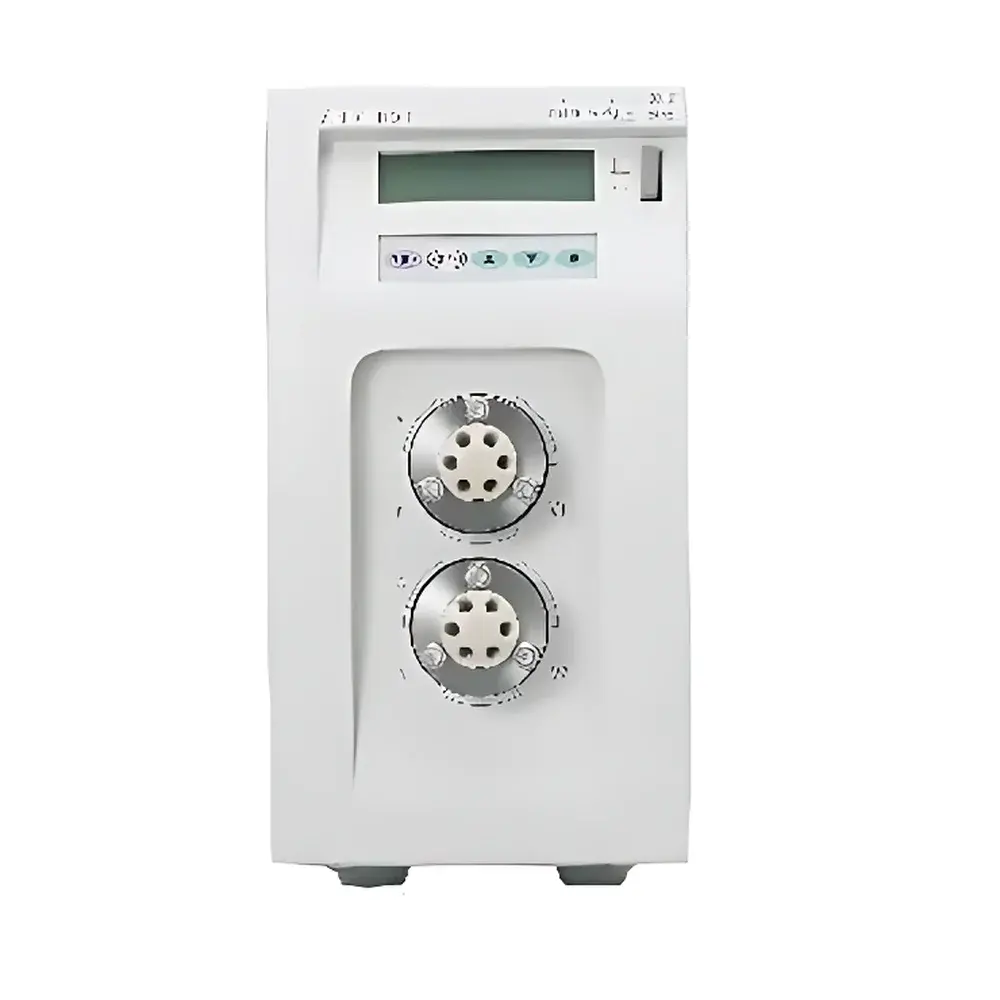
NANOSPACE F3012 Dual High-Pressure 6-Port 2-Position Switching Valve
| Brand | NANOSPACE |
|---|---|
| Origin | Japan |
| Model | F3012 |
| Max. Operating Pressure | 35 MPa |
| Dead Volume | 1.0 µL |
| Wetted Materials | PEEK, Ceramics |
| Control Modes | Manual, Time-Programmable (0.00–999.99 min), External TTL Trigger (Start Signal), SYSCON & PC Communication |
| Power Supply | AC 100 V ±10%, 50/60 Hz, 15 W |
| Dimensions | 120(W) × 230(H) × 491(D) mm |
| Weight | 10 kg |
Overview
The NANOSPACE F3012 Dual High-Pressure 6-Port 2-Position Switching Valve is an engineered solution for precise, reproducible column switching in high-performance liquid chromatography (HPLC), ultra-high-performance liquid chromatography (UHPLC), and multidimensional chromatographic systems. Designed around Couette-flow-optimized fluidic pathways and minimal internal volume geometry, the valve operates on a rotary actuation principle with ceramic-PEEK hybrid sealing surfaces to ensure long-term integrity under sustained pressure loads up to 35 MPa (5,076 psi). Its core function is to redirect mobile phase flow between multiple columns or sample streams without compromising peak shape, retention time stability, or system backpressure—critical requirements in heart-cutting, trap-elute, and comprehensive 2D-LC configurations. The valve’s mechanical architecture eliminates dead-volume-induced band broadening, enabling sub-microliter dispersion control essential for trace-level biomolecule analysis and high-resolution small-molecule separations.
Key Features
- Ultra-low dead volume of 1.0 µL per port configuration—achieved through integrated micro-bore PEEK manifolds and precision-machined ceramic rotor plates.
- Chemically inert wetted path composed exclusively of PEEK polymer and technical ceramics—resistant to hydrolysis, oxidation, and adsorption of proteins, peptides, nucleotides, and other labile biological analytes.
- Dual-unit configuration (2× independent 6-port/2-position valves in one chassis) supports parallel or sequential column-switching schemes within a single footprint.
- Three operational modes: front-panel manual actuation, time-based program execution (0.00–999.99 minutes resolution), and external TTL-triggered activation via Start signal input compatible with third-party instrument controllers.
- Built-in RS-232 interface for bidirectional communication with NANOSPACE System Control Software (SYSCON); also supports integration into custom LabVIEW, Python, or PLC-driven automation frameworks via ASCII command protocol.
- No external power supply or dedicated controller required—self-contained operation powered by standard AC 100 V input with low thermal dissipation (15 W).
Sample Compatibility & Compliance
The F3012 is validated for use with aqueous, organic, and mixed mobile phases across pH 1–14, including aggressive solvents such as trifluoroacetic acid (TFA), hexafluoroisopropanol (HFIP), and high-concentration ammonium acetate buffers. Its PEEK/ceramic construction meets ISO 13485 material biocompatibility guidelines and complies with USP for plastic components in pharmaceutical analytical instrumentation. While not intrinsically certified for GMP environments, the valve’s deterministic timing behavior, non-volatile program memory, and audit-ready event logging (when used with SYSCON v3.2+) support alignment with FDA 21 CFR Part 11 requirements for electronic records and signatures when deployed within validated chromatographic workflows.
Software & Data Management
The valve integrates natively with NANOSPACE SYSCON software, providing synchronized timeline-based method editing, real-time position status feedback, and automatic error logging (e.g., timeout detection, pressure fault correlation). All program parameters—including dwell times, sequence order, and external trigger mapping—are stored in non-volatile flash memory and persist across power cycles. When connected to a host PC, SYSCON generates timestamped CSV logs containing valve position transitions, elapsed cycle time, and communication handshake status—enabling full traceability for GLP audits. No proprietary drivers are required; standard Windows COM port enumeration enables direct scripting access via Python’s pySerial or MATLAB’s Instrument Control Toolbox.
Applications
- Online solid-phase extraction (SPE)-LC coupling for automated sample cleanup and preconcentration.
- Heart-cutting 2D-LC for targeted isolation of co-eluting isomers in complex matrices (e.g., glycoforms, lipid regioisomers).
- Parallel column screening in method development, where two independent separation conditions are evaluated simultaneously.
- Multi-analyte assay platforms requiring alternating injection paths for calibration standards, QC samples, and unknowns.
- Automated fraction collection triggering in preparative HPLC systems using external TTL synchronization.
- On-line derivatization workflows involving reagent loop switching prior to post-column reaction chambers.
FAQ
What is the maximum recommended operating pressure for continuous use?
The F3012 is rated for continuous operation at ≤35 MPa (5,076 psi) at ambient temperatures between 4 °C and 40 °C.
Can this valve be used with acidic or basic mobile phases?
Yes—the PEEK and alumina ceramic components exhibit stable performance across pH 1–14; however, prolonged exposure to >1 M NaOH above 60 °C is not recommended.
Is firmware upgrade capability supported?
Firmware updates are performed via SYSCON software using the RS-232 interface; version history and release notes are available through NANOSPACE technical support portals.
Does the valve retain its programmed sequence after power loss?
Yes—time-programmed sequences and user-defined settings are stored in non-volatile memory and restored automatically upon power-up.
How is synchronization achieved with third-party LC systems?
Via TTL-compatible Start signal input (active-low, 5 V logic); the valve accepts external triggers independently of SYSCON, enabling plug-and-play integration with Agilent, Waters, Shimadzu, and Thermo instruments.






