
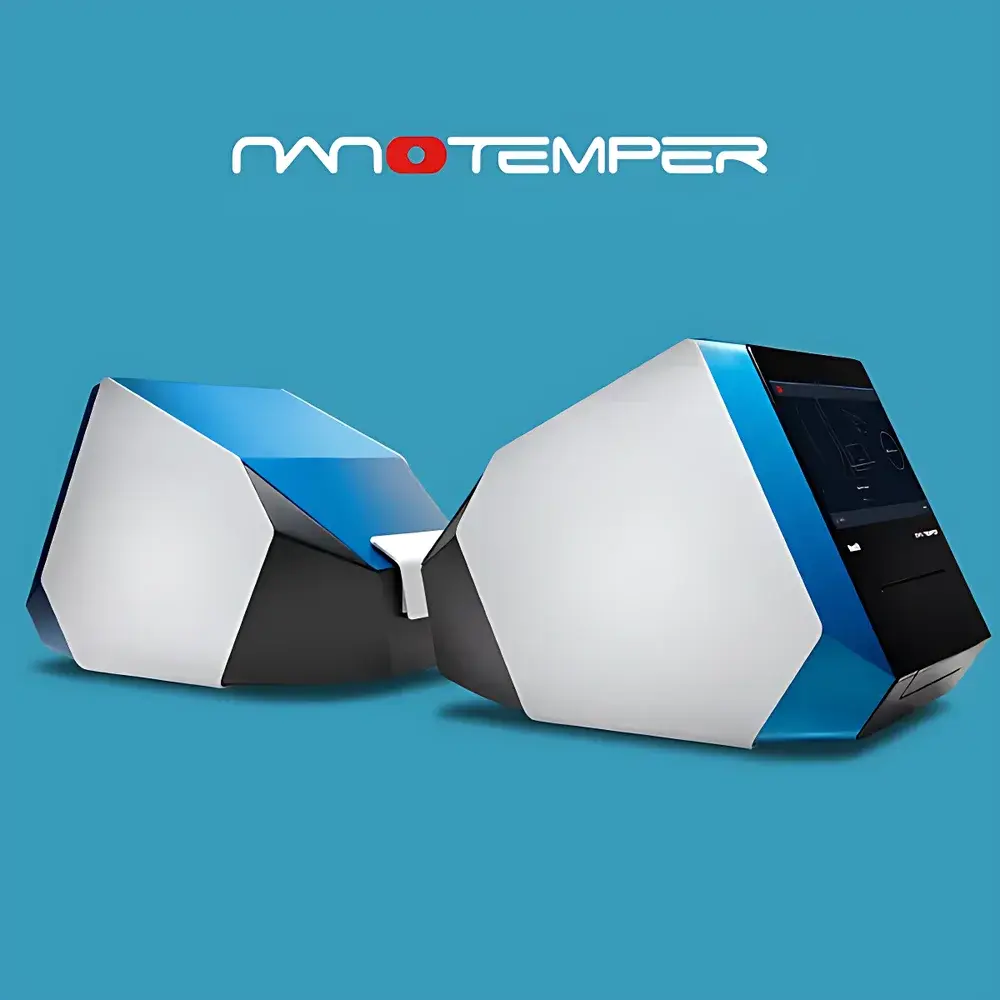
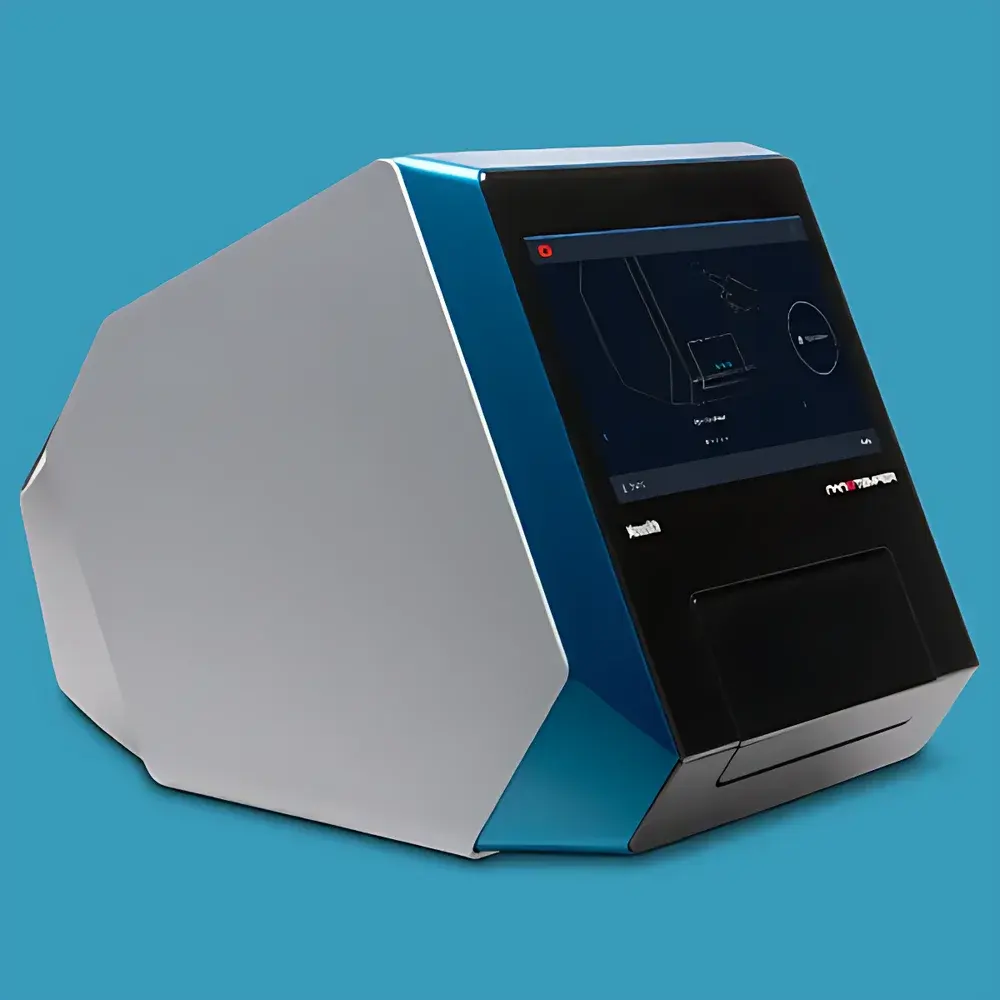
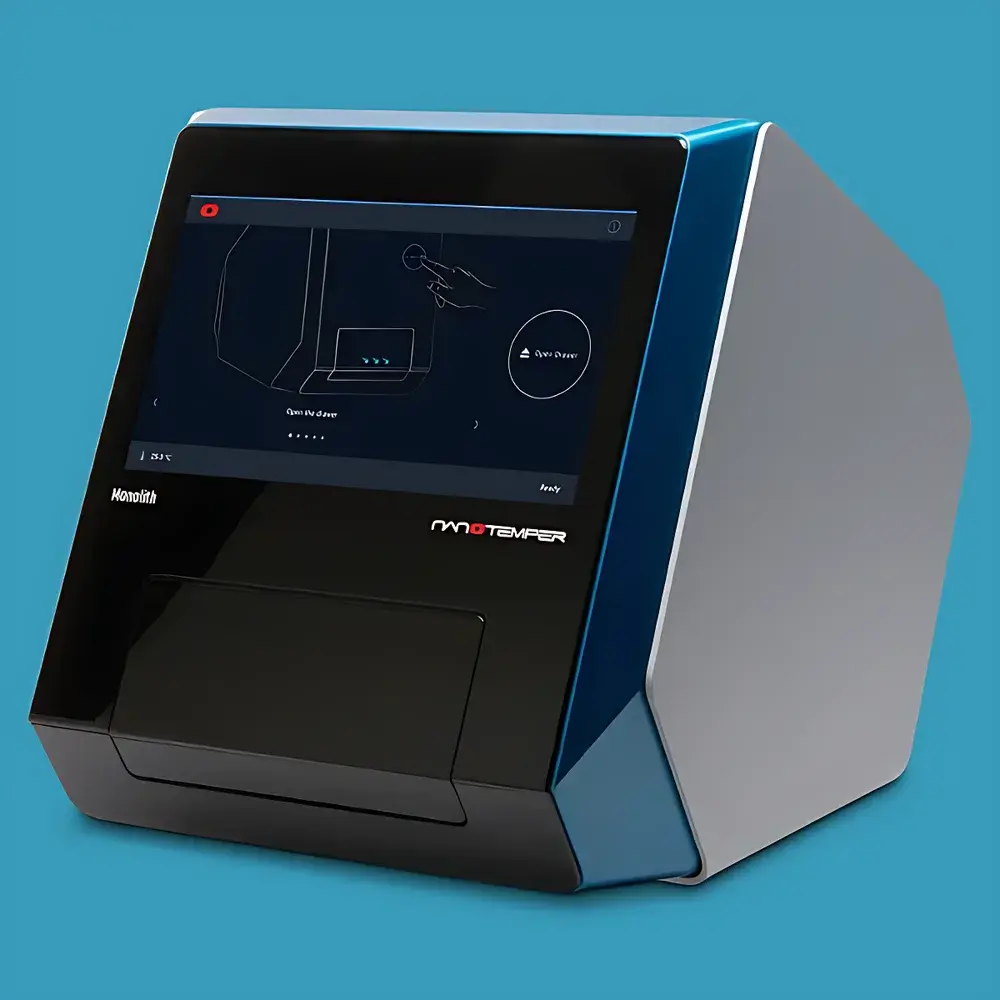
NanoTemper Monolith X Next-Generation Molecular Interaction Analyzer
| Brand | NanoTemper |
|---|---|
| Origin | Germany |
| Manufacturer Type | Original Equipment Manufacturer (OEM) |
| Product Origin | Imported |
| Model | Monolith X |
| Instrument Type | MicroScale Thermophoresis (MST) & Spectral Shift Analyzer |
| Channel Configuration | Single-Channel |
| Sample Capacity | ≤24 samples per run |
| Sample Volume per Assay | 4 µL |
| Analysis Time per K<sub>D</sub> | ≤10 min |
| Temperature Control Range | 20–40 °C with ±0.5 °C active thermal regulation |
Overview
The NanoTemper Monolith X is a next-generation molecular interaction analyzer engineered for label-free, solution-phase quantification of biomolecular binding affinities. It integrates two orthogonal, complementary detection principles—MicroScale Thermophoresis (MST) and Spectral Shift (SS)—within a single, compact platform. MST measures changes in the directed movement of fluorescently labeled molecules along a microscopic temperature gradient induced by an infrared laser; binding-induced alterations in hydration shell, charge, or size modulate thermophoretic mobility, resulting in quantifiable fluorescence signal shifts. Spectral Shift detects nanometer-scale shifts in the emission spectrum (e.g., 650 nm vs. 670 nm) upon complex formation—enabling direct observation of conformational or environmental changes without requiring equilibrium dissociation kinetics. Unlike surface-based techniques such as Surface Plasmon Resonance (SPR), Monolith X operates entirely in free solution, eliminating artifacts from immobilization, steric hindrance, or matrix interference. This makes it uniquely suited for intrinsically disordered proteins (IDPs), membrane-associated targets, covalently bound complexes, and analytes prone to aggregation or surface adsorption.
Key Features
- Integrated dual-mode detection: Simultaneous MST and Spectral Shift measurement on a single instrument platform, enabling cross-validated affinity determination and mechanistic insight into binding-induced structural perturbations.
- Solution-phase assay format: No immobilization, no regeneration cycles, no chip surface optimization—preserves native conformation and avoids avidity effects or orientation bias.
- Ultra-low sample consumption: As little as 4 µL per assay, with total analyte requirement typically <10 µg for most protein targets—critical for scarce or difficult-to-express biomolecules.
- Rapid kinetic profiling: Full KD determination achievable in under 10 minutes per concentration series, supporting high-throughput screening workflows without compromising data fidelity.
- Precision thermal control: Active Peltier-based temperature regulation across 20–40 °C (±0.5 °C stability), ensuring reproducible thermophoretic response and enabling temperature-dependent binding studies (e.g., ΔH estimation via van’t Hoff analysis).
- No fluidic system: Eliminates clogging, carryover, and maintenance associated with microfluidic or SPR instrumentation—maximizes uptime and operational robustness.
Sample Compatibility & Compliance
Monolith X supports broad analyte versatility—including proteins (monomeric, multimeric, IDPs), nucleic acids (DNA, RNA, aptamers), peptides, small molecules (<100 Da), ions, lipids, glycans, nanoparticles, and crude biological matrices (e.g., cell lysates, serum, purified exosomes). Its solution-phase design inherently complies with ICH Q5E and USP <1117> guidelines for assessing higher-order structure and binding integrity in biologics development. Data acquisition and processing adhere to ALCOA+ principles (Attributable, Legible, Contemporaneous, Original, Accurate, Complete, Consistent, Enduring, Available), and optional audit trail functionality meets FDA 21 CFR Part 11 requirements for regulated environments. Instrument validation packages support IQ/OQ/PQ protocols aligned with ISO/IEC 17025 and GLP/GMP frameworks.
Software & Data Management
The Monolith Control Software provides real-time monitoring of raw thermophoretic traces, spectral profiles, and quality metrics—including signal-to-noise ratio, baseline stability, and photobleaching correction. Built-in QC algorithms assess sample integrity pre-run and recommend optimal labeling ratios or buffer adjustments. Data analysis employs non-linear regression fitting (Levenberg–Marquardt algorithm) to derive KD, Hill coefficient, and stoichiometry directly from normalized fluorescence responses. Export formats include CSV, PDF reports, and structured JSON for LIMS integration. Version-controlled software updates are distributed via secure HTTPS channels, with full traceability of analysis parameters and metadata embedded in each exported dataset.
Applications
- Fragment-based drug discovery (FBDD): Affinity ranking of low-molecular-weight hits against challenging targets (e.g., protein–protein interfaces, allosteric sites).
- Biophysical characterization of biologics: Binding epitope mapping, excipient screening, and comparability assessment across biosimilar development stages.
- RNA–protein interactions: Quantifying affinities of RBP–RNA complexes under physiologically relevant ionic conditions.
- Membrane protein pharmacology: Direct analysis of detergent-solubilized or nanodisc-reconstituted GPCRs and ion channels without reconstitution onto sensor chips.
- Diagnostic biomarker validation: Measuring endogenous ligand–receptor affinities in diluted serum or plasma with minimal sample cleanup.
- Enzyme–inhibitor kinetics: Distinguishing competitive, non-competitive, and uncompetitive mechanisms through multi-concentration titrations.
FAQ
How does Monolith X differ from traditional SPR platforms in measuring high-affinity interactions?
Unlike SPR—which relies on dissociation phase kinetics to calculate KD and becomes impractical for KD values below ~100 pM due to excessively long dissociation times—Monolith X measures binding at equilibrium using endpoint fluorescence signals. This enables accurate KD determination down to sub-picomolar ranges without extended incubation periods.
Can Monolith X analyze unpurified samples such as cell lysates?
Yes. The technology’s insensitivity to light scattering and matrix interference allows direct analysis in clarified lysates or diluted serum, provided background fluorescence is minimized and target concentration is within the dynamic range.
Is labeling required for both binding partners?
No. Only one partner requires fluorescent labeling—typically the lower-abundance or more stable component. Unlabeled analytes (e.g., small molecules, ions) bind and induce detectable changes in thermophoretic behavior or emission spectra of the labeled species.
What regulatory documentation is available for use in GMP environments?
NanoTemper provides comprehensive validation documentation, including instrument qualification templates, software verification reports, and electronic record security assessments compliant with 21 CFR Part 11 Annex 11 and EU GMP Annex 11 requirements.
How is temperature precision maintained during extended runs?
The Monolith X employs a closed-loop Peltier system with dual-sensor feedback (sample chamber and reference junction), actively compensating for ambient fluctuations and ensuring thermal homogeneity across all capillaries throughout the assay duration.
Related Products



