
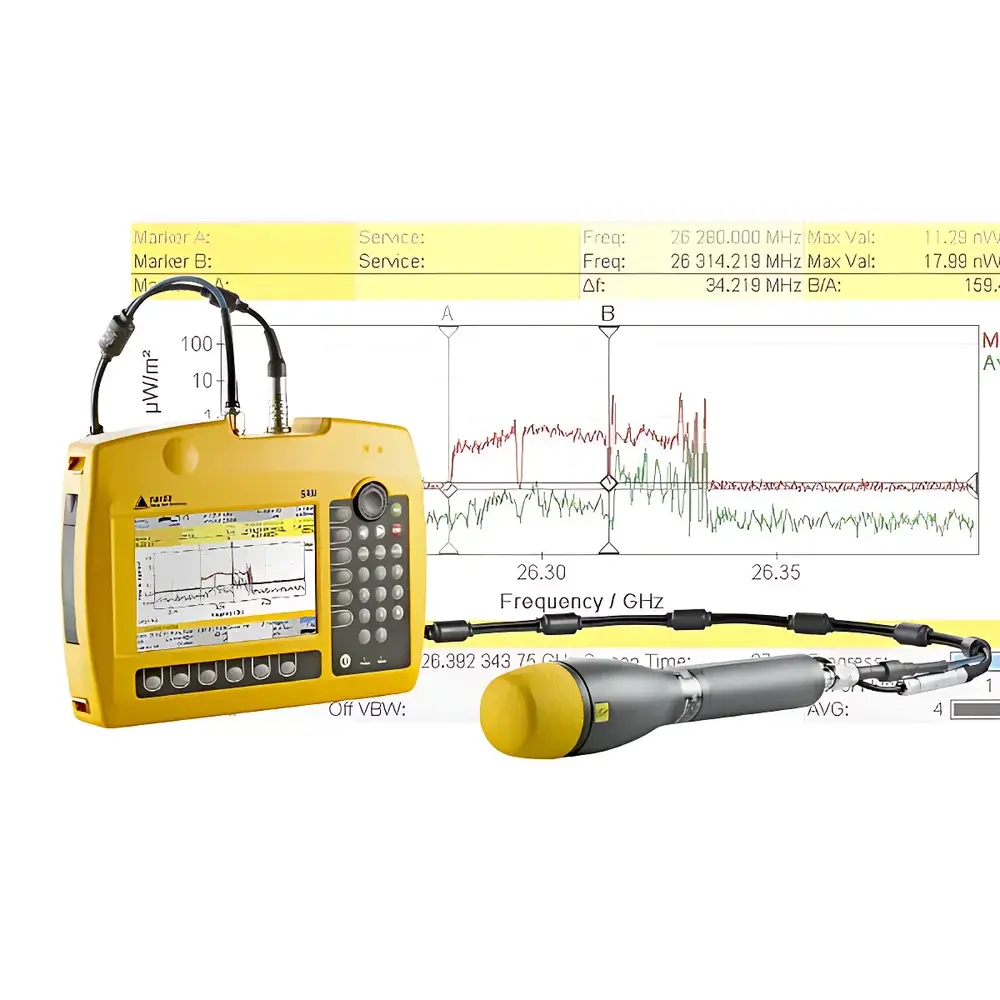
Narda SRM-3006 Selective Electromagnetic Field Analyzer
| Brand | Narda |
|---|---|
| Origin | Germany |
| Model | SRM-3006 |
| Frequency Range | 9 kHz – 6 GHz |
| Display Range | DANL to +20 dBm |
| Measurement Range | −30 dBm to +20 dBm (1 dB steps) |
| RF Input Attenuation | 0–50 dB (1 dB steps) |
| Level Uncertainty | ≤1.2 dB (15–30 °C) |
| Antenna Auto-Detection | Yes (type & calibration date) |
| Compliance Standards | HJ 1151–2020, IEC 62232, EN 50492, ICNIRP, GB 8702 |
Overview
The Narda SRM-3006 Selective Electromagnetic Field Analyzer is a high-precision, field-deployable instrument engineered for frequency-selective assessment of electromagnetic field (EMF) exposure in compliance with international safety and environmental monitoring requirements. Operating on the principle of real-time spectrum analysis with calibrated broadband detection, the SRM-3006 enables quantitative evaluation of electric field strength (V/m), magnetic field strength (A/m), and power density (W/m²) across its full 9 kHz–6 GHz frequency range. Designed specifically for regulatory-grade EMF surveys—especially those targeting modern wireless infrastructure including 5G NR, LTE, UMTS, WiMAX, broadcast, and IoT transmitters—the analyzer integrates hardware-level signal conditioning, adaptive dynamic range control, and traceable antenna factor compensation to ensure metrological integrity under variable ambient conditions.
Key Features
- Compliance-ready measurement engine supporting HJ 1151–2020 (China’s 5G base station monitoring standard), IEC 62232 (radio base station EMF assessment), EN 50492 (EMF exposure evaluation methodology), and ICNIRP/GB 8702 exposure limit frameworks.
- Real-time spectral display with user-defined limit lines; results presented as percentage-of-limit (%IL) directly referenced to selected standards without post-processing.
- Dedicated LTE/UMTS mode for pilot signal identification and exposure level estimation based on reference signal received power (RSRP) and channel quality indicators.
- Oscilloscope mode enabling time-domain visualization of transient or pulsed emissions (e.g., radar, TDD-based 5G frames), with configurable recording duration and trigger thresholds.
- Service-specific band mapping: preloaded or user-defined frequency allocations (e.g., FM broadcast, GSM900/1800, LTE Band 1/3/7/41, 5G n78/n41) allow instantaneous attribution of measured field contributions per operator or service type.
- Ruggedized portable design rated IP54 (dust-protected, water-splashing resistant); ergonomic handle; hot-swappable Li-ion battery; integrated GPS geotagging and voice annotation for field documentation.
- Full front-panel operability via rotary encoder, soft keys, numeric keypad, and context-sensitive menu navigation—no external PC required for configuration or data acquisition.
Sample Compatibility & Compliance
The SRM-3006 is compatible with Narda’s full suite of isotropic, tri-axial, and directional EMF probes—including EF, HF, and EHP series antennas—with automatic recognition of probe model, serial number, and calibration validity date. All antenna-specific correction factors are applied in real time during measurement. The system supports traceable calibration in accordance with ISO/IEC 17025-accredited laboratories and maintains full audit trail capability for GLP/GMP-aligned reporting workflows. Its architecture satisfies technical prerequisites for use in legally binding environmental impact assessments, municipal planning reviews, and operator self-monitoring programs mandated under national EMF protection regulations.
Software & Data Management
The included PC application “SRM-3006Tools” provides comprehensive post-processing, report generation, and database management functionality. Users may import third-party antenna calibration files (via editable CSV tables), define custom evaluation curves aligned with site-specific policy limits, and maintain hierarchical service provider registries. Measurement configurations—including detector types (RMS, peak, quasi-peak), sweep parameters, averaging modes, and limit line sets—are fully exportable/importable. All raw spectra, time-series logs, GPS tracks, and voice annotations are stored in vendor-neutral binary formats (.srp, .csv) compatible with long-term archival and cross-platform interoperability. Software update history and configuration change logs support 21 CFR Part 11-compliant electronic record retention where applicable.
Applications
- Regulatory monitoring of 5G macro/micro cell sites, small cells, and distributed antenna systems (DAS) in urban and suburban environments.
- Pre-commissioning and periodic compliance verification for broadcast transmitters, radar installations, and industrial RF heating equipment.
- Occupational exposure assessment near base stations, rooftop installations, and indoor DAS nodes per ICNIRP/IEEE C95.1 guidelines.
- Electromagnetic compatibility (EMC) site surveys prior to sensitive facility deployment (e.g., hospitals, research labs, observatories).
- Public concern response investigations, including residential proximity assessments and school campus evaluations.
- Academic and metrological research involving spatial-temporal EMF characterization, propagation modeling validation, and spectral occupancy studies.
FAQ
Does the SRM-3006 support simultaneous multi-band measurements?
Yes—it performs real-time FFT-based spectrum analysis across its entire 9 kHz–6 GHz range, allowing concurrent identification and quantification of signals from multiple services without manual band switching.
Can measurement configurations be saved and reused across different survey sites?
Absolutely. Full measurement setups—including frequency spans, detector settings, limit lines, and antenna selections—can be saved as named profiles and recalled instantly in the field.
Is GPS data embedded in exported reports?
Yes. Geotagged coordinates, timestamps, and altitude data are automatically synchronized with each measurement and preserved in both .srp and PDF report exports.
How does the instrument handle unknown or non-standard signals?
The analyzer supports user-defined integration bands for arbitrary frequency ranges; field strength within any selected span is calculated as RMS-averaged power density, traceable to primary calibration standards.
What documentation accompanies the system for regulatory submissions?
Each unit ships with a factory calibration certificate (traceable to PTB/NIST), declaration of conformity, and full technical documentation—including uncertainty budgets, antenna factor tables, and software validation summaries—for audit readiness.







