
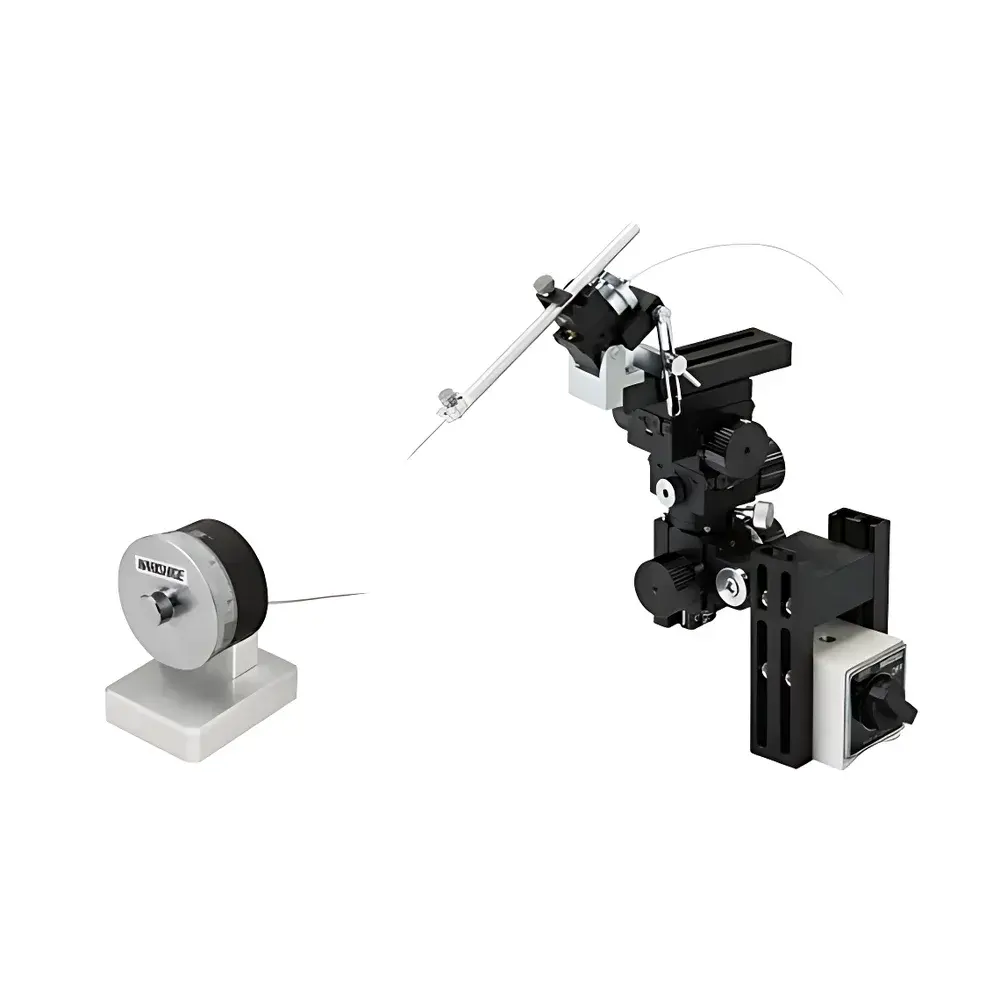
Narishige M-152 Precision Micromanipulator
| Brand | Narishige |
|---|---|
| Origin | Japan |
| Model | M-152 |
| Coarse Travel (X/Y/Z) | 25 mm / 20 mm / 25 mm |
| Fine Adjustment Resolution | Sub-micrometer (via optional single-axis micrometer drive) |
| Dimensions (W×D×H) | 95 × 36 × 135 mm |
| Weight | 320 g |
| Standard Accessory | B-8B Spherical Joint |
| Optional Upgrade | Uniaxial Micrometer Drive (pipette-aligned axis) |
Overview
The Narishige M-152 Precision Micromanipulator is an electromechanically passive, manually operated micro-positioning device engineered for high-stability, low-drift manipulation in live-cell imaging, intracellular injection, patch-clamp electrophysiology, and microelectrode placement. Unlike motorized or piezoelectric manipulators, the M-152 relies on precision-machined mechanical linkages and friction-damped coaxial motion control to deliver deterministic, backlash-free positioning without electronic noise or thermal drift—critical for long-duration physiological experiments under inverted or upright microscopes. Its dual-stage architecture integrates coarse translation (for rapid target acquisition) with fine adjustment capability (enabling sub-micrometer positional repeatability), making it suitable for applications demanding both operational speed and nanoscale fidelity.
Key Features
- Compact monolithic design measuring only 95 × 36 × 135 mm (W×D×H) and weighing just 320 g—optimized for integration into confined microscope stages, stereotaxic rigs, or multi-manipulator arrays without compromising optical access.
- Three-axis coarse travel: X-axis ±12.5 mm (25 mm total), Y-axis ±10 mm (20 mm total), Z-axis ±12.5 mm (25 mm total), achieved via calibrated rack-and-pinion mechanisms with tactile end-stop feedback.
- Integrated fine-adjustment capability: When equipped with the optional uniaxial micrometer drive (aligned parallel to the pipette holder axis), users achieve 1 µm per division resolution with 10 mm total travel—ideal for depth-controlled electrode penetration or controlled membrane contact.
- B-8B spherical joint mount provides 360° rotational freedom and ±20° tilt range, ensuring robust mechanical coupling to glass micropipettes, tungsten electrodes, or fiber-optic probes while maintaining axial rigidity during lateral loading.
- Tool-free modular attachment system compatible with standard Narishige mounting bases (e.g., MN-1, MN-2) and third-party microscope adapters, supporting rapid reconfiguration between upright, inverted, and confocal platforms.
Sample Compatibility & Compliance
The M-152 is routinely deployed in GLP-compliant electrophysiology labs and ISO 13485-certified medical device R&D environments. Its all-metal construction (anodized aluminum housing, stainless steel linkage components) ensures chemical resistance to ethanol, isopropanol, and mild aqueous disinfectants used in sterile cell culture workflows. While the manipulator itself carries no CE marking or FDA 510(k) clearance (as a Class I non-powered accessory), its use conforms to ASTM F2143–22 (Standard Practice for Microelectrode Positioning Systems) and supports adherence to ICH E6(R3) principles for data integrity in preclinical neurophysiology studies. No firmware or software dependencies eliminate validation overhead associated with electronic systems under 21 CFR Part 11.
Software & Data Management
As a purely mechanical instrument, the M-152 requires no embedded firmware, drivers, or host software. All positional data are recorded manually or synchronized externally via microscope stage encoders or digital caliper interfaces. This architecture eliminates cybersecurity vulnerabilities, electromagnetic interference risks, and calibration drift associated with digital feedback loops—making it preferred for EM-compatible environments (e.g., combined light/electron microscopy setups) and Faraday-cage electrophysiology suites. Lab managers may integrate position logs into LIMS or ELN systems using standardized CSV exports from external tracking hardware.
Applications
- Single-cell patch-clamp recording in primary neuronal cultures and brain slices
- Microinjection of CRISPR-Cas9 ribonucleoproteins into zebrafish embryos or mouse oocytes
- Controlled insertion of silicon-based neural probes in acute rodent brain preparations
- Alignment and positioning of optical fibers in optogenetics experiments
- Manipulation of microbeads or synthetic vesicles in microrheology assays
- Serial section electron microscopy (ssEM) sample trimming and stage navigation
FAQ
Is the M-152 compatible with inverted microscopes?
Yes—the compact footprint and low-profile base allow unobstructed objective lens clearance down to 40× water-immersion objectives.
Can multiple M-152 units be mounted simultaneously on one microscope stage?
Yes—its 95 mm width enables side-by-side installation with ≥5 mm inter-unit spacing when using standard Narishige MN-series mounting plates.
Does the B-8B joint support torque transmission for rotating electrodes?
No—the B-8B is a passive articulating joint; rotational actuation requires an external motorized rotator (e.g., Narishige MO-202) mounted upstream.
What is the maximum recommended load capacity?
300 g at the tip of a standard 1.5 mm OD glass pipette; exceeding this may compromise fine-resolution repeatability due to lever-arm deflection.
Is calibration documentation provided with the unit?
No formal calibration certificate is included, as the M-152 is a mechanical displacement device; users perform traceable verification using NIST-traceable digital calipers or laser interferometry per internal SOPs.



