
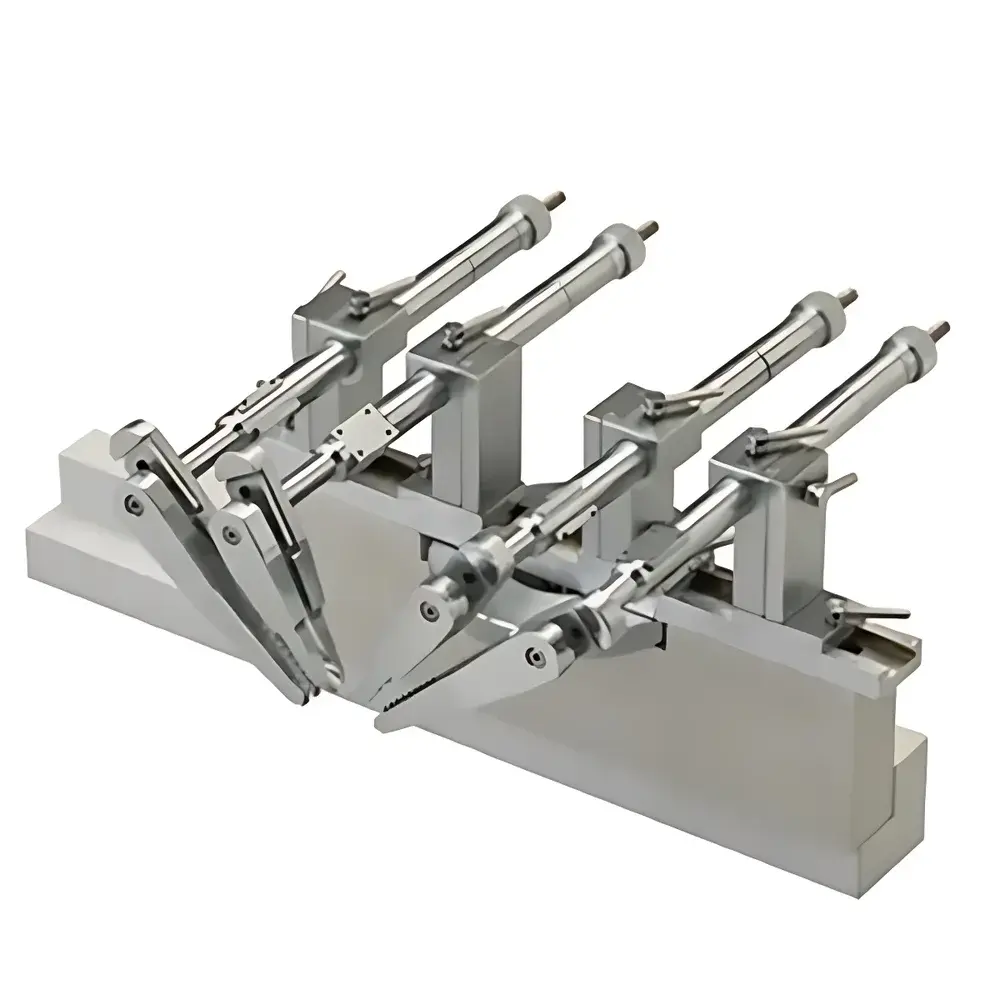
Narishige STS-B Rat Spinal Cord Clamp
| Origin | Japan |
|---|---|
| Manufacturer Type | Distributor |
| Origin Category | Imported |
| Model | STS-B |
| Pricing | Upon Request |
| Attachment Components | Mounting Ring, Securing Screws, Hex Key |
| Dimensions (W × D × H) | 205 × 140 × 95–125 mm |
| Weight | 1.18 kg |
Overview
The Narishige STS-B Rat Spinal Cord Clamp is a precision neurosurgical accessory engineered for controlled, atraumatic immobilization of the spinal cord during in vivo rodent experiments. Designed exclusively for integration with Narishige’s SR-series stereotaxic frames, the STS-B operates on a vertically adjustable mechanical principle—utilizing calibrated elevation and lowering mechanisms to position the clamp relative to the exposed spinal column without direct manual pressure on neural tissue. Its function is grounded in biomechanical stabilization: by rigidly coupling to the AP (anterior–posterior) rail of the stereotaxic system, it converts macroscopic frame movements into micron-level vertical displacement of the clamping assembly, enabling reproducible placement across sequential experimental sessions. This design eliminates reliance on freehand manipulation, thereby reducing inter-operator variability and minimizing iatrogenic trauma during spinal cord exposure, laminectomy, or intraspinal injection procedures.
Key Features
- Direct mechanical compatibility with Narishige SR-series stereotaxic frames via standardized AP rail interface
- Stepwise vertical positioning mechanism allowing fine-tuned height adjustment (range: 95–125 mm total height; travel distance optimized for C1–L6 vertebral levels in adult Sprague-Dawley or Wistar rats)
- Low-profile, rigid aluminum alloy construction ensuring dimensional stability under repeated sterilization cycles and mechanical loading
- Included mounting hardware: stainless steel securing ring, M3 threaded screws, and 1.5 mm hex key for tool-free reconfiguration between experimental setups
- Ergonomic lever-free actuation—clamping force applied solely through precise screw advancement, preventing sudden compression or slippage
- Weight-optimized design (1.18 kg) to maintain stereotaxic frame balance without requiring counterweight recalibration
Sample Compatibility & Compliance
The STS-B is validated for use with adult male and female rats (200–500 g body weight), accommodating standard dorsal laminectomy protocols at thoracic and lumbar segments. It is not intended for use with mice, guinea pigs, or non-rodent species due to anatomical scale mismatch. The device complies with ISO 13485:2016 design control requirements for laboratory instrumentation accessories and conforms to JIS T 0601-1 (Japanese Industrial Standard for medical electrical equipment safety). All metallic components meet ASTM F899-22 specifications for surgical-grade stainless steel finishes. While the clamp itself is non-implantable and non-invasive, its use supports GLP-compliant preclinical neuroscience studies when documented within SOPs covering instrument calibration, cleaning validation (autoclave cycle: 121°C, 15 psi, 20 min), and traceable maintenance logs.
Software & Data Management
The STS-B is a fully mechanical, analog device with no embedded electronics, firmware, or digital connectivity. As such, it requires no software installation, driver configuration, or data export functionality. Its operational parameters—including vertical position, clamping torque, and frame attachment status—are recorded manually in laboratory notebooks or electronic lab notebooks (ELNs) compliant with 21 CFR Part 11 (e.g., LabArchives, Benchling) when used in regulated environments. Position repeatability is ensured via engraved depth markings on the vertical adjustment sleeve and torque-limited screw engagement—enabling audit-ready documentation of setup conditions across longitudinal studies. Integration with digital stereotaxic platforms (e.g., NeuroStar, Kopf 940) remains possible via physical rail coupling, though positional feedback must be sourced externally from the host frame’s encoder system.
Applications
- Stabilization during intraspinal microinjection of viral vectors, stem cells, or pharmacological agents
- Support for high-resolution intraoperative imaging (e.g., two-photon microscopy of dorsal horn circuitry)
- Facilitation of electrophysiological recordings from ventral or dorsal roots under stable mechanical conditions
- Enabling precise lesion modeling via controlled application of mechanical or thermal stimuli to defined spinal segments
- Standardized spinal cord harvesting for ex vivo slice preparation with minimized tissue distortion
- Training platform for stereotaxic surgery proficiency in graduate neuroscience curricula
FAQ
Is the STS-B compatible with non-Narishige stereotaxic frames?
No—the STS-B relies on proprietary rail geometry and mounting interface dimensions specific to Narishige SR-series frames. Adapters for competing platforms (e.g., David Kopf, Stoelting) are not manufactured or validated.
Can the clamp be autoclaved?
Yes—full assembly withstands standard gravity-displacement autoclaving (121°C, 15 psi, 20 minutes); however, repeated cycles may affect anodized surface integrity. Post-sterilization visual inspection for thread wear or ring deformation is recommended.
What is the maximum clamping force?
Clamping force is operator-dependent and governed by hand-torque application. No quantitative force specification is provided; users are instructed to advance the screw until gentle resistance is felt—excessive torque may deform the spinal dura or compromise vertebral stability.
Does Narishige provide calibration certificates for the STS-B?
No—calibration is not applicable to this passive mechanical device. Users are advised to verify vertical travel range and screw engagement smoothness prior to first use and after each sterilization cycle.




