
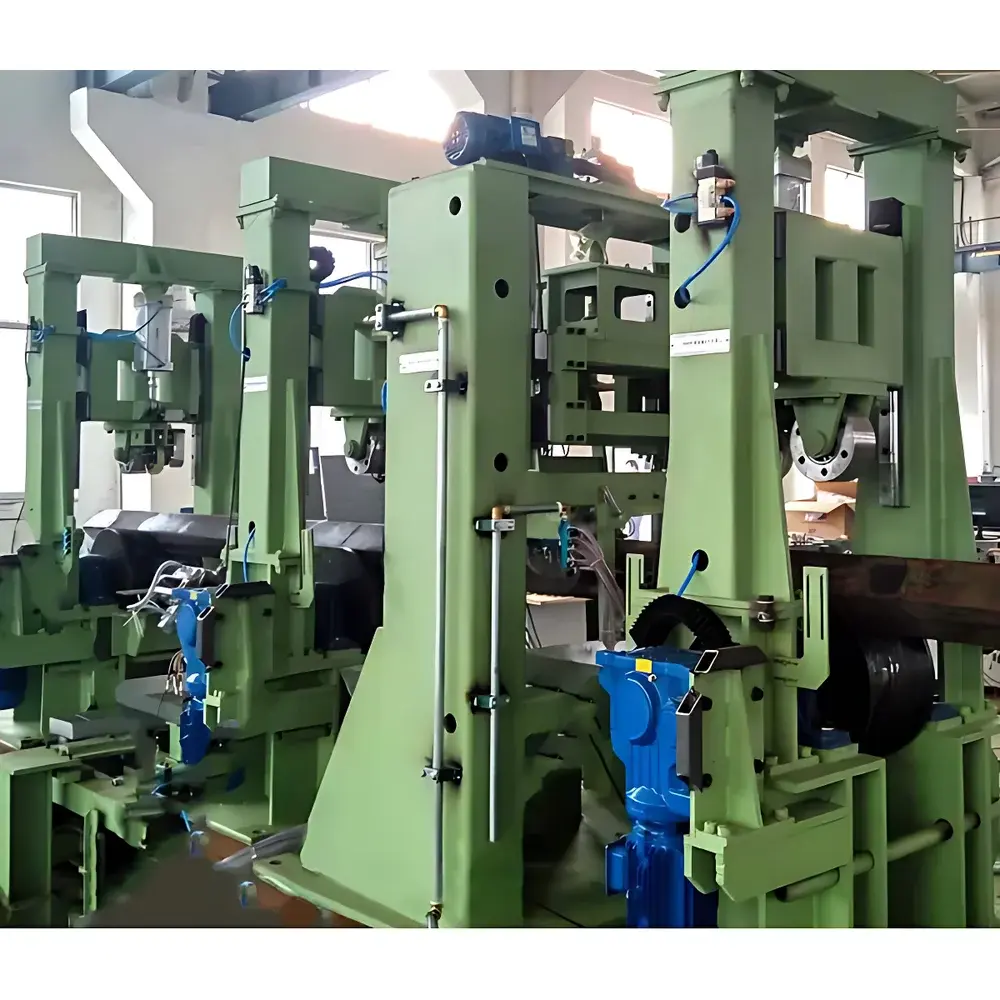
NC-PUT Billet Ultrasonic Testing System by NCS (China Steel Research Academy)
| Brand | NCS (China Steel Research Academy) |
|---|---|
| Origin | Beijing, China |
| Manufacturer Type | Direct Manufacturer |
| Origin Category | Domestic (China) |
| Model | NC-PUT Billet Series |
| Pricing | Available Upon Request |
Overview
The NC-PUT Billet Ultrasonic Testing System is an industrial-grade, fully integrated ultrasonic non-destructive testing (NDT) platform engineered for high-speed, volumetric inspection of hot-rolled and cold-drawn steel billets. Based on pulse-echo and through-transmission ultrasonic principles—employing high-frequency broadband transducers (typically 2–10 MHz) with phased array or dual-element probe configurations—the system detects internal discontinuities including voids, inclusions, central segregation, shrinkage cavities, and longitudinal/transverse cracks. Designed for continuous production line integration, it operates within ambient temperatures up to 80 °C and accommodates surface scale and minor oxidation typical of post-rolling conditions. Its architecture complies with the fundamental physical requirements outlined in ISO 12718:2019 (Non-destructive testing — Ultrasonic testing — Vocabulary) and aligns with the procedural framework of EN 10228-3:2016 (Non-destructive testing of steel forgings — Part 3: Ultrasonic testing of ferritic and martensitic steel forgings) and ASTM E114-20 (Standard Practice for Ultrasonic Pulse-Echo Straight-Beam Contact Testing).
Key Features
- Fully automated, multi-channel ultrasonic scanning with real-time A-scan, B-scan, and C-scan data synthesis for comprehensive volumetric coverage of square, round, hexagonal, and I-beam cross-sections.
- Adaptive billet tracking system utilizing encoder-coupled motion synchronization and optical edge detection—enabling stable coupling and consistent stand-off distance across variable feed rates (0–30 m/min) and dimensional tolerances (±1.5 mm).
- Modular transducer array design supporting configurable probe layouts (e.g., 4×4 immersion or focused contact arrays) to accommodate billet diameters/widths from 50 mm to 250 mm.
- Ruggedized mechanical frame with corrosion-resistant stainless-steel housing and IP54-rated electronics enclosure for long-term operation in rolling mill environments.
- Real-time signal processing engine with digital filtering, time-gain compensation (TGC), and automatic threshold-based defect classification per user-defined acceptance criteria.
Sample Compatibility & Compliance
The NC-PUT system is validated for ferrous materials with acoustic impedance compatible with water- or oil-coupled ultrasonic transmission—including carbon steels (e.g., Q235, S45C), alloy steels (e.g., 42CrMo, 20MnTiB), and stainless steels (e.g., 304, 430). It supports inspection of both hot-rolled billets (surface temperature ≤80 °C) and normalized/cold-drawn stock. All measurement protocols are traceable to national metrological standards maintained by the China National Institute of Metrology (NIM). The system’s calibration methodology follows ISO 16810:2014 (Non-destructive testing — General principles for ultrasonic testing) and supports audit-ready documentation required under ISO 9001:2015 and IATF 16949:2016 quality management systems.
Software & Data Management
The proprietary NCS UT-Studio software provides a Windows-based interface for setup, acquisition, analysis, and reporting. It features full GLP-compliant audit trails—including user login history, parameter change logs, calibration timestamps, and raw RF-data archiving. Reports are exportable in PDF and XML formats compliant with ISO/IEC 17025:2017 documentation requirements. Optional integration with MES/SCADA platforms is supported via OPC UA and Modbus TCP protocols. Data integrity safeguards include SHA-256 hashing of stored scan files and optional 21 CFR Part 11-compliant electronic signature modules for regulated manufacturing environments.
Applications
This system serves as a primary inline inspection solution in steel production facilities, particularly for downstream quality assurance prior to forging, extrusion, or machining. Typical use cases include: verification of internal soundness in billets destined for automotive crankshafts and connecting rods; screening of aerospace-grade alloy billets for turbine disc forgings; pre-heat-treatment validation in rail steel production; and incoming material inspection for power generation components such as generator rotor shafts and boiler tube stock. It is also deployed in third-party certification laboratories conducting supplier audits per EN 10027 or GB/T 699 standards.
FAQ
What billet dimensions and shapes does the NC-PUT system support?
It accommodates square billets (50–250 mm side length), round billets (Ø50–250 mm), hexagonal bars (across-flats 50–220 mm), and structural sections including I-beams and rails with symmetrical cross-sections up to 250 mm height.
Is the system suitable for hot billet inspection immediately after rolling?
Yes—designed for direct line integration with cooling beds or shear lines, it tolerates surface temperatures up to 80 °C and includes high-temperature transducer options and adaptive gain compensation to maintain signal-to-noise ratio.
Does the system provide automated defect sizing and classification?
It delivers amplitude-based indication evaluation and positional mapping; quantitative sizing (e.g., equivalent reflector diameter) requires optional calibration block sets and operator-defined reference standards per ASTM E273-21.
Can the NC-PUT be integrated into existing plant automation networks?
Yes—standard Ethernet/IP and optional Profibus-DP or PROFINET interfaces enable seamless PLC communication and pass/fail signal output to upstream/downstream process controllers.
What regulatory documentation is provided with the system?
Each unit ships with Factory Acceptance Test (FAT) reports, ultrasonic calibration certificates traceable to NIM, CE Declaration of Conformity (for EU export variants), and a complete technical manual compliant with ISO/IEC Guide 98-3 (GUM) uncertainty reporting conventions.



