
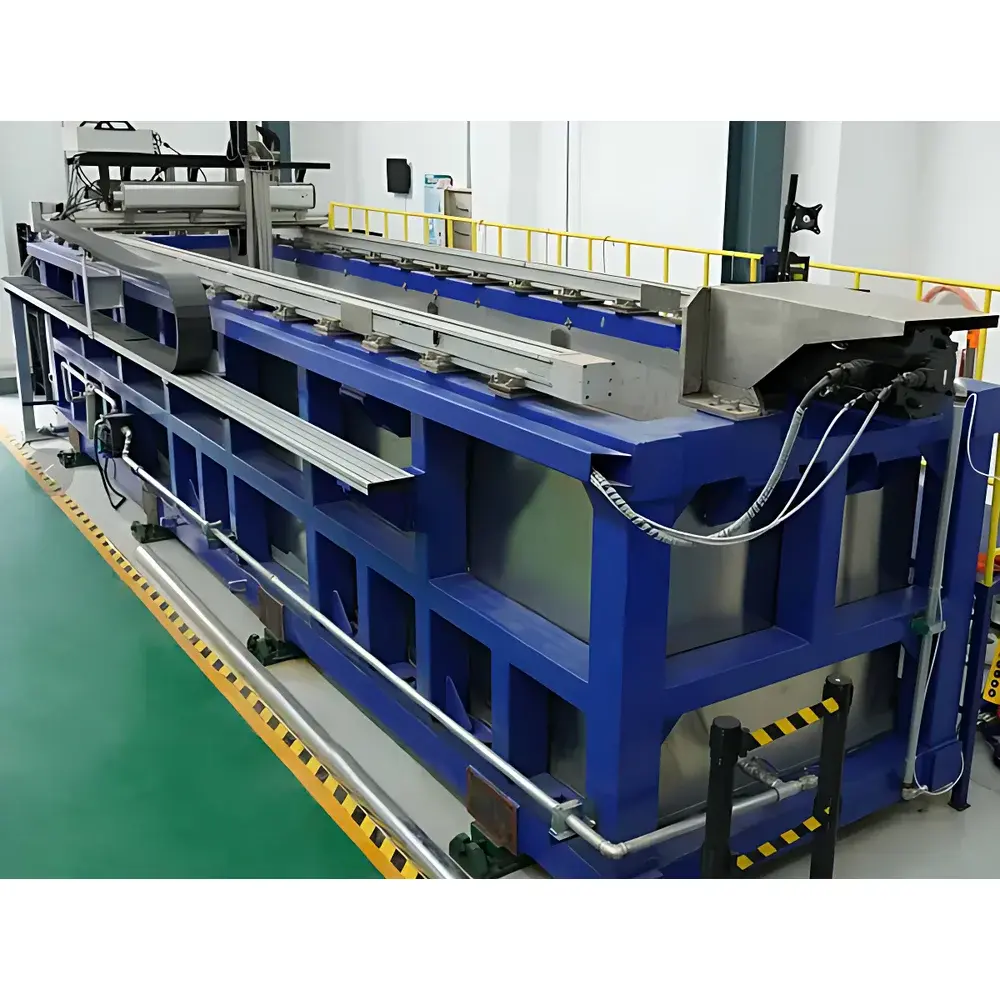
NC-C-SCAN Long-Product C-Scan Ultrasonic Testing System
| Brand | NCS (China Iron & Steel Research Institute Group) |
|---|---|
| Model | NC-C-SCAN Long-Product Series |
| Origin | Beijing, China |
| Manufacturer Type | Direct Manufacturer |
| Regional Classification | Domestic (China) |
| Compliance | GB/T 4730, GB/T 5777, GB/T 18248 |
| Detection Modes | Simultaneous axial & circumferential flaw detection, lamination assessment, and wall thickness measurement |
| Positioning | Dual-axis (axial + circumferential) encoder-based positioning |
| Data Output | C-scan image mapping with embedded A-scan waveform storage |
| Real-time monitoring | Live A-scan waveform display during scanning |
| Application Scope | Cylindrical and elongated components including seamless high-pressure gas cylinders (CNG, LPG), welded pressure vessels, forgings, castings, carbon fiber composites, honeycomb structures, bars, tubes, billets, and irregular-shaped industrial parts |
Overview
The NC-C-SCAN Long-Product C-Scan Ultrasonic Testing System is an industrial-grade automated ultrasonic inspection platform engineered for high-reliability volumetric evaluation of cylindrical and elongated metallic and composite components. Built upon pulse-echo and through-transmission ultrasonic principles, the system utilizes focused immersion or contact transducers coupled with precision-encoded mechanical scanning to generate quantitative C-scan images—representing planar cross-sections orthogonal to the sound beam propagation axis. Unlike conventional manual or B-scan methods, this system delivers spatially registered amplitude- and time-of-flight-based defect mapping across full surface perimeters and longitudinal lengths, enabling traceable, repeatable, and auditable inspection outcomes essential for safety-critical applications in pressure equipment manufacturing and aerospace component certification.
Key Features
- Simultaneous multi-parameter acquisition: Integrated detection of transverse (circumferential) and longitudinal (axial) flaws, internal laminations, and wall thickness variations within a single scan pass.
- Modular ultrasonic instrumentation architecture: Compliant with IEEE 1617-2007 interface standards; supports integration with third-party pulser-receivers and digitizers via Ethernet or USB 3.0.
- Dual-axis synchronized motion control: High-resolution rotary encoder (±0.05° angular resolution) and linear encoder (±5 µm positional accuracy) ensure sub-millimeter spatial fidelity across scans up to 12 m in length and 2 m in diameter.
- Real-time waveform monitoring: On-screen A-scan display synchronized with scanning position, allowing immediate verification of signal-to-noise ratio, echo amplitude, and gate settings during operation.
- C-scan imaging engine: Generates grayscale or color-mapped amplitude/TOF images with pixel resolution configurable down to 0.1 mm × 0.1 mm; supports dynamic thresholding and defect sizing algorithms per ASTM E273-22 Annex A2.
- Robust mechanical frame: Stainless steel gantry structure with IP54-rated enclosures for operation in shop-floor environments subject to vibration, temperature fluctuation, and ambient dust.
Sample Compatibility & Compliance
The NC-C-SCAN system accommodates a broad spectrum of long-product geometries—including seamless cold-drawn or hot-forged steel cylinders (CNG/LPG automotive tanks, ASME BPVC Section VIII Div. 1 vessels), welded pipe sections, turbine shafts, extruded aluminum profiles, and filament-wound CFRP pressure vessels. Its scanning configuration conforms to ISO 16810:2014 (Ultrasonic testing — General principles), and its validation protocols align with EN 13663:2019 (Non-destructive testing — Qualification of ultrasonic testing equipment). All inspection procedures are fully traceable to Chinese national standards GB/T 4730.3–2013 (Ultrasonic testing of welds), GB/T 5777–2008 (Ultrasonic testing of seamless steel tubes), and GB/T 18248–2012 (Seamless stainless steel tubes for fluid conveyance), supporting mandatory regulatory submissions for pressure equipment type approval and periodic in-service inspection under TSG 21–2016 (Safety Technical Supervision Regulation for Fixed Pressure Vessels).
Software & Data Management
The proprietary NCS-Ultraview software suite provides full lifecycle data handling—from setup calibration and procedure definition to post-scan analysis and report generation. It features audit-trail logging compliant with GLP/GMP requirements (21 CFR Part 11 ready mode), including user authentication, electronic signatures, and immutable record retention. Inspection data is stored in vendor-neutral HDF5 format with embedded metadata (transducer ID, coupling status, gain settings, temperature compensation values). Export options include PDF inspection reports with annotated C-scan overlays, CSV-formatted defect coordinates, and DICOM-UT compatible datasets for enterprise-level NDT data management systems (e.g., GE Sensing’s InSight, Olympus NDT Connect).
Applications
This system serves as a production-line or laboratory reference solution for manufacturers and third-party inspection agencies engaged in quality assurance of structural integrity for critical rotating and static components. Primary application domains include: (1) Certification testing of high-pressure gas cylinders per ISO 11119-2 and ISO 11120; (2) In-process inspection of forged crankshafts and connecting rods in automotive OEM supply chains; (3) Acceptance testing of nickel-alloy heat exchanger tubes in petrochemical refineries; (4) Structural health monitoring of composite overwrapped pressure vessels (COPVs) used in satellite propulsion systems; and (5) Periodic fitness-for-service assessment of aging steam piping in nuclear and thermal power plants per ASME OM Code Case N-770.
FAQ
What ultrasonic inspection standards does the NC-C-SCAN system support out of the box?
It includes preloaded procedure templates aligned with GB/T 4730.3, GB/T 5777, and ISO 16810, with customizable parameter sets for ASTM E213, E273, and EN 12668-1.
Can the system perform both immersion and contact scanning?
Yes—mechanical fixture adaptability allows interchangeable use of water-coupled immersion probes or dry-coupled piezocomposite transducers depending on part geometry and surface finish requirements.
Is raw A-scan data export supported?
Absolutely—the system exports time-domain waveform files (.bin or .mat) with full sampling metadata, enabling offline analysis in MATLAB, Python (NumPy/SciPy), or commercial NDT software platforms.
How is system calibration verified?
Calibration is traceable to NIM (National Institute of Metrology, China) certified reference blocks (IIW Type 1, ASTM E127, and custom long-product notched cylinder standards); automated calibration routines validate sensitivity, resolution, and linearity prior to each inspection shift.
Does the software support multi-language UI and report generation?
English and Simplified Chinese language interfaces are available; inspection reports may be generated in either language with configurable corporate branding and regulatory footer text.



