
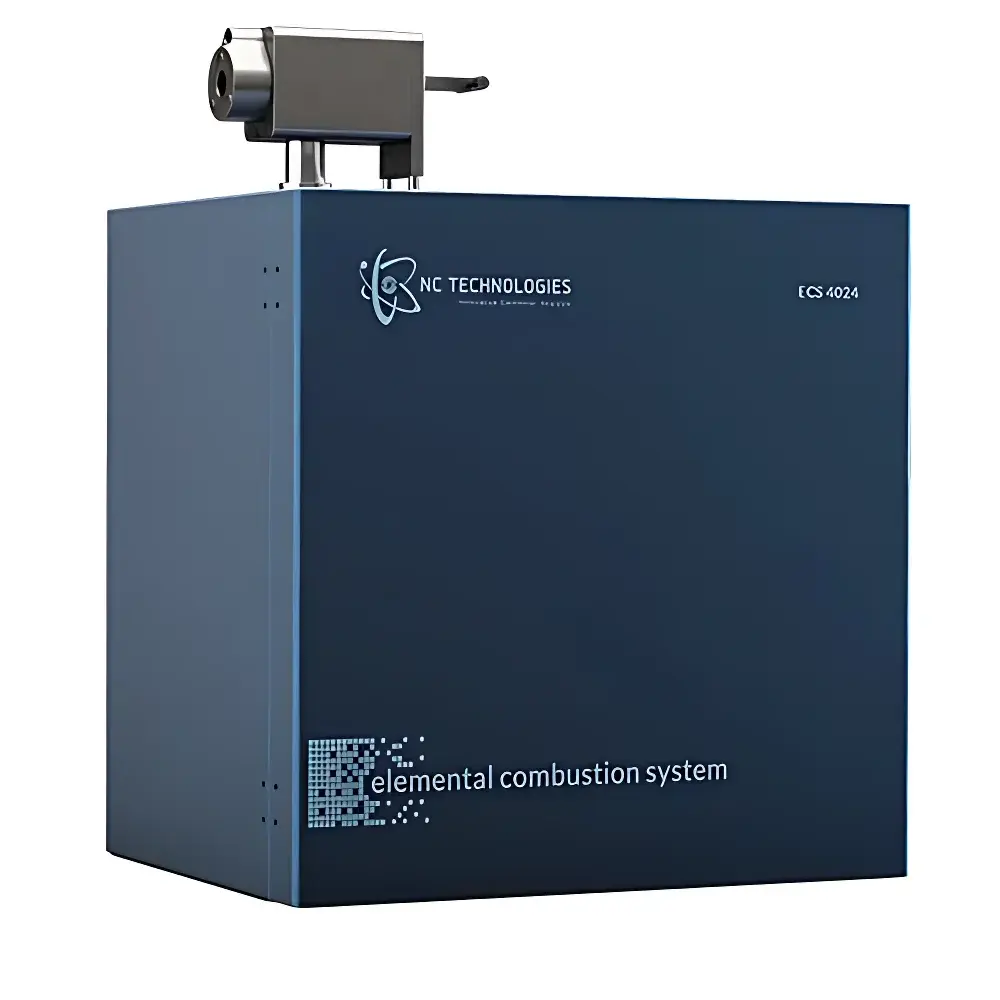
NC Technologies ECS 4024 Classic Organic Elemental Analyzer
| Brand | NC Technologies |
|---|---|
| Origin | Italy |
| Model | ECS 4024 |
| Analysis Principle | High-Temperature Catalytic Combustion (Dumas Method) |
| Elements Determined | C, H, N, S (O optional) |
| Detection Method | Thermal Conductivity Detection (TCD) |
| Chromatographic Separation | Isothermal GC column (30–110 °C) |
| Automation Level | Semi-automatic |
| Software Interface | PC-based dedicated acquisition and reporting software |
| Isotope Compatibility | Compatible with IRMS (Isotope Ratio Mass Spectrometry) coupling |
| Sample Type | Homogeneous solid or liquid organic samples (micro-weighing capable) |
| Regulatory Alignment | Designed for GLP-compliant workflows |
Overview
The NC Technologies ECS 4024 Classic Organic Elemental Analyzer is a semi-automated benchtop instrument engineered for precise quantitative determination of carbon (C), hydrogen (H), nitrogen (N), and sulfur (S) in organic matrices using high-temperature catalytic combustion—commonly referred to as the Dumas method. Optional oxygen (O) analysis is supported via pyrolysis–reduction configuration. The system operates on the principle of instantaneous flash combustion at temperatures up to 1,150 °C in a pure oxygen environment, followed by catalytic conversion of combustion products into stable molecular species (CO₂, H₂O, SO₂, N₂). These gases are then separated under isothermal conditions using a packed capillary gas chromatography column maintained between 30 °C and 110 °C. Quantification is achieved via a highly stable thermal conductivity detector (TCD), which offers intrinsic baseline stability and long-term signal reproducibility without requiring reference gas streams—a key differentiator from conventional dual-beam TCD architectures.
Key Features
- Semi-automated sample introduction with programmable micro-weighing capability for high-precision mass loading (typical range: 0.1–10 mg for solids; 1–50 µL for liquids)
- Microprocessor-controlled combustion furnace with real-time temperature monitoring and adaptive oxygen flow regulation
- Self-calibrating TCD detector: no reference gas required; factory-calibrated sensitivity traceable to NIST-standard gas mixtures
- Modular architecture comprising three functionally isolated units: (1) Sample introduction & combustion module, (2) Gas separation & detection module, (3) Data acquisition & reporting module
- Multi-mode analytical flexibility: selectable configurations for CN, CHN, and CHNS determinations; O-module upgrade path available
- Low operational overhead: minimal consumables (quartz combustion tubes, catalysts, desiccants); <5 min average cycle time per analysis
Sample Compatibility & Compliance
The ECS 4024 accommodates a broad spectrum of homogeneous organic materials—including pharmaceutical actives, polymers, foodstuffs, soils, sediments, and certified reference materials (CRMs)—provided they exhibit sufficient homogeneity for micro-weighing protocols. It complies with internationally recognized standard methods including ASTM D5291, ISO 16968, and USP . When operated within validated software environments supporting electronic signatures and audit trails, the system meets foundational requirements for GLP and GMP laboratories under FDA 21 CFR Part 11. All hardware components—including combustion tubes, catalyst beds, and GC columns—are replaceable using standardized OEM parts with documented lot traceability.
Software & Data Management
Data acquisition and processing are managed through proprietary Windows-based software that provides real-time chromatogram visualization, peak integration, calibration curve generation (linear and quadratic), and automated stoichiometric correction for matrix-specific recovery factors. Raw data files are stored in vendor-neutral ASCII format for third-party statistical analysis. The software supports LIMS integration via ASTM E1384-compliant export protocols and includes configurable report templates aligned with ISO/IEC 17025 documentation standards. For isotopic applications, the system features analog/digital output ports enabling synchronized triggering and signal routing to external IRMS systems.
Applications
This analyzer serves critical roles across quality control laboratories in pharmaceutical manufacturing (e.g., assay verification of API elemental composition), academic research in environmental geochemistry (C/N ratios in sediment cores), polymer science (elemental fingerprinting of synthetic macromolecules), and agricultural testing (protein content estimation via nitrogen quantification). Its robustness and low maintenance profile make it especially suitable for routine QC labs performing >200 analyses per week. The ability to interface with isotope ratio mass spectrometers extends its utility to stable isotope ecology, forensic chemistry, and metabolic tracer studies.
FAQ
What sample types are compatible with the ECS 4024?
Solid or liquid organic samples exhibiting physical and chemical homogeneity—such as powders, tablets, oils, and purified compounds—are suitable. Inhomogeneous or highly volatile matrices require pre-treatment or alternative instrumentation.
Does the ECS 4024 require carrier gas or reference gas for TCD operation?
No. The TCD is single-beam, self-balancing, and requires only ultra-high-purity helium or argon as the mobile phase; no reference gas stream is needed for baseline stabilization.
Can the ECS 4024 be upgraded for oxygen analysis?
Yes. An optional pyrolysis–reduction module (ECS-OX) can be retrofitted to enable quantitative oxygen determination via thermal decomposition in graphite-packed reactors.
How is calibration performed?
Calibration uses certified reference materials (e.g., sulfanilamide, benzoic acid, EDTA) with known C/H/N/S content. Multi-point calibration curves are generated automatically; drift correction is applied using internal standard pulses during sequence runs.
Is remote diagnostics or service support available?
NC Technologies provides secure remote access capabilities for firmware updates and diagnostic logging, subject to customer network policy and IT security approval. On-site service contracts include annual performance verification per ISO/IEC 17025 Annex A.




