
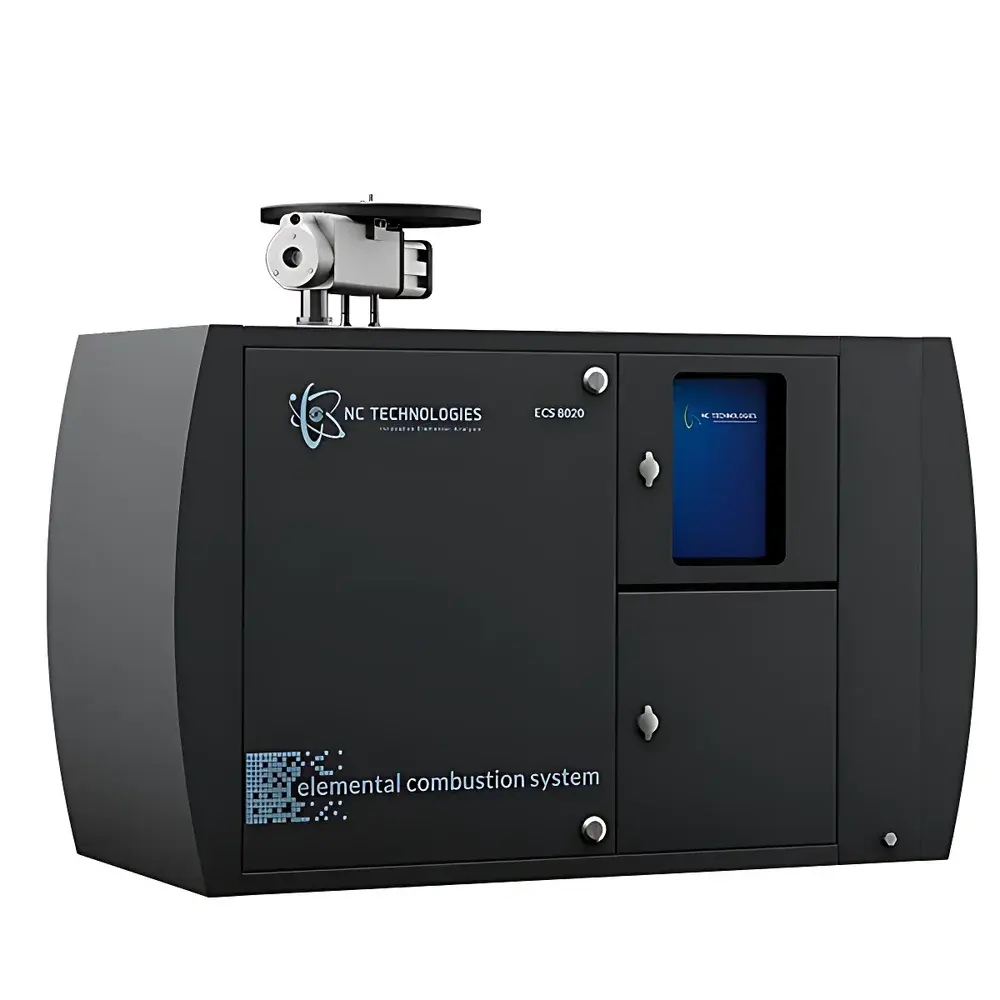
NC Technologies ECS 8020 CHNSO Automated Elemental Analyzer
| Brand | NC Technologies |
|---|---|
| Origin | Italy |
| Model | ECS 8020 |
| Analysis Principle | High-Temperature Catalytic Combustion (Dumas Method) |
| Elements Determined | C, H, N, S (O optional) |
| Detection Method | Thermal Conductivity Detection (TCD) |
| Chromatographic Separation | Isothermal GC column (30–110 °C) |
| Automation Level | Fully automated with microprocessor control and PC integration |
| Sample Introduction Options | Manual, Pneumatic, Motorized Zero-Blank Autosampler |
| Detector Features | Reference-gas-free TCD with auto-calibration |
| Software Interface | Dedicated Windows-based acquisition and reporting software with audit trail capability |
| Compliance Support | Designed for GLP/GMP environments |
| Isotope Interface | Integrated IDMicro EA port for coupling to isotope ratio mass spectrometers (IRMS) |
| Power & Gas Management | Standby mode reduces carrier gas consumption (He or Ar), energy use, and idle time |
Overview
The NC Technologies ECS 8020 CHNSO Automated Elemental Analyzer is a high-performance, fully integrated combustion-based system engineered for precise quantification of carbon (C), hydrogen (H), nitrogen (N), sulfur (S), and optionally oxygen (O) in organic and heterogeneous solid samples. It operates on the Dumas principle—high-temperature catalytic oxidation at ≥1,150 °C in a pure oxygen environment—ensuring complete and reproducible conversion of sample-bound elements into gaseous oxides (CO₂, H₂O, SO₂) and molecular nitrogen (N₂). The evolved gases undergo isothermal separation on a packed chromatographic column maintained between 30 °C and 110 °C, enabling baseline-resolved elution prior to detection. Quantification is performed using a proprietary thermal conductivity detector (TCD) featuring built-in auto-zero calibration and no requirement for reference gas—minimizing operational complexity and long-term drift. The ECS 8020 is purpose-built for laboratories handling diverse, non-homogeneous matrices including soils, biomass, composts, sludges, fertilizers, feedstuffs, and pharmaceutical excipients.
Key Features
- Fully automated microprocessor-controlled platform with real-time status monitoring via integrated touchscreen interface
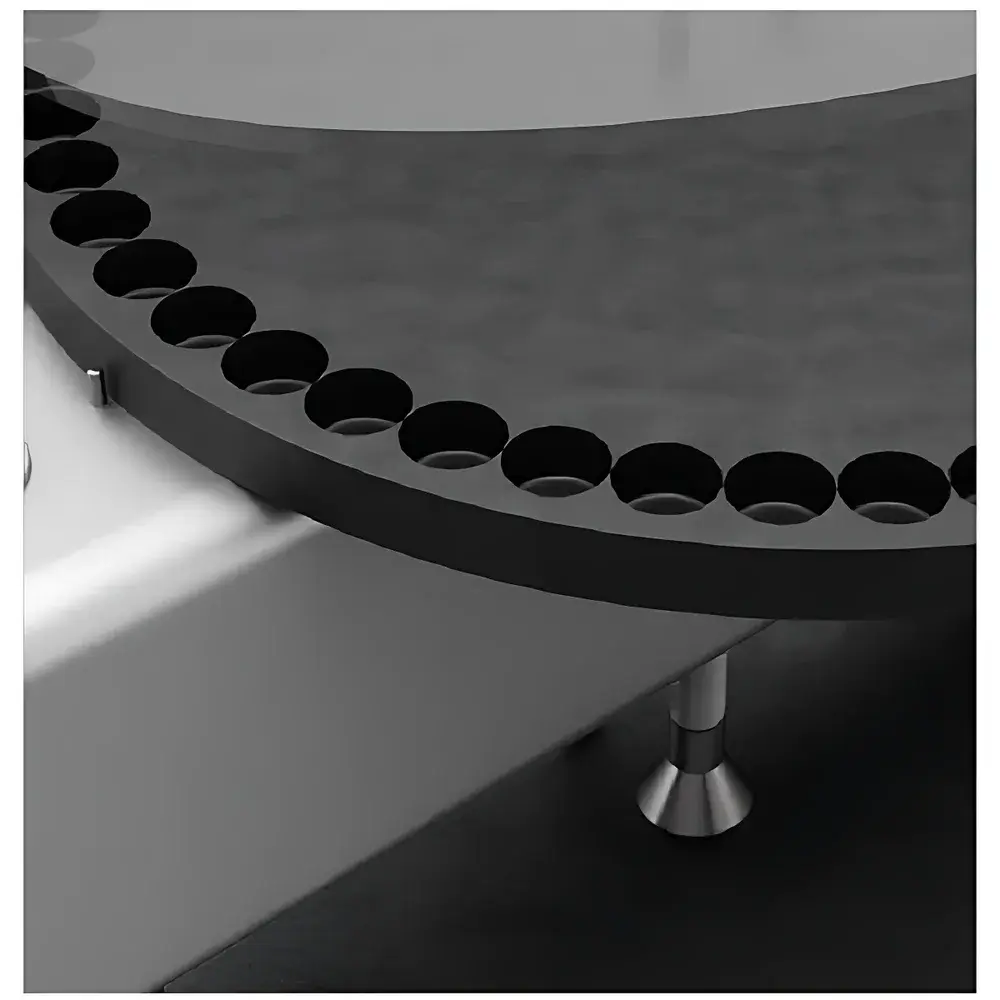
- Three interchangeable autosampling options: manual loading, pneumatic push-rod, and motorized Zero-Blank autosampler for ultra-low background analysis
- Modular combustion unit with dual-stage reactor design (oxidation + reduction) and programmable catalyst regeneration cycles
- Reference-gas-free TCD with temperature-stabilized cell architecture and automatic baseline correction
- Integrated consumables tracking system that monitors catalyst life, desiccant saturation, and CO₂ absorbent depletion
- Low-power standby mode reducing helium or argon carrier gas flow by >70% and cutting energy consumption during idle periods
- IDMicro EA interface compliant with ASTM D5291, ISO 16968, and USP for seamless coupling to isotope ratio mass spectrometers (IRMS)
Sample Compatibility & Compliance
The ECS 8020 accommodates sample masses from 0.1 mg to 500 mg across a wide range of physical forms—including powders, granules, pellets, and irregular solids—without pre-digestion or derivatization. Its robust combustion architecture delivers high recovery (>99.5%) and low method blank levels (<0.5 µg C, <0.2 µg N), essential for regulatory-grade analysis of environmental and agricultural materials. The system supports full traceability per GLP and GMP requirements: electronic signatures, user access controls, change logs, and audit trails are enabled through its validated software suite. Optional 21 CFR Part 11 compliance packages include electronic record archiving, role-based permissions, and secure data encryption—making it suitable for QA/QC labs operating under FDA, EPA, or EU REACH frameworks.
Software & Data Management
Data acquisition, processing, and reporting are handled by NC Technologies’ proprietary EA-Control Suite—a Windows-native application supporting real-time chromatogram visualization, peak integration with retention time locking, and customizable report templates (PDF, CSV, XML). All raw data files are stored with embedded metadata (operator ID, instrument serial number, calibration history, method parameters), ensuring full chain-of-custody integrity. Batch processing, QC flagging (e.g., %RSD thresholds, recovery limits), and LIMS export via ODBC or HL7 protocols are standard. The software includes built-in calibration curve management with polynomial fitting, multi-point standard verification, and drift compensation algorithms aligned with ISO/IEC 17025 validation guidelines.
Applications
The ECS 8020 serves as a core analytical tool in environmental testing laboratories analyzing total organic carbon (TOC) and total nitrogen (TN) in soils and sediments; in agronomy research assessing nutrient composition of biofertilizers and compost amendments; in waste characterization studies evaluating elemental profiles of municipal and industrial residuals; and in pharmaceutical development for residual solvent and excipient purity verification. Its compatibility with IRMS enables stable isotope ratio analysis (δ¹³C, δ¹⁵N, δ³⁴S) in ecological tracing, food authenticity, and forensic geochemistry applications. The system’s tolerance for high-salt, high-moisture, and high-ash samples further extends utility to coal, coke, and biomass co-firing feedstock qualification.
FAQ
What sample types are compatible with the ECS 8020?
Solid organic matrices including soils, plant tissues, animal feeds, sewage sludge, plastics, pharmaceuticals, and geological samples—with no requirement for acid digestion or liquid handling.
Is oxygen determination truly optional and fully integrated?
Yes—O analysis is enabled via pyrolytic reduction in a dedicated furnace zone and quantified as CO; hardware and software modules are factory-installed and validated as part of the CHNSO configuration.
Can the ECS 8020 be validated for regulated environments?
Absolutely—the platform supports IQ/OQ/PQ documentation packages, and its software offers configurable 21 CFR Part 11 modules for electronic records and signatures.
How does the Zero-Blank autosampler reduce contamination risk?
It employs a sealed, inert sample pathway with ceramic components and active blank subtraction logic, eliminating carryover and enabling sub-microgram-level detection limits for trace C/N analysis.
What maintenance intervals are recommended for routine operation?
Catalyst replacement every 1,500–2,000 injections; desiccant and CO₂ absorbent every 200–300 runs; full system performance verification quarterly using certified reference materials (CRMs) such as IAEA-CH-6, NIST 8542, or LECO 50-556.
Related Products




