
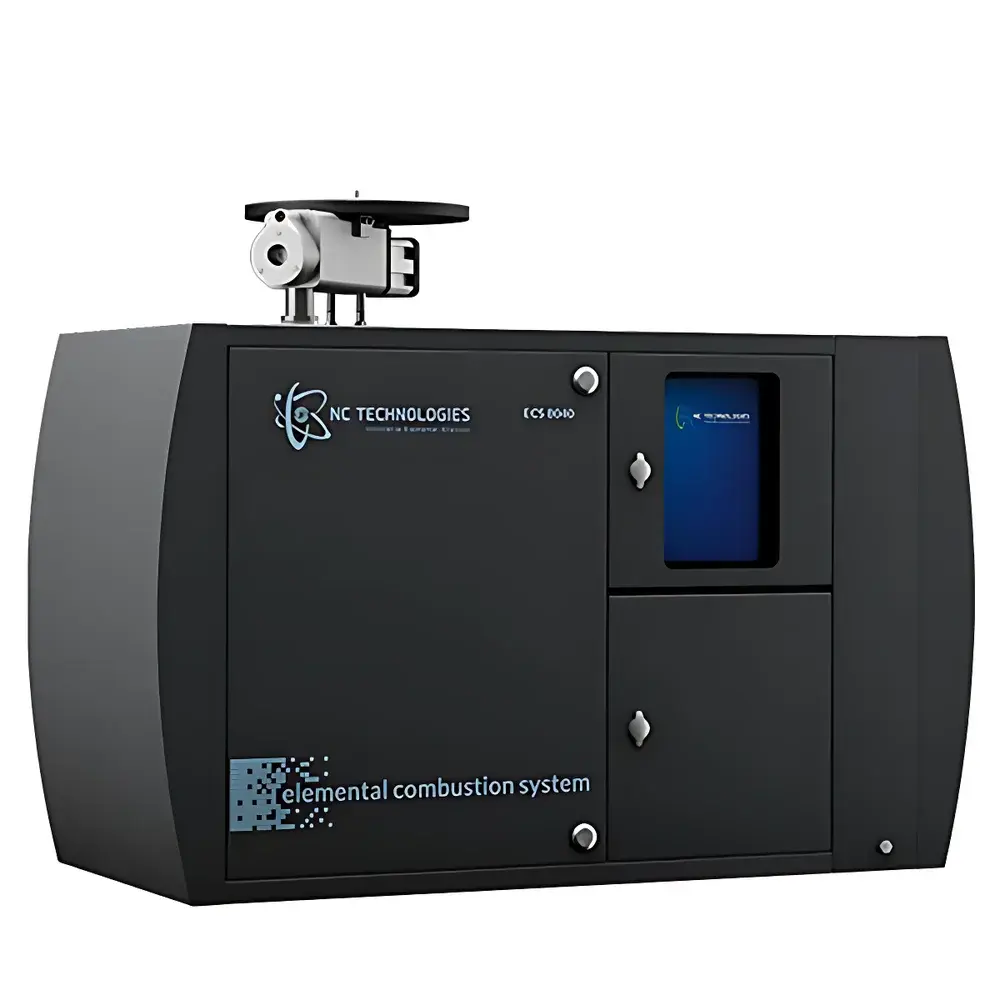
NC Technologies ECS 8040 CHNSO Automatic Elemental Analyzer
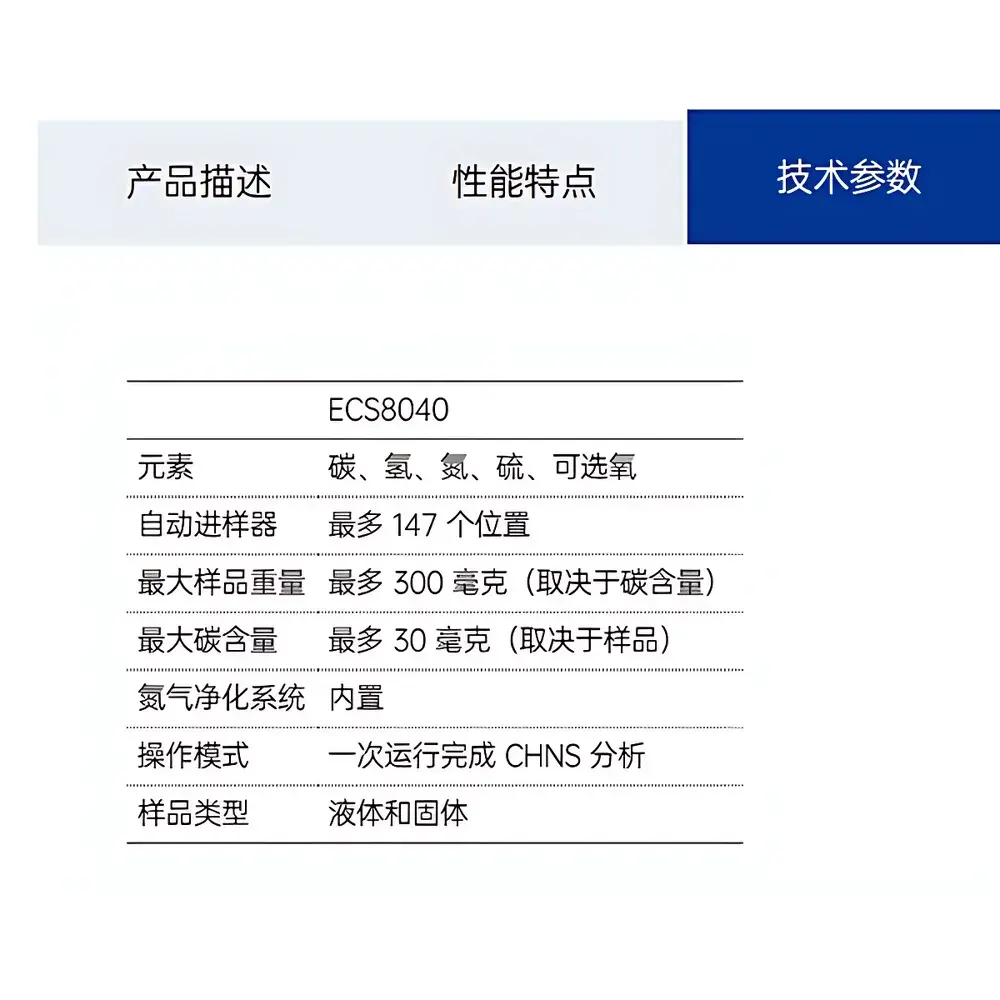
| Brand | NC Technologies |
|---|---|
| Origin | Italy |
| Model | ECS 8040 |
| Analysis Principle | High-Temperature Catalytic Combustion (Dumas Method) |
| Elements Measured | C, H, N, S, O (O optional) |
| Detection Method | Thermal Conductivity Detection (TCD) |
| Gas Separation | Isothermal Capillary Chromatography (30–110 °C) |
| Automation Level | Fully Automated with Microprocessor Control & PC Integration |
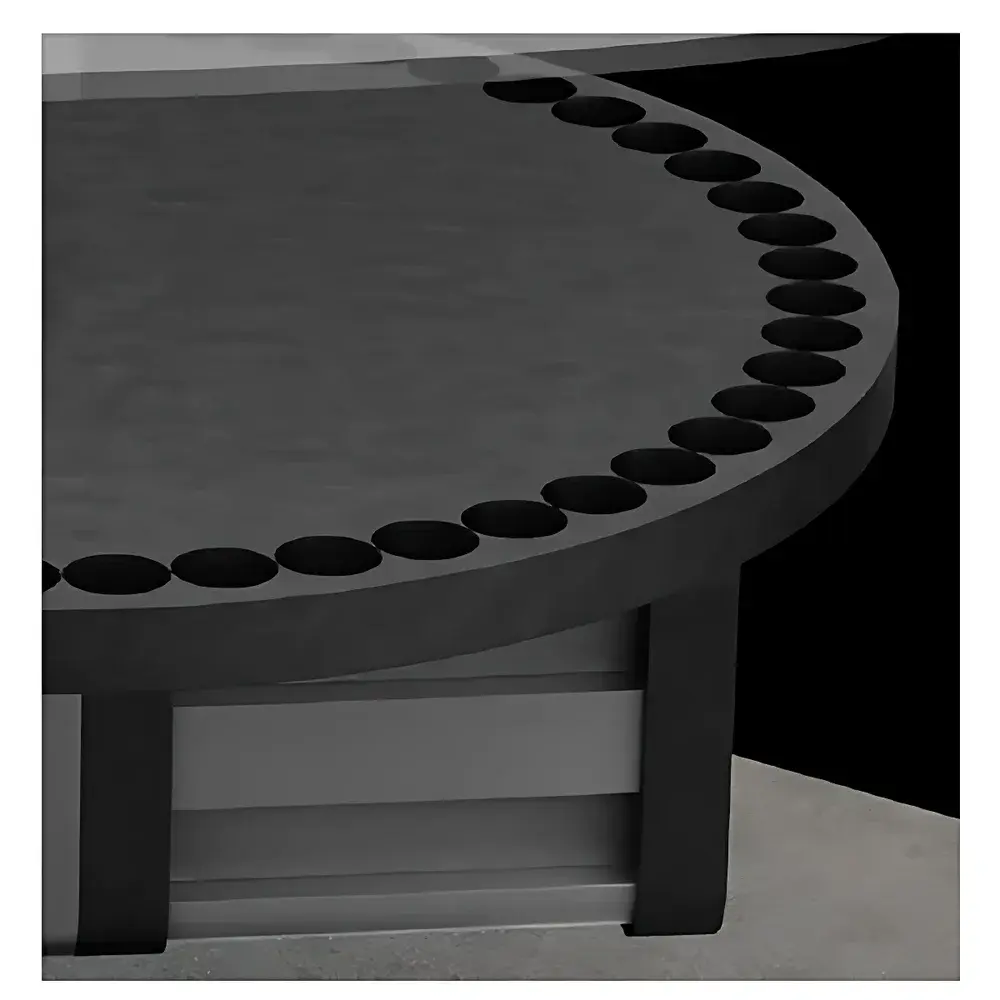
| Sample Introduction Options | Manual, Pneumatic, Motorized Zero-Blank Autosampler |
| Detector Configuration | Dual TCD with Reference-Free Operation |
| Software | Dedicated Windows-Based Acquisition & Quantification Suite with Audit Trail Capability |
| Compliance Framework | Designed for GLP/GMP environments |
| Power Supply | 230 V AC, 50/60 Hz |
| Dimensions (W×D×H) | 700 × 650 × 550 mm |
| Weight | ~75 kg |
Overview
The NC Technologies ECS 8040 CHNSO Automatic Elemental Analyzer is a high-precision, fully automated combustion-based system engineered for quantitative determination of carbon (C), hydrogen (H), nitrogen (N), sulfur (S), and optionally oxygen (O) in organic and organometallic samples. It implements the Dumas combustion principle—where sample aliquots are flash-combusted at temperatures up to 1,150 °C in an oxygen-rich environment over platinum- and cobalt-catalyst beds—ensuring complete oxidation of all heteroatoms. The resulting gaseous effluent (CO₂, H₂O, N₂, SO₂, and CO for O-mode analysis) is swept through a precisely temperature-controlled capillary chromatographic column (operable between 30 °C and 110 °C), enabling baseline-resolved separation prior to detection. Quantification is performed using dual-cell thermal conductivity detectors (TCDs) operating without reference gas—a design feature that eliminates drift-related calibration uncertainty and enhances long-term reproducibility. As a microprocessor-driven platform, the ECS 8040 integrates real-time system diagnostics, closed-loop catalyst health monitoring, and automated leak verification, making it suitable for regulated laboratories requiring traceable, auditable elemental data.
Key Features
- Fully automated operation with three interchangeable autosampler configurations: manual, pneumatic, and motorized zero-blank—optimized for low-mass (< 5 mg), heterogeneous, or matrix-sensitive samples requiring semi-micro weighing protocols.
- Reference-free dual TCD architecture delivering stable baseline performance and sub-ppm detection limits for C, H, N, and S across wide dynamic ranges (0.01–100% w/w).
- Intelligent catalyst management system continuously evaluates catalytic bed activity and triggers maintenance alerts based on cumulative oxygen consumption and signal decay trends.
- Integrated gas flow control with programmable oxygen dosing per injection, minimizing carrier gas waste and ensuring stoichiometric combustion consistency.
- Touchscreen HMI for local method setup, status monitoring, and consumables inventory tracking—including quartz boat life, catalyst age, and desiccant saturation indicators.
- Modular detector interface supporting direct coupling to isotope-ratio mass spectrometers (IRMS) for δ¹³C, δ¹⁵N, δ³⁴S, and δ¹⁸O applications via standardized GC-MS transfer lines.
Sample Compatibility & Compliance
The ECS 8040 accommodates solid, liquid, and viscous samples—including pharmaceutical intermediates, polymers, soils, sediments, food matrices, and biofuels—without derivatization. Its robust combustion chamber tolerates halogenated, acidic, or high-sulfur materials when paired with appropriate trap configurations (e.g., Ag-coated CuO for halogen removal). All hardware and firmware components comply with IEC 61000-6-3 (EMC) and IEC 61010-1 (safety) standards. When deployed with validated software modules, the system supports analytical workflows aligned with ASTM D5291, ISO 14852, USP , and EPA Method 525.3. Electronic records generated by the acquisition software include full audit trails, user authentication logs, and immutable result archives—enabling compliance with FDA 21 CFR Part 11 requirements for computerized systems in GxP environments.
Software & Data Management
The proprietary ECS Control Suite runs natively on Windows 10/11 platforms and provides comprehensive instrument control, sequence scheduling, peak integration, calibration curve generation (linear, quadratic, or multipoint weighted), and report export in PDF, CSV, and XML formats. Each analysis session stores raw chromatograms, system parameter snapshots, and environmental metadata (ambient temperature, pressure, gas purity logs). Version-controlled method templates support laboratory-wide standardization, while role-based access control enforces SOP adherence. Data backups are configurable for network-attached storage or cloud-synced repositories with AES-256 encryption. Optional LIMS integration is supported via ASTM E1384-compliant HL7 and ASTM E2500-07 messaging protocols.
Applications
- Pharmaceutical quality control: Assay verification of active pharmaceutical ingredients (APIs), excipient purity screening, and residual solvent quantification.
- Academic and industrial research: Stoichiometric characterization of novel catalysts, MOFs, covalent organic frameworks (COFs), and synthetic polymers.
- Environmental testing labs: Total organic carbon (TOC) and total nitrogen (TN) profiling in wastewater sludge, leachates, and airborne particulates.
- Food & agriculture: Protein content estimation (via N-to-protein conversion), adulteration detection in dairy products, and nutrient labeling compliance.
- Geochemical and petrochemical analysis: Carbon speciation in kerogen, sulfur distribution in crude fractions, and heteroatom mapping in heavy fuel oils.
FAQ
What sample mass range is optimal for the ECS 8040?
For maximum precision in semi-micro analysis, recommended masses range from 1.0 to 5.0 mg for homogeneous solids and 5–20 µL for liquids—adjustable based on expected element concentration and matrix volatility.
Can the ECS 8040 perform simultaneous CHNS and O analysis in a single run?
No—oxygen analysis requires a separate combustion regime (pyrolysis in graphite furnace under helium), necessitating dedicated method selection and hardware configuration (O-module installation). CHNS analysis occurs in the primary combustion tube.
Is method validation support available from NC Technologies?
Yes—NC Technologies provides IQ/OQ documentation packages, certified reference material (CRM) test protocols (e.g., NIST SRM 85d, 278a), and on-site performance qualification services aligned with ISO/IEC 17025 requirements.
How frequently must the catalyst be replaced?
Under typical usage (50–100 injections/day), platinum/cobalt catalysts maintain performance for ≥12 months; the system’s predictive algorithm estimates remaining service life based on cumulative thermal cycles and signal fidelity metrics.
Does the ECS 8040 meet regulatory requirements for GLP audits?
When operated with enabled audit trail, electronic signatures, and secure user authentication, the ECS 8040 satisfies core GLP principles outlined in OECD Series on Principles of Good Laboratory Practice and EU Directive 2004/10/EC.






