
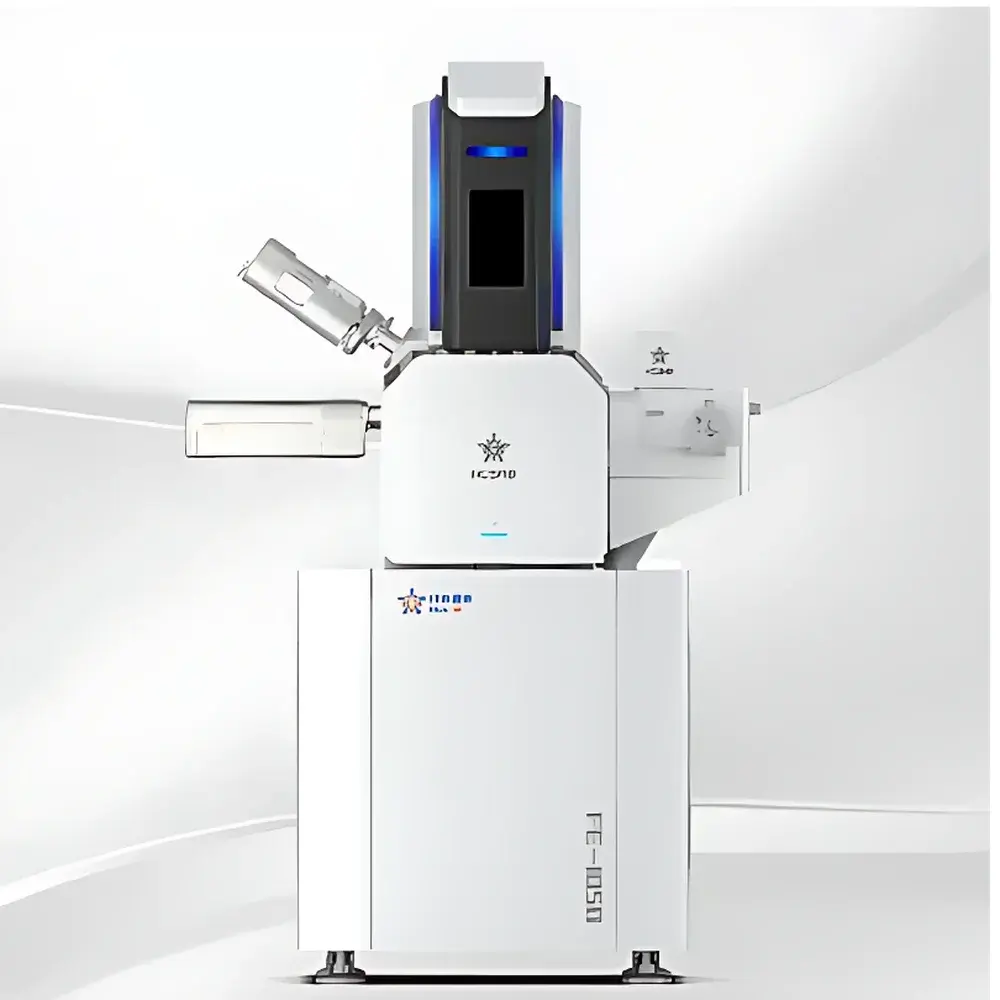
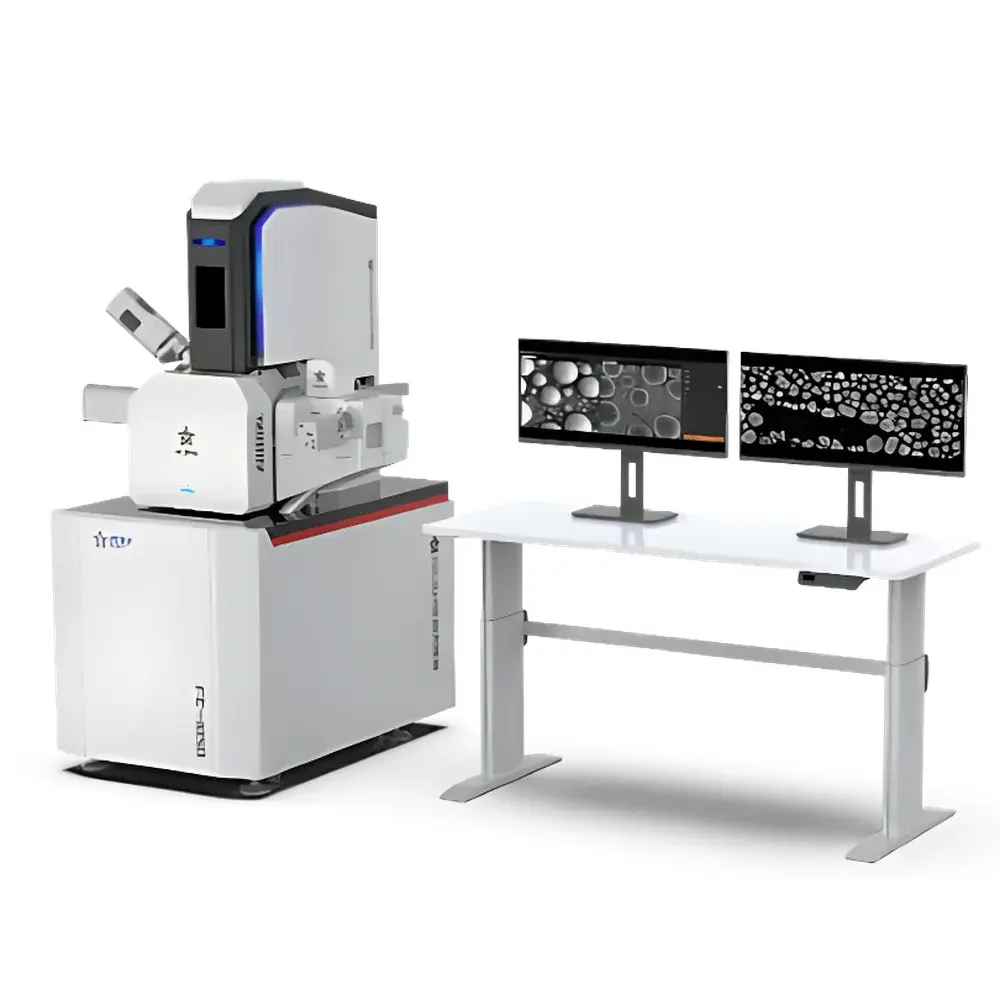
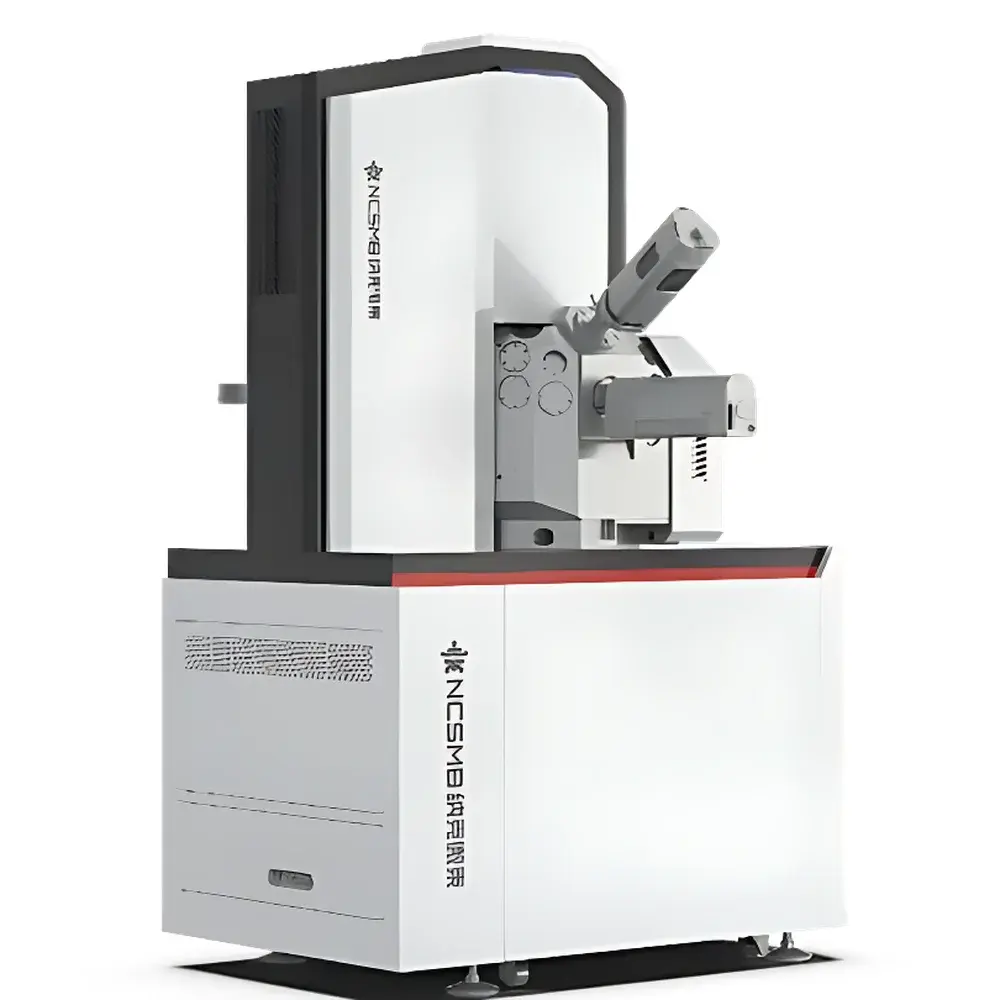
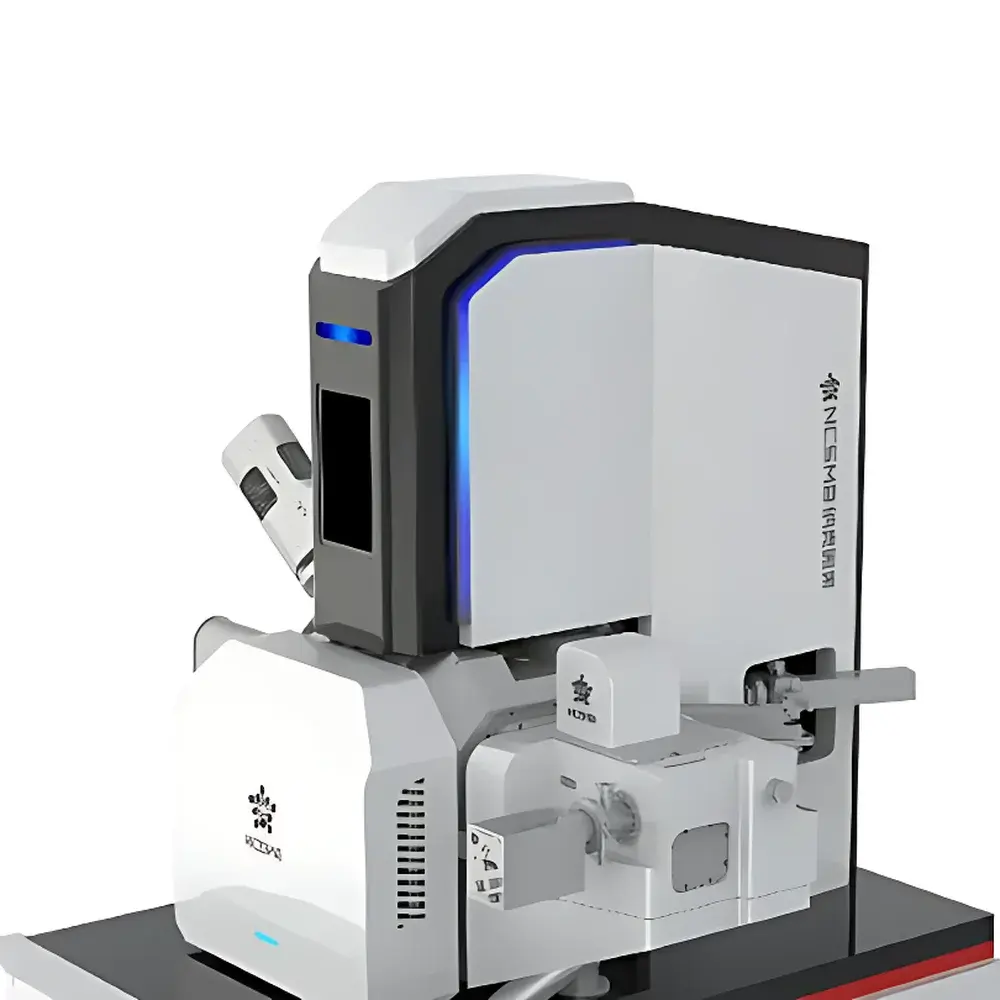
NCS FE-1050 Series High-Resolution Field Emission Scanning Electron Microscope
| Brand | NCS |
|---|---|
| Origin | Beijing, China |
| Manufacturer Type | Direct Manufacturer |
| Product Category | Domestic |
| Model | FE-1050 Series |
| Instrument Form Factor | Floor-Standing |
| Electron Gun Type | Thermal Field Emission |
| Secondary Electron (SE) Resolution | 1.5 nm @ 1 kV, 0.9 nm @ 15 kV |
| Magnification Range | 10× to 1,000,000× |
| Accelerating Voltage | 0.02–30 kV |
| Backscattered Electron (BSE) Resolution | 2.5 nm @ 1 kV, 1.5 nm @ 15 kV |
| Sample Chamber Port Count | 27 |
| Stage Motion | 5-Axis Motorized (X = 140 mm, Y = 140 mm, Z = 60 mm, Rotation = 360°, Tilt = −10° to +80°) |
| Standard Detectors | In-Column SE Detector, Everhart-Thornley SE Detector, Optional Insertable BSE Detector, Optional STEM Detector, Triple-Channel IR CCD Chamber Monitoring System |
Overview
The NCS FE-1050 Series is a high-performance, floor-standing field emission scanning electron microscope (FE-SEM) engineered for nanoscale imaging and microstructural characterization in academic research laboratories, industrial quality control facilities, and advanced materials development centers. Utilizing a thermally assisted field emission (Schottky-type) electron source, the system delivers exceptional beam brightness, energy stability, and long-term emission consistency—critical for high-resolution secondary electron (SE) and backscattered electron (BSE) imaging across a wide accelerating voltage range (20 V to 30 kV). Its optimized electron optical column incorporates aberration-reduced lens design and low-voltage correction capabilities, enabling sub-nanometer resolution at 1 kV—particularly advantageous for beam-sensitive, uncoated, or insulating specimens where charging and surface damage must be minimized. The FE-1050 is not a modified conventional SEM; it represents a purpose-built platform developed with full vertical integration by National Center for Iron and Steel Research (NCS), ensuring rigorous alignment between hardware architecture, vacuum integrity, and signal detection fidelity.
Key Features
- Thermal field emission electron gun with <1.0 µA emission current stability over 8+ hours, supporting stable low-kV imaging and high-current analytical modes.
- Dual-mode detector architecture: integrated in-column SE detector for high-efficiency low-voltage imaging and Everhart-Thornley (ET) SE detector for topographic contrast enhancement at medium-to-high kV.
- Modular sample chamber with 27 standardized flanged ports (CF40/CF63), enabling simultaneous integration of EDS, WDS, EBSD, CL, micro-XRF, and gas injection systems without compromising vacuum performance.
- Five-axis motorized stage with ±0.1 µm repeatability in X/Y, fully programmable tilt and rotation—designed for automated multi-region acquisition, cross-sectional alignment, and crystallographic orientation mapping workflows.
- Triple-channel infrared CCD monitoring system providing real-time, non-intrusive visualization of specimen loading, stage motion, and detector positioning—enhancing operational safety and procedural traceability.
- Embedded real-time image processing engine supporting auto-focus, auto-stigmation, contrast/brightness normalization, and intelligent feature-based region-of-interest (ROI) selection—reducing operator dependency while maintaining metrological rigor.
Sample Compatibility & Compliance
The FE-1050 accommodates specimens up to 200 mm in diameter and 80 mm in height, with standard compatibility for conductive, semi-conductive, and non-conductive samples—including polymers, ceramics, biological tissues (after critical-point drying or cryo-transfer), and battery electrode cross-sections. Optional low-vacuum and variable-pressure modes (via differential pumping) support hydrated or outgassing-prone samples without sputter coating. The system complies with IEC 61000-6-2 (EMC immunity) and IEC 61000-6-4 (EMC emissions), and its vacuum architecture meets ISO 20484:2020 requirements for ultra-high vacuum (UHV) SEM environments (<5 × 10⁻⁷ Pa base pressure). All software-controlled parameters—including kV, probe current, dwell time, and scan speed—are logged with timestamped audit trails, supporting GLP/GMP documentation practices and FDA 21 CFR Part 11 compliance when deployed with validated electronic signature modules.
Software & Data Management
The proprietary NCS-SEM Suite v4.2 provides a unified interface for instrument control, image acquisition, quantitative analysis, and metadata embedding. It supports DICOM-SR export for correlative microscopy workflows, TIFF-64 with embedded scale bars and acquisition metadata (EXIF-like SEM tags), and direct export to common EDS/EBSD data formats (e.g., .eds, .ctf, .h5). Batch acquisition scripts can be defined via Python API (PyNCS), enabling integration into automated material screening pipelines. Raw image buffers are stored in lossless HDF5 containers with checksum validation, ensuring bit-perfect reproducibility for longitudinal studies or inter-laboratory comparison projects. Data management policies—including automatic backup to network-attached storage (NAS), role-based access control (RBAC), and retention scheduling—are configurable per institutional IT governance frameworks.
Applications
The FE-1050 serves as a primary characterization tool across multiple domains: failure analysis of microelectronic interconnects and solder joints; grain boundary and phase distribution mapping in Ni-based superalloys and Ti-6Al-4V; nanoparticle size distribution quantification in catalyst supports; pore structure analysis in MOFs and aerogels; and high-fidelity morphological assessment of freeze-fractured lipid bilayers. Its low-voltage SE resolution enables direct imaging of graphene layers on SiO₂ substrates without charge compensation, while its high-kV BSE capability supports Z-contrast imaging of metal/ceramic composites with atomic number sensitivity down to ΔZ/Z ≈ 0.05. In regulatory environments, the system supports USP method verification for particle morphology assessment in pharmaceutical excipients and ISO 13322-1:2020-compliant particle sizing protocols.
FAQ
What vacuum level does the FE-1050 achieve in the specimen chamber?
The system maintains a base pressure of ≤5 × 10⁻⁷ Pa using a combination of turbomolecular pumping and ion gettering, with active pressure monitoring via Bayard-Alpert and cold cathode gauges.
Is the stage compatible with in-situ heating or cooling stages?
Yes—the 27-port chamber includes dedicated electrical feedthroughs and thermal isolation pathways for third-party in-situ holders (e.g., DENSsolutions, Gatan), with full motorized synchronization supported via NCS-SEM Suite.
Does the software support automated particle analysis per ISO standards?
Yes—integrated particle analysis module conforms to ISO 9276-2:2014 for size distribution reporting and supports customizable classification rules based on aspect ratio, circularity, and convexity thresholds.
Can the FE-1050 be integrated into a centralized lab automation infrastructure?
It features OPC UA server implementation and RESTful API endpoints for bidirectional communication with LIMS, MES, and digital twin platforms—enabling remote scheduling, status polling, and event-triggered acquisition.
What service and calibration support is provided internationally?
NCS offers factory-certified calibration services traceable to NIM (National Institute of Metrology, China), with on-site preventive maintenance contracts available in EMEA, APAC, and North America through authorized technical partners.






