
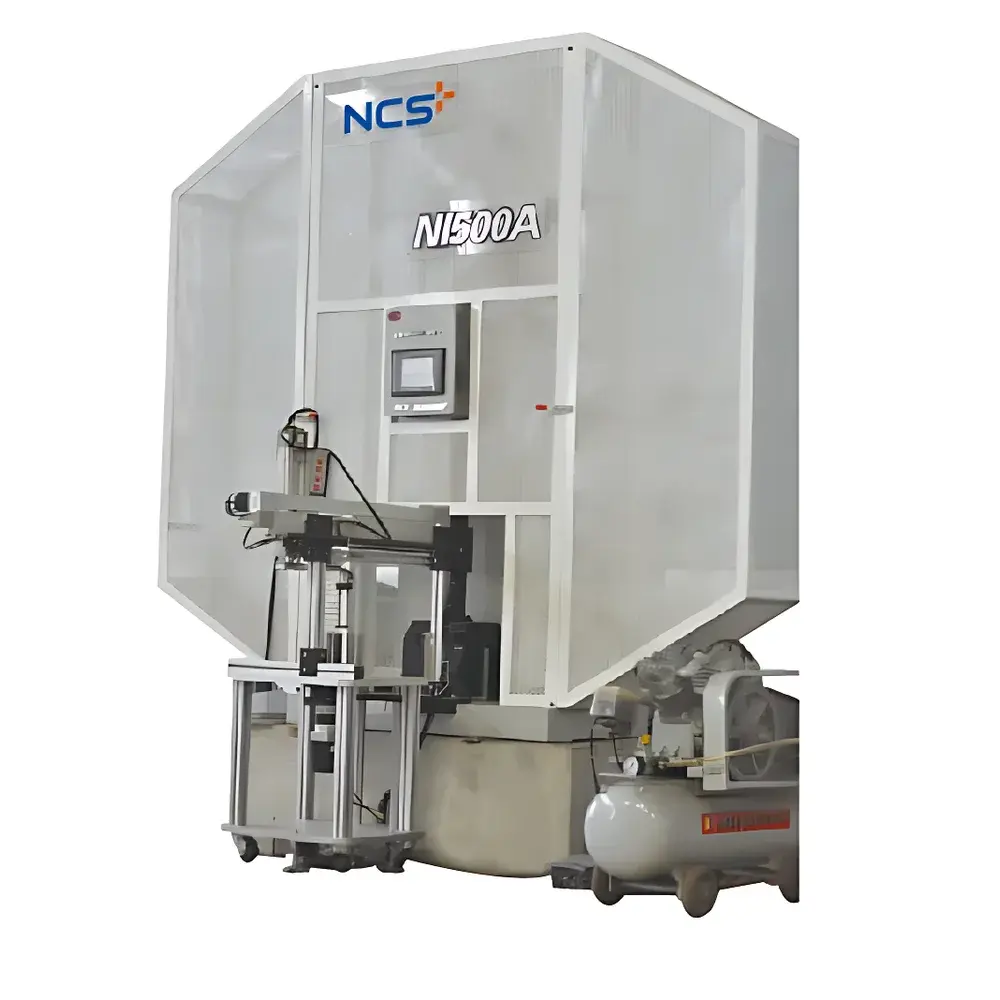
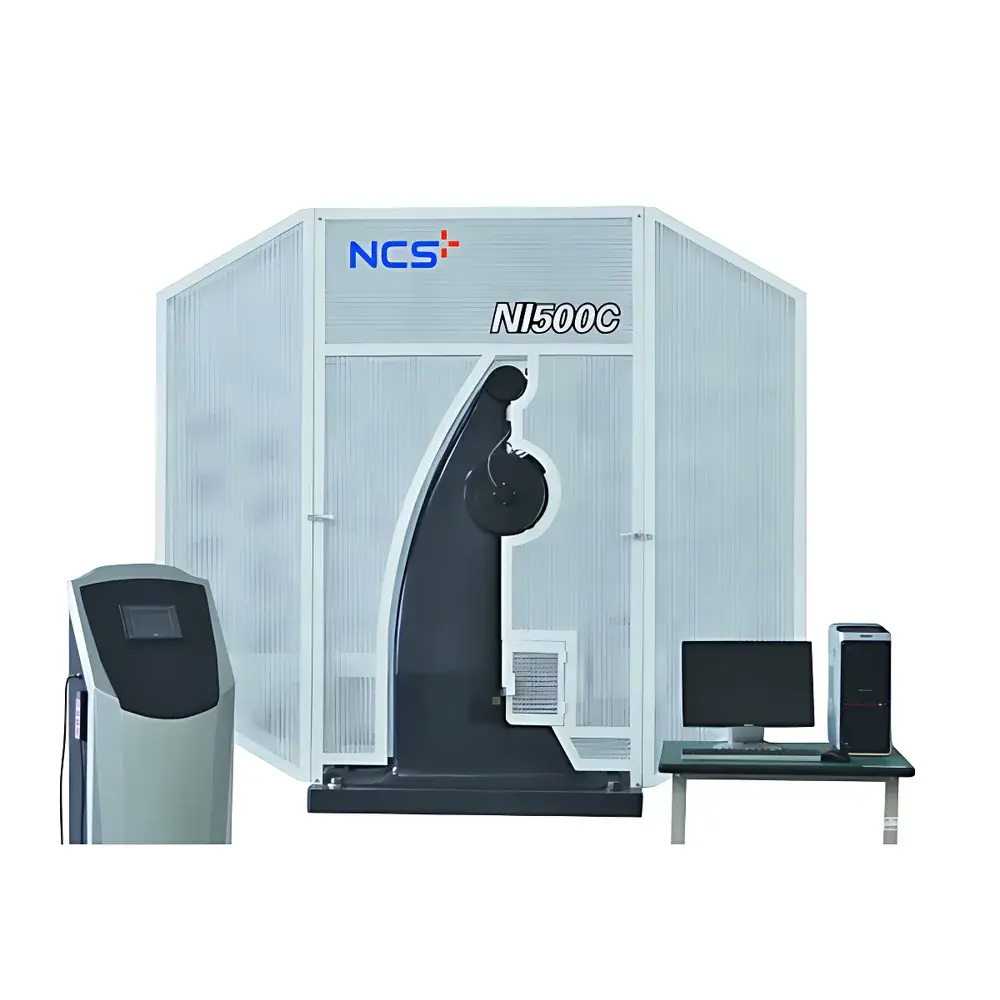
NCS NI Instrumented Impact Testing Machine (Pendulum Type)
| Brand | NCS |
|---|---|
| Origin | Beijing, China |
| Manufacturer | NCS (Steel Research Institute Nano-Characterization Co., Ltd.) |
| Type | Pendulum Impact Tester |
| Compliance Standards | GB/T 229, GB/T 19478–2005, ASTM E23, ISO 14556 |
| Output Data | Load-time, Force-displacement, Energy absorption, Crack initiation & propagation parameters (K₁d, J₁d) |
| Sensor Resolution | High-resolution dynamic load cell & energy transducer |
| Control Interface | Touchscreen-based digital control system |
| Test Modes | Charpy, Izod, Tensile Impact, Bending Impact |
| Report Export | Word, Excel-compatible formats |
| Frame Construction | Monolithic cast steel base and column |
Overview
The NCS NI Instrumented Impact Testing Machine is a high-precision pendulum-type impact tester engineered for quantitative fracture mechanics analysis of metallic, polymeric, and composite materials under dynamic loading conditions. Based on the principle of conservation of mechanical energy and real-time force-time signal acquisition, the system measures not only total absorbed energy but also critical transient parameters—including peak load, crack initiation energy, crack propagation energy, and dynamic fracture toughness indicators such as K1d and J1d. Unlike conventional non-instrumented impact testers, the NI series integrates synchronized high-speed data acquisition (≥1 MHz sampling rate) with calibrated dynamic load cells and angular displacement encoders to reconstruct full force–displacement and load–time histories. This enables rigorous compliance with fracture mechanics standards including ASTM E23 Annex A3 (instrumented impact testing), ISO 14556 (metallic materials—Charpy impact test—instrumented test method), and GB/T 229–2020 (metallic materials—Charpy pendulum impact test—instrumented test method). The monolithic cast steel frame ensures exceptional rigidity and minimal vibrational coupling during high-energy impacts up to 300 J, supporting reproducible measurements across repeated test cycles.
Key Features
- Monolithic cast steel structural frame for dimensional stability and vibration damping during high-magnitude impact events
- Digitally controlled pendulum release mechanism with touchscreen HMI interface and programmable test sequences
- Integrated high-resolution dynamic load sensor and angular position encoder for synchronized force–time and energy–displacement profiling
- Dual-mode impact configuration: standardized Charpy V-notch and Izod geometries, with interchangeable anvils and strikers compliant with ISO 148-1, ASTM E23, and GB/T 229
- Shock-dampened pendulum suspension system minimizing bearing friction and mechanical hysteresis at the pivot joint
- Fixed-span anvil design ensuring consistent support distance throughout testing—critical for eliminating specimen torsional distortion in high-energy regimes
- Modular striker assembly with standardized knife-edge radii (2 mm, 8 mm per ASTM/ISO) and certified calibration traceability to national metrology institutes
Sample Compatibility & Compliance
The NI instrumented impact tester accommodates standard Charpy specimens (10 × 10 × 55 mm), sub-sized variants (e.g., 5 × 5 × 55 mm, 7.5 × 7.5 × 55 mm), and specialized geometries for tensile-impact or bending-impact configurations. Specimen alignment is verified via precision-ground reference surfaces and optical centering aids. All mechanical components—including anvils, strikers, and specimen supports—conform to dimensional tolerances specified in ISO 148-2 and ASTM E23 Appendix X1. Calibration is performed using certified reference specimens with known absorbed energy values and dynamic response characteristics. The system meets requirements for GLP-compliant laboratories and supports audit-ready documentation per ISO/IEC 17025:2017, including electronic calibration logs, sensor drift verification records, and uncertainty budgets for K1d and J1d derivations.
Software & Data Management
The proprietary NCS ImpactSuite™ software provides real-time waveform visualization, automated parameter extraction (e.g., Fmax, Einit, Eprop, total absorbed energy), and ASTM/ISO-compliant report generation. Raw time-series data are stored in vendor-neutral binary format with embedded metadata (operator ID, timestamp, environmental conditions, calibration status). Export options include CSV for third-party statistical analysis, and formatted Word/Excel documents containing test summary tables, graphical overlays of comparative curves, and annotated fracture event markers. Audit trail functionality complies with FDA 21 CFR Part 11 requirements, recording all user actions, parameter modifications, and data exports with time-stamped digital signatures.
Applications
- Quantitative assessment of ductile-to-brittle transition temperature (DBTT) in ferritic steels for nuclear and pipeline applications
- Fracture toughness validation of additive-manufactured alloys per ASTM F3049 and ISO/ASTM 52900
- Quality control of weld metal and heat-affected zones (HAZ) in pressure vessel fabrication
- Dynamic mechanical characterization of polymer composites subjected to automotive crash simulations
- Research into strain-rate sensitivity of advanced high-strength steels (AHSS) and aluminum-lithium alloys
- Validation of cryogenic material performance per ASTM G154 and ISO 2812-2
FAQ
What standards does the NI instrumented impact tester support for K1d and J1d calculation?
It fully implements the methodologies defined in ASTM E23 Annex A3, ISO 14556, and GB/T 229–2020 for instrumented Charpy testing, enabling direct derivation of dynamic fracture toughness parameters from recorded force–displacement traces.
Can the system perform tensile-impact tests?
Yes—the NI platform supports optional tensile-impact fixtures compliant with ISO 8256 and ASTM D1822, allowing evaluation of dynamic tensile properties including yield strength, elongation at break, and energy absorption under impact loading.
Is calibration traceable to national metrology institutes?
All load sensors and energy transducers are factory-calibrated with certificates traceable to CNAS-accredited laboratories; on-site recalibration kits and procedures align with ISO 17025 requirements.
How is data integrity ensured during high-speed acquisition?
The system employs isolated analog front-end circuitry, anti-aliasing filters, and hardware-triggered acquisition to prevent timing skew between force and displacement channels—ensuring phase coherence essential for accurate J-integral computation.
Does the software support multi-user access with role-based permissions?
Yes—ImpactSuite™ includes configurable user profiles with tiered privileges (operator, supervisor, administrator), enforcing separation of test execution, result review, and system configuration functions.



