
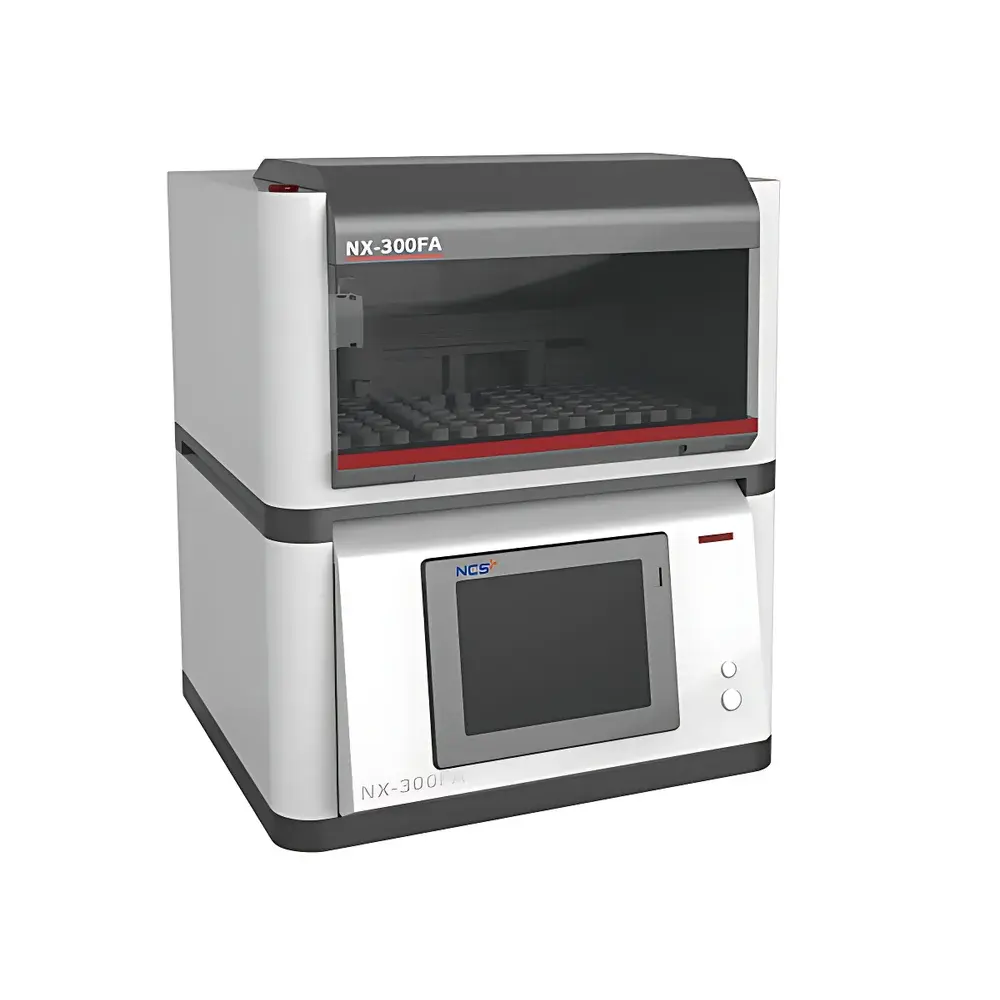
NCS NX-300 Food Safety Heavy Metal Analyzer
| Brand | NCS |
|---|---|
| Origin | Beijing, China |
| Manufacturer Type | Direct Manufacturer |
| Country of Origin | China |
| Model | NX-300 |
| Function Type | Multi-analyte (Cd, Pb, As, Hg, Cr, etc.) |
| Sample Type Compatibility | Solid food matrices (rice, grains, flour, spices, infant formula, dried vegetables) |
| Detection Time | ≤3 min for screening |
| Power Supply | 220 VAC ±10%, 50/60 Hz, 1.5 A |
| Dimensions | 550 W × 330 D × 440 H mm |
| Weight | 30 kg |
| X-ray Source | Air-cooled microfocus X-ray tube |
| Detector | Fast Silicon Drift Detector (FastSDD) |
| Optical Path | Non-destructive, optimized beam collimation and scatter suppression architecture |
| Radiation Safety | Compliant with GBZ 115–2002 “Hygienic Protection Standard for X-ray Diffraction and Fluorescence Analyzers” |
Overview
The NCS NX-300 Food Safety Heavy Metal Analyzer is a benchtop energy-dispersive X-ray fluorescence (EDXRF) spectrometer engineered for rapid, non-destructive quantification of toxic heavy metals—including cadmium (Cd), lead (Pb), arsenic (As), mercury (Hg), and chromium (Cr)—in solid food matrices. Unlike wet-chemistry or atomic spectroscopy methods requiring digestion, acid reagents, and laboratory infrastructure, the NX-300 leverages direct solid-sample analysis via optimized EDXRF physics: a high-stability air-cooled microfocus X-ray tube excites characteristic K- and L-shell emissions from target elements, while a Fast Silicon Drift Detector (FastSDD) delivers high count-rate capability and superior energy resolution (<140 eV at Mn Kα). The instrument’s proprietary optical path minimizes bremsstrahlung background and Compton scatter through precision collimation and geometry-driven signal-to-noise enhancement—enabling sub-ppm detection limits in rice without sample preparation. Designed for field-deployable operation, it functions reliably under ambient environmental conditions (15–35 °C, 30–80% RH), eliminating requirements for climate-controlled labs, water cooling, or hazardous consumables.
Key Features
- Air-cooled microfocus X-ray tube: Eliminates need for external chillers or deionized water, reducing operational overhead and increasing portability.
- FastSDD detector with real-time pulse processing: Supports high-throughput screening (≤3 min/sample) and full-quantitative mode (≤10 min/sample) with reproducible peak deconvolution.
- Non-destructive sample chamber with dedicated food-grade cup design: Ensures consistent geometry, minimal cross-contamination, and compliance with ISO 13877:2017 for solid-food XRF sampling protocols.
- Embedded high-precision HV power supply: Delivers stable tube voltage (up to 50 kV) and current control (1–1000 µA), critical for matrix-matched calibration robustness across diverse grain types.
- Integrated radiation shielding: Fully compliant with GBZ 115–2002 and aligned with IEC 61000-6-3/6-4 electromagnetic compatibility standards; leakage dose <0.1 µSv/h at 5 cm distance.
- Benchtop footprint (550 × 330 × 440 mm) and 30 kg mass: Enables deployment in mobile labs, regulatory checkpoints, agro-processing facilities, and rural testing stations.
Sample Compatibility & Compliance
The NX-300 is validated for homogeneous or homogenized solid food samples with particle size ≤250 µm—particularly rice, paddy, wheat flour, maize meal, infant cereals, dried herbs, and seafood powders. It supports ASTM D6440–22 (Standard Guide for XRF Analysis of Solid Waste) and ISO 21047:2022 (Foodstuffs — Determination of selected elements by EDXRF) methodologies. Quantitative accuracy is traceable to NCS-certified reference materials, including GBW(E)100348–362 (rice CRM for Cd), and aligns with China’s GB 2762–2022 (Limits of Contaminants in Foods) and EU Commission Regulation (EU) No 1881/2006. Instrument software logs full audit trails per GLP/GMP principles and supports 21 CFR Part 11-compliant user authentication and electronic signature workflows when deployed in regulated quality assurance environments.
Software & Data Management
Controlled via NCS FoodScan™ v3.2 software, the NX-300 provides intuitive method setup, automated calibration curve generation (linear and quadratic), and matrix-matched correction algorithms for organic/inorganic interference compensation. All spectral data are stored in vendor-neutral .csv and .rdb formats; raw spectra (.spe) include full metadata (tube settings, live time, dead time, ambient temperature/humidity). Software supports multi-user role-based access, configurable report templates (PDF/Excel), and integration with LIMS via OPC UA or RESTful API. Audit logs record operator ID, timestamp, method version, and result revision history—fully compliant with ISO/IEC 17025:2017 clause 7.10 on result reporting integrity.
Applications
- Rapid pre-harvest and post-harvest screening of rice paddies for Cd contamination in endemic regions (e.g., Hunan, Jiangxi).
- On-site verification of compliance with GB 2762–2022 limits during grain procurement at state reserve depots and milling facilities.
- Quality control of imported spices, infant formula, and dietary supplements in customs laboratories.
- Field-based surveillance programs conducted by provincial CDCs and agricultural extension services.
- Method validation support for accredited food testing labs seeking ISO/IEC 17025 accreditation for EDXRF-based heavy metal testing.
FAQ
Does the NX-300 require acid digestion or chemical reagents?
No. It performs direct solid-sample analysis with zero sample preparation beyond grinding and homogenization.
Can it quantify multiple elements simultaneously in a single measurement?
Yes. The FastSDD detector enables simultaneous quantification of Cd, Pb, As, Hg, and Cr in one acquisition cycle.
Is operator radiation safety training required?
While the unit meets GBZ 115–2002 shielding requirements, users must complete site-specific radiation safety orientation per national regulatory mandates.
What reference materials are recommended for calibration verification?
GBW(E)100348–362 (rice Cd CRM), GBW10045 (wheat flour multi-element CRM), and NCS internal food matrix blanks.
How is instrument performance verified between calibrations?
Daily system suitability checks include certified check standards, peak resolution monitoring (Mn Kα FWHM), and background stability assessment over 30-minute idle periods.
Related Products





