
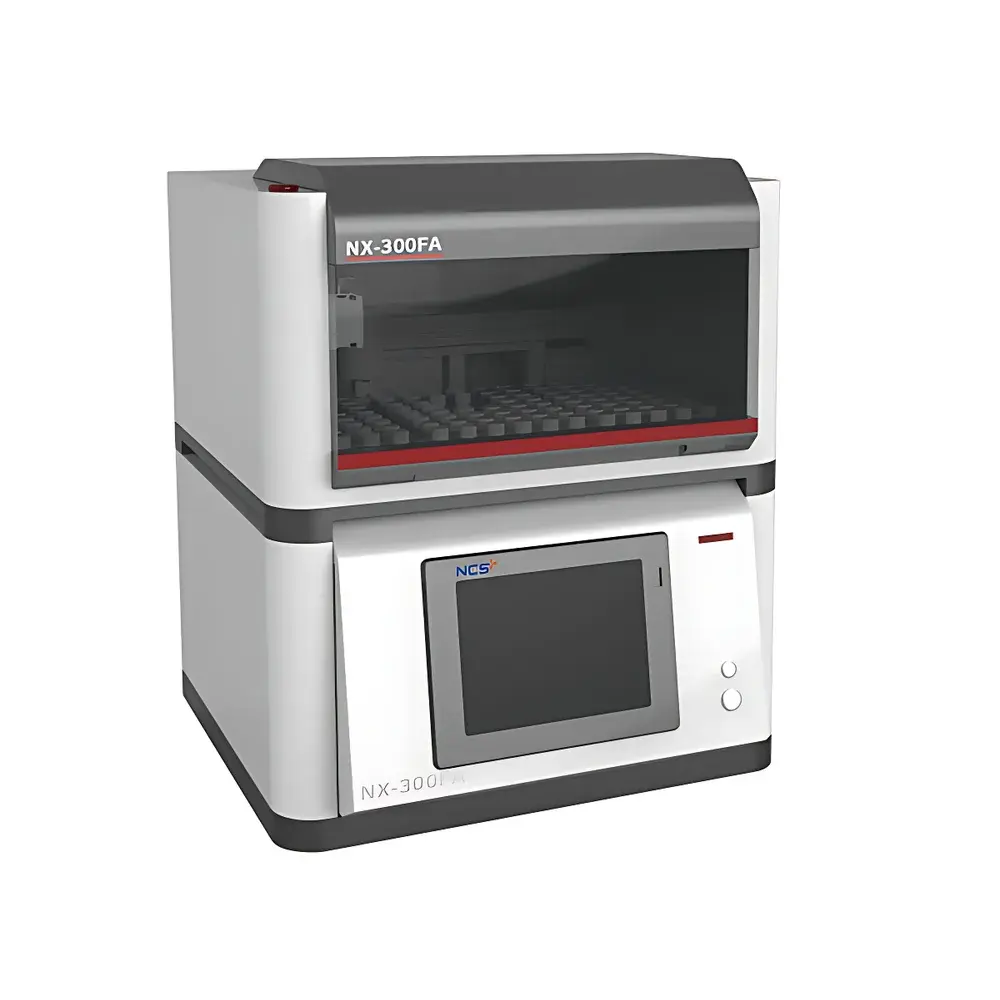
NCS NX-300FA Food Safety Heavy Metal Analyzer
| Brand | NCS (China Iron and Steel Research Institute Group) |
|---|---|
| Origin | Beijing, China |
| Manufacturer | Yes |
| Country of Origin | China |
| Model | NX-300FA |
| Pricing | Upon Request |
| Detection Principle | Energy-Dispersive X-ray Fluorescence (EDXRF) |
| Sample Throughput | Up to 84 samples unattended |
| Analysis Time | 3 min (Cd screening), 10 min (Cd quantification), 6 min (multi-element screening), 20 min (multi-element quantification) |
| Detection Limits | Cd ≤ 0.038 mg/kg, Se ≤ 0.048 mg/kg |
| Linear Range | Cd 0.038–2.6 mg/kg, Se 0.048–2.0 mg/kg |
| Precision (RSD) | Cd ≤ 5%, Se ≤ 10% |
| Reproducibility | Absolute difference between two independent measurements ≤ 20% of mean |
| Radiation Safety | Compliant with GBZ 115–2002 (Chinese national standard for radiation protection of XRF instruments) |
| Sample Form | Direct analysis of powdered or granular cereal grains and processed food matrices |
| Elements Supported | Cd, Pb, As, Cr, Hg, Se |
| Regulatory Alignment | Designed for compliance with GB 2762–2022 (Chinese National Standard for Contaminants in Foods), aligned with ISO 13253:2012 (EDXRF for metals in food), and supports audit-ready data handling per GLP/GMP principles |
Overview
The NCS NX-300FA Food Safety Heavy Metal Analyzer is a benchtop energy-dispersive X-ray fluorescence (EDXRF) spectrometer engineered for regulatory-grade screening and quantification of toxic and essential elements in cereal grains and processed food commodities. Unlike wet-chemistry or ICP-based methods requiring digestion, acid reagents, and laboratory infrastructure, the NX-300FA enables direct solid-sample analysis—eliminating sample preparation, consumables, and hazardous waste generation. Its core measurement principle relies on primary X-ray excitation from a microfocus X-ray tube, followed by spectral discrimination of characteristic fluorescent X-rays emitted by target elements (Cd, Pb, As, Cr, Hg, Se) using a high-resolution FastSDD (Silicon Drift Detector). The system integrates a precision collimation and filter selection module to optimize signal-to-background ratio for low-concentration heavy metals in complex organic matrices. Designed specifically for grain inspection environments—including national grain reserves, procurement stations, milling facilities, and food safety laboratories—the instrument meets the operational demands of field-deployable accuracy, robustness against ambient temperature/humidity fluctuations, and minimal operator dependency.
Key Features
- 84-position robotic autosampler enabling fully unattended batch analysis—reducing labor input and human error while maintaining traceable sample positioning.
- Direct analysis capability for intact powders and granules (e.g., brown rice, milled wheat, soybeans, corn grits); no grinding, sieving, or chemical digestion required.
- Zero-consumable operation: no gases, acids, standards, or calibration kits needed beyond initial factory certification; powered solely by standard AC supply.
- Modular mechanical design: autosampler and main spectrometer unit feature rapid tool-free coupling/decoupling—validated for secure transport in standard sedans without shock-sensitive recalibration.
- Integrated all-in-one workstation: 15.6″ industrial touchscreen PC embedded within the instrument chassis, eliminating external cabling and peripheral dependencies.
- Triple-layer radiation safety architecture: physical labyrinth shielding, hardware interlock circuits that terminate X-ray emission upon door opening, and software-enforced beam gating with real-time exposure logging.
- Automated workflow resilience: power-fail recovery preserves measurement state and resumes analysis at the exact interrupted sample position; auto-save functionality captures full spectral and metadata logs every 30 seconds.
Sample Compatibility & Compliance
The NX-300FA is validated for use across staple food matrices defined in GB 2762–2022 and Codex Alimentarius STAN 193–1995, including paddy rice, polished rice, brown rice, wheat kernels, maize, barley, oats, soybeans, lentils, and their milled derivatives (e.g., flour, bran, meal). It demonstrates matrix-matched performance under variable moisture content (10–15% w/w) and bulk density conditions typical of silo-stored grain. Instrumental output complies with ISO 13253:2012 (EDXRF determination of metals in foodstuffs) and supports method validation per AOAC Official Method 2019.01 (for Cd and Pb in cereals). Data integrity features—including user role-based access control (administrator/operator tiers), electronic signature support, and immutable audit trails—facilitate alignment with GLP and GMP documentation requirements. Radiation emissions are certified below 1 µSv/h at 5 cm distance, exceeding GBZ 115–2002 limits by a factor of ≥3.
Software & Data Management
The proprietary NCS FoodScan™ software provides dual-mode operation: rapid pass/fail screening (threshold-based flagging per GB 2762 limits) and quantitative reporting with internal standard correction and matrix normalization algorithms. All spectra are stored in vendor-neutral .spe format with embedded metadata (sample ID, timestamp, operator, instrument serial, environmental sensor readings). Reporting templates are configurable in Excel (.xlsx) or PDF, with automatic inclusion of uncertainty estimates, calibration history, and QC check results. Barcode/QR code scanning integrates seamlessly with LIMS via RS-232 or Ethernet TCP/IP protocols. Software enforces 21 CFR Part 11–compatible controls: electronic signatures, session lockout after 15 minutes of inactivity, and tamper-evident log files archived daily to encrypted network storage.
Applications
- Grain procurement quality control: real-time Cd/Pb verification at elevator intake points to enforce contractual limits.
- Storage facility monitoring: longitudinal tracking of elemental accumulation during long-term warehousing under varying humidity/temperature regimes.
- Food processing line release testing: verification of raw material conformity prior to milling, extrusion, or blending operations.
- Regulatory surveillance: official testing by provincial grain inspection centers supporting national food safety risk assessment programs.
- Research applications: nutritional profiling (e.g., Se bioavailability studies), soil-to-grain transfer modeling, and cultivar screening for low-accumulating traits.
FAQ
Does the NX-300FA require annual recalibration by a certified service engineer?
No. The instrument employs a self-referencing internal calibration source and drift-compensation algorithms. Annual verification against NIST-traceable reference materials (e.g., SRM 1568b Rice Flour) is recommended but not mandatory for routine operation.
Can the system analyze liquid or viscous samples such as cooking oil or fruit juice?
Not natively. The NX-300FA is optimized for dry, particulate, or powdered solids. Liquid analysis requires pre-concentration onto filter substrates—a protocol outside its validated scope.
Is method transfer possible from ICP-MS or AAS workflows?
Yes. NCS provides cross-platform correlation reports demonstrating equivalence for Cd and Pb in cereal matrices (r² ≥ 0.985, bias < ±8% vs. ICP-MS), facilitating regulatory acceptance of EDXRF data in lieu of wet chemistry.
What cybersecurity safeguards are implemented in the embedded operating system?
The device runs a locked-down Windows IoT Enterprise image with disabled USB mass storage, disabled remote desktop, and automatic monthly security patching via authenticated firmware updates.
How is measurement uncertainty estimated for each reported result?
Uncertainty is calculated per GUM (JCGM 100:2008) using Type A (repeatability RSD) and Type B (calibration curve fit, detector resolution, matrix correction error) components, displayed alongside concentration values in all reports.





