
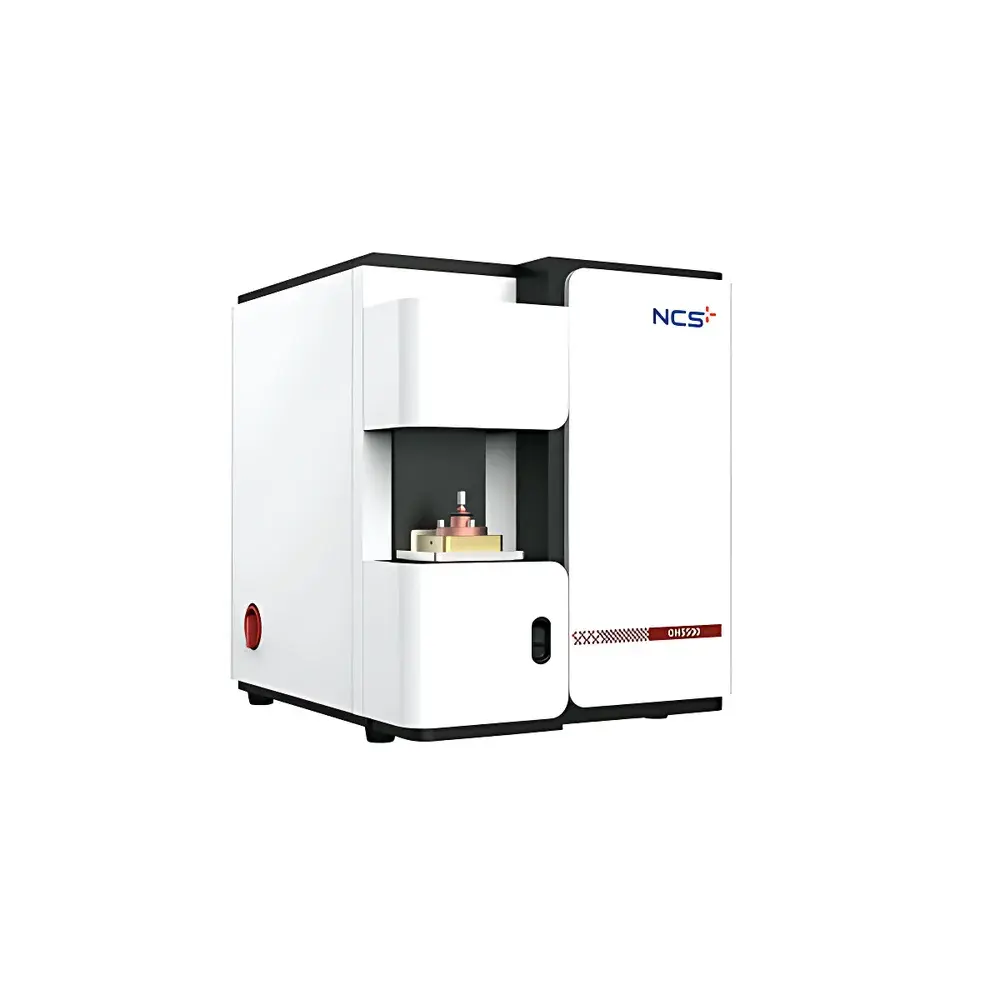
NCS OH5500 Oxygen-Hydrogen Analyzer
| Brand | NCS |
|---|---|
| Origin | Beijing, China |
| Manufacturer | NCS (Beijing Central Iron and Steel Research Institute) |
| Model | OH5500 |
| Instrument Type | Oxygen-Hydrogen Analyzer |
| Oxygen Range | Low-O: 0.1 ppm – 0.5 wt% |
| High-O | 0.5 wt% – 20 wt% |
| Hydrogen Range | Low-H: 0.1 ppm – 200 ppm |
| High-H | 200 ppm – 5000 ppm |
| Accuracy | O₂: ±1 ppm or ±1.0% RSD |
| H₂ | ±0.2 ppm or ±2.0% RSD |
| Sensitivity | 0.01 ppm |
| Analysis Time | 3 min |
| Pulse Furnace | 0–1500 A, 7.5 kVA, max. temp. 3500 °C |
| Detection Principle | Non-Dispersive Infrared (NDIR) for oxygen |
| Carrier Gas | Ultra-high-purity N₂ (≥99.9995%) |
| Sample Mass | Typically 1 g (adjustable to extend range) |
| Dimensions | 63 cm × 76 cm × 76 cm (W×D×H) |
| Weight | ~180 kg |
Overview
The NCS OH5500 Oxygen-Hydrogen Analyzer is a high-performance solid-state elemental analyzer engineered for precise, simultaneous quantification of oxygen and hydrogen in inorganic materials—including ferrous and non-ferrous metals, metal powders, ceramics, refractories, and geological samples. Based on vacuum inert-gas fusion coupled with dual detection technology, the instrument thermally decomposes samples in a graphite crucible under high-purity nitrogen atmosphere using a high-power pulse-heated furnace (up to 3500 °C). Released oxygen forms CO, which is oxidized to CO₂ and measured via non-dispersive infrared (NDIR) detection; hydrogen is quantified directly as H₂ gas using a high-stability thermal conductivity detector (TCD). This physical separation of analyte pathways ensures minimal cross-interference and supports full-range analysis across four decades—from sub-ppm to several weight percent—without manual reconfiguration.
Key Features
- Integrated dual-detection architecture: NDIR for oxygen (CO₂ channel) and TCD for hydrogen (H₂ channel), each optimized for dynamic range, linearity, and long-term baseline stability.
- Pulse-heated graphite furnace with programmable current control (0–1500 A) and rated power of 7.5 kVA, enabling rapid, reproducible melting of refractory and high-melting-point samples (e.g., tungsten, molybdenum, silicon carbide).
- Low-dead-volume, low-flow gas circuit design minimizes carrier gas consumption (≤40 mL/min during analysis) while maintaining robust purge efficiency and reducing background drift.
- Automated dual-range switching: software-controlled valve sequencing enables seamless transition between low-concentration (ppm-level) and high-concentration (wt%-level) measurement modes within a single run.
- Real-time system diagnostics: automated leak-check routines, pressure monitoring at critical nodes (furnace chamber, IR cell, TCD cell), and temperature profiling of furnace zones ensure operational integrity prior to and during analysis.
- Critical components—including IR source, detector, TCD filaments, and high-temperature graphite crucibles—are sourced from internationally certified suppliers to meet ISO 9001-compliant manufacturing and lifetime reliability targets (>10,000 analyses per crucible set under standard conditions).
Sample Compatibility & Compliance
The OH5500 accommodates solid, non-volatile inorganic matrices with minimal pretreatment. Standard sample mass is 1.0 g; reduced masses (0.1–0.5 g) extend upper detection limits for high-content applications (e.g., hydrogen in titanium alloys), while increased masses (up to 2.0 g) enhance sensitivity for ultra-trace oxygen in superalloys. The system complies with ASTM E1447 (Standard Test Method for Determination of Hydrogen in Titanium and Titanium Alloys), ASTM E1019 (Standard Test Methods for Determination of Carbon, Sulfur, Nitrogen, and Oxygen in Steel, Iron, Nickel, and Cobalt Alloys), and ISO 22036 (Rubber—Determination of oxygen and hydrogen by inert gas fusion). Full audit trail, user access control, electronic signatures, and data immutability features support compliance with FDA 21 CFR Part 11 and GLP/GMP laboratory requirements when configured with validated software modules.
Software & Data Management
NCS FusionControl™ v4.2 provides intuitive method setup, real-time signal visualization (IR absorbance, TCD voltage, furnace current/temperature), and automated calibration curve generation using certified reference materials (CRMs) traceable to NIST SRMs. All raw signals, integration parameters, and system logs are stored in a relational SQLite database with timestamped metadata. Export options include CSV, PDF analytical reports, and XML for LIMS integration. Software validation documentation (IQ/OQ/PQ protocols), change control records, and version history are provided to support regulated environments. Remote monitoring via secure HTTPS interface allows centralized fleet management without compromising data sovereignty.
Applications
- Quality control of aerospace-grade titanium, nickel-based superalloys, and zirconium alloys where hydrogen embrittlement thresholds are below 50 ppm.
- Process validation in additive manufacturing (AM) powder supply chains—monitoring oxygen pickup during atomization and storage.
- Research into hydrogen storage materials (e.g., MgH₂, complex hydrides) requiring accurate quantification across both stoichiometric and defect-driven H-content regimes.
- Geological sample analysis (e.g., olivine, garnet) for mantle geochemistry studies demanding sub-ppm oxygen precision in silicate matrices.
- Failure analysis labs performing root-cause investigation of brittle fracture in high-strength steels linked to interstitial oxygen or hydrogen segregation.
FAQ
What carrier gas is required, and what purity specifications must it meet?
Ultra-high-purity nitrogen (≥99.9995% N₂, ≤0.5 ppm O₂, ≤0.1 ppm H₂O) is mandatory. Optional helium carrier mode is available for specialized applications upon hardware configuration.
Can the OH5500 analyze liquid or organic samples?
No. The instrument is designed exclusively for solid, thermally stable, non-volatile inorganic materials. Volatile, halogenated, or carbon-rich organics may damage the furnace or contaminate the gas path.
Is calibration traceable to international standards?
Yes. Calibration is performed using NCS-certified CRMs with uncertainty statements traceable to NIST SRMs (e.g., NIST SRM 660c for oxygen, NIST SRM 679 for hydrogen) and accredited per ISO/IEC 17025.
How frequently does the graphite crucible require replacement?
Under routine operation (10 analyses/day, 1 g steel samples), crucible lifetime exceeds 10,000 cycles. Lifetime decreases with refractory samples (e.g., Ta, Nb) or high-oxygen-content ceramics; furnace temperature profiling and post-analysis ash inspection are recommended for predictive maintenance.
Does the system support automated sample changers?
Yes. The OH5500 is compatible with the NCS AutoSampler AS-24, enabling unattended 24-position analysis with integrated weigh station synchronization and CRM bracketing protocols.





