
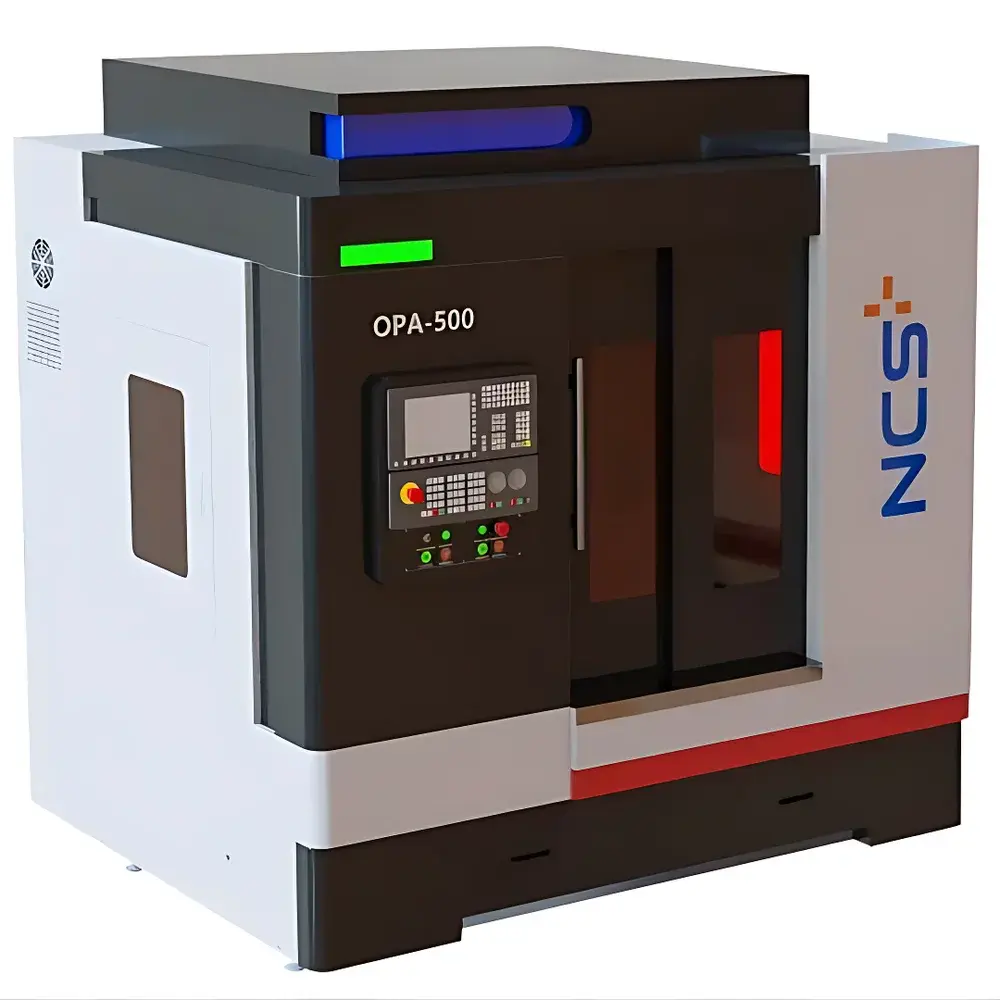
NCS OPA-500 In-Situ Statistical Distribution Analyzer for Large-Scale Metallic Components
| Brand | NCS (China Iron and Steel Research Institute Group) |
|---|---|
| Model | OPA-500 |
| Optical System | Czerny-Turner spectrometer with 500 mm focal length |
| Grating | 2700 lines/mm |
| Linear dispersion | 0.7407 nm/mm |
| Spectral resolution | ≤0.01 nm |
| Wavelength range | 160–650 nm |
| Excitation source | High-stability continuous spark source, no pre-burn required |
| Data acquisition rate | 100 kHz |
| Scanning platform | Siemens CNC-controlled 3-axis system (X: 360 mm, Y: 247 mm, Z: 350 mm) |
| Positioning accuracy (bidirectional) | X-axis ±0.016/±0.010 mm, Y/Z-axis ±0.012/±0.010 mm |
| Repeatability (bidirectional) | ±0.008/±0.006 mm (X/Y/Z) |
| Maximum scan area | 300 × 200 mm |
| Sample weight capacity (uniform load) | 200 kg |
| Compressed air requirement | 0.6 MPa |
| Power supply | 220 VAC ±10%, 50 Hz |
| Dimensions (W×D×H) | 1929 × 1428 × 2016 mm |
| Scan patterns | Rectangular, circular, cross (“rice”), sector, and custom-defined contours |
| Data interface | Ethernet |
| Software compliance | Supports audit trail, user access control, and electronic signature per FDA 21 CFR Part 11 requirements |
Overview
The NCS OPA-500 In-Situ Statistical Distribution Analyzer is a purpose-built spectroscopic instrumentation platform engineered for quantitative elemental mapping and microstructural heterogeneity assessment across large-scale metallic components—up to 300 × 200 mm in planar dimension. Unlike conventional bulk or point-wise analytical spectrometers, the OPA-500 implements Original Position Analysis (OPA), a patented in-situ statistical distribution methodology developed under China’s National Major Scientific Instrument Development Program. It combines high-throughput spark emission spectroscopy with precision CNC-driven spatial scanning to acquire statistically robust, position-resolved spectral data without sample sectioning, polishing, or vacuum chamber constraints. The instrument operates on the principle of continuous, non-preburn spark excitation across the native surface of conductive metallic samples, capturing single-discharge spectra at up to 100 kHz sampling frequency. Each discharge event is spatially registered via synchronized encoder feedback from the three-axis Siemens motion control system, enabling direct correlation between spectral intensity and Cartesian coordinate (X,Y). This architecture supports rigorous statistical treatment of elemental concentration distributions—including skewness, kurtosis, and spatial autocorrelation—essential for evaluating macrosegregation, dendritic arm spacing, and inclusion clustering in structural alloys used in rail transportation, energy infrastructure, and aerospace forging.
Key Features
- Full-field in-situ elemental quantification: Delivers calibrated mass fraction (wt%) values at every measured coordinate within the 300 × 200 mm scan area, traceable to certified reference materials (CRMs) and validated per ISO/IEC 17025 procedures.
- Multi-parameter heterogeneity metrics: Computes segregation index (SI), conformity index (CI), and porosity-related dispersion parameters directly from positionally tagged spectral datasets using embedded statistical models compliant with ASTM E2902 (Standard Guide for Statistical Analysis of Spectrochemical Data).
- Automated inclusion characterization: Leverages boundary-diffusion discharge signatures to classify non-metallic inclusions (e.g., Al₂O₃, MnS, CaO–Al₂O₃–SiO₂ systems) by composition, size distribution (0.5–100 µm), and spatial density—without SEM/EDS corroboration.
- Adaptive contour scanning: Integrates real-time topographic simulation to maintain consistent spark gap (0–120 mm) over curved, inclined, or irregular surfaces—enabling analysis of forged wheels, rolled plates, and welded joints in as-received condition.
- Integrated metrological traceability: Onboard wavelength calibration using Hg/Ne lamp references; intensity normalization via internal standard lines (e.g., Fe I 404.58 nm); drift compensation through periodic reference pulse injection.
Sample Compatibility & Compliance
The OPA-500 accepts flat or moderately contoured metallic specimens—ferrous and non-ferrous—including carbon steels, stainless grades, aluminum alloys, titanium billets, and nickel-based superalloys. No conductive coating or vacuum compatibility is required. Sample preparation is limited to surface cleaning (e.g., acetone wipe) to remove oxides and oils; no metallographic polishing is necessary. The system conforms to electromagnetic compatibility (EMC) standards IEC 61326-1 and safety requirements IEC 61010-1. All software operations—including method creation, data export, and report generation—support ALCOA+ principles (Attributable, Legible, Contemporaneous, Original, Accurate, Complete, Consistent, Enduring, Available) and are fully compatible with GLP/GMP environments requiring 21 CFR Part 11 compliance. Audit trails record operator ID, timestamp, parameter changes, and raw spectral file checksums.
Software & Data Management
The proprietary OPA Studio v4.x software suite provides end-to-end workflow automation: from scan path definition and real-time spectral preview to multivariate statistical modeling and ISO-standardized reporting. Data are stored in HDF5 format with embedded metadata (coordinate maps, acquisition parameters, calibration history). Visualization modules generate frequency histograms, 1D line scans, 2D heatmaps (elemental concentration gradients), and 3D isosurface reconstructions. Batch processing enables comparative analysis across multiple samples using PCA, hierarchical clustering, or spatial autocorrelation functions (Moran’s I). Export options include CSV, PDF reports compliant with ISO 14284 (steel—determination of inclusion content), and XML files for LIMS integration. Role-based access control (RBAC) enforces separation of duties between analysts, reviewers, and administrators.
Applications
- Macrosegregation assessment in heavy-section castings and ingots per ASTM E1122 and ISO 11699.
- Anisotropy quantification in hot-rolled plates and extruded profiles via directional elemental variance mapping.
- High-throughput materials genomics screening: Rapid statistical mapping of composition–structure–property linkages across combinatorial alloy libraries.
- Quality gate verification for critical railway components (e.g., axle forgings, bogie frames) where local chemistry deviations exceed ±0.03 wt% C or ±0.1 wt% Mn trigger rejection.
- Inclusion engineering validation: Correlating inclusion type/distribution with fatigue crack initiation sites in bearing steels per ISO 4967.
FAQ
What sample preparation is required prior to OPA-500 analysis?
Minimal preparation: mechanical cleaning to remove surface contaminants and oxide layers. No polishing, coating, or vacuum conditioning is needed.
Can the OPA-500 analyze coated or plated metals?
Yes—provided the coating thickness is ≤5 µm and electrically conductive; thicker or insulating coatings require localized removal at measurement locations.
How does the system ensure long-term measurement stability?
Through daily automated wavelength calibration, internal standard line monitoring, and thermal management of the optical bench (±0.1°C stabilization).
Is remote operation supported?
Yes—via secure TLS-encrypted Ethernet connection; full instrument control, live spectral streaming, and report generation are accessible through browser-based client.
Does the OPA-500 support method transfer between laboratories?
Yes—methods include embedded calibration coefficients, CRM assignment logic, and spectral preprocessing parameters, ensuring reproducibility across multi-site deployments under ISO/IEC 17025 accreditation.
Related Products




