
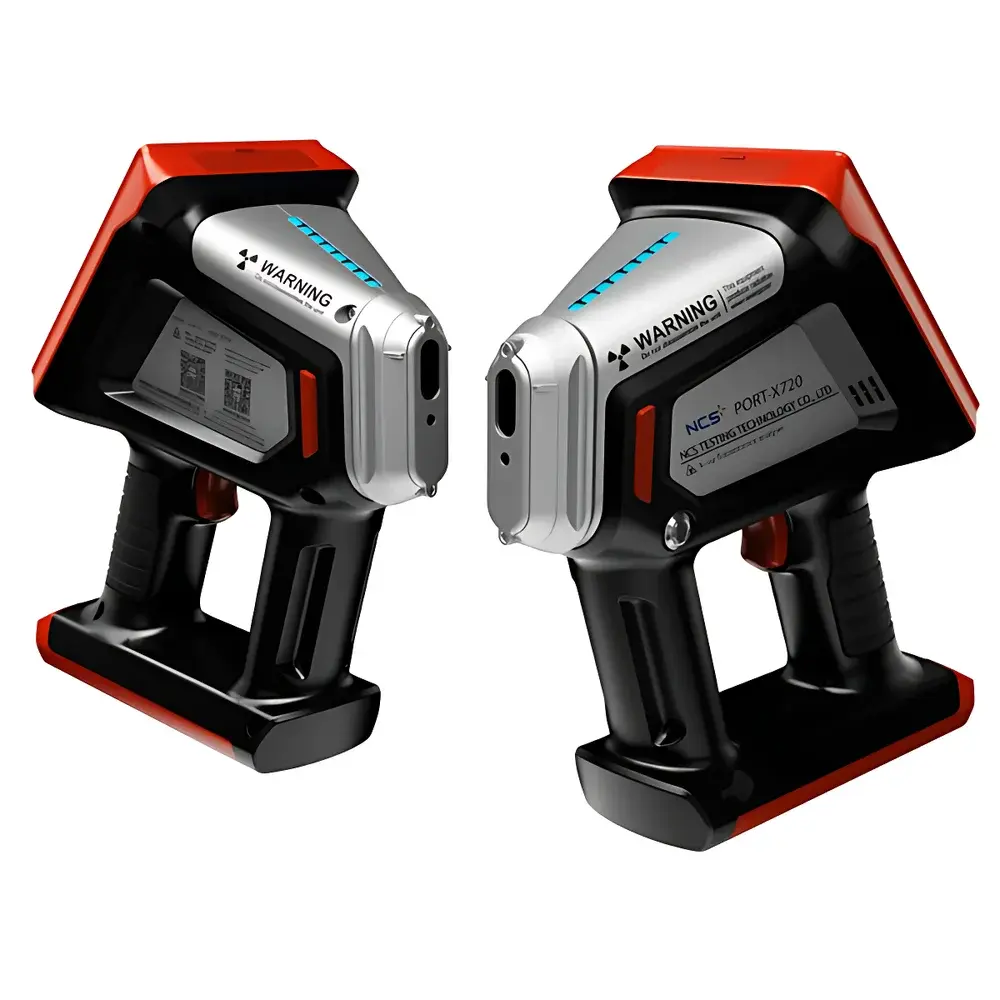
NCS PORT-X720 Handheld Energy Dispersive X-Ray Fluorescence Spectrometer
| Brand | NCS |
|---|---|
| Origin | Jiangsu, China |
| Manufacturer Type | Manufacturer |
| Product Type | Handheld/Portable |
| Model | PORT-X720 |
| X-ray Tube | 5 W, 50 kV, 200 µA max |
| Anode Material | Rhodium (Rh) |
| Detector | Silicon Drift Detector (SDD) |
| Energy Resolution | ≤155 eV |
| Operating Temperature | −10 °C to 50 °C |
| Dimensions | 240 × 110 × 240 mm |
| Weight | 1.6 kg |
| Measurement Elements | Mg to U |
| Battery | Dual 7.4 V / 9600 mAh Li-ion |
| Runtime | ≥10 h |
| Processor | Qualcomm Snapdragon™ Octa-core (14 nm FinFET), 2.0 GHz, 1 MB L2 cache |
| OS | Android 7.1 |
| Display | 5.5-inch Full HD (1080p) touchscreen |
| Connectivity | Wi-Fi 802.11 a/b/g/n/ac, Bluetooth 4.2/LE, USB |
| Radiation Safety | Integrated shutter, sample proximity sensor, password-protected startup, regulatory compliance per CNAS and GBZ 188–2014 |
| Analysis Algorithm | Fundamental Parameters (FP) method with user-customizable method development capability |
Overview
The NCS PORT-X720 Handheld Energy Dispersive X-Ray Fluorescence (ED-XRF) Spectrometer is an industrial-grade field analytical instrument engineered for rapid, non-destructive elemental composition analysis of metallic alloys in situ. Based on the physical principle of energy-dispersive X-ray fluorescence—where primary X-rays from a Rh-anode microfocus tube excite characteristic secondary X-ray emissions from sample atoms—the PORT-X720 quantifies elemental concentrations by measuring photon energies and intensities with high-resolution silicon drift detection (SDD). Its optimized optical path, thermally stabilized detector housing, and real-time pulse processing architecture ensure consistent spectral fidelity across ambient temperature fluctuations (−10 °C to 50 °C). Designed for metallurgical QA/QC, scrap sorting, and incoming material verification, the system delivers laboratory-grade repeatability without requiring sample preparation or vacuum environments.
Key Features
- High-performance Rh-target X-ray source (50 kV, 5 W, 200 µA max) delivering stable excitation for light elements (Mg–Al–Si) through heavy metals (Ni–Cu–Zn–Mo–W–Pb–U)
- Silicon drift detector (SDD) with ≤155 eV Mn-Kα resolution at 0 °C, enabling precise peak deconvolution in complex alloy matrices
- Fundamental Parameters (FP)-based quantification engine, pre-calibrated for stainless steels, low-alloy steels, aluminum alloys, copper-based alloys (brass, bronze), and nickel superalloys
- Ergonomic dual-handled chassis (240 × 110 × 240 mm, 1.6 kg) eliminating need for external stands; integrated calibration reference and beam collimation shield
- Industrial-grade thermal management system maintaining detector stability during prolonged operation in elevated ambient conditions
- Android 7.1 operating system with 5.5-inch 1080p capacitive touchscreen, intuitive icon-driven workflow, and on-device report generation
- Dual 7.4 V / 9600 mAh Li-ion battery pack supporting >10 h continuous operation and hot-swap charging—enabling uninterrupted measurement during shift transitions
- Comprehensive radiation safety architecture: mechanical shutter interlocked with sample proximity sensor, firmware-enforced password access, and certified compliance with GBZ 188–2014 occupational exposure limits
Sample Compatibility & Compliance
The PORT-X720 is validated for direct analysis of solid metallic samples ≥5 mm thick, including castings, forgings, sheet stock, and scrap fragments. Surface roughness and curvature are compensated via built-in geometry correction algorithms. It meets ISO 21043-1:2021 (XRF instrumentation performance criteria) and aligns with ASTM E1621–22 (Standard Guide for XRF Elemental Analysis of Metals) for quantitative accuracy in alloy identification. The instrument’s FP algorithm supports traceability under GLP and GMP frameworks, with audit-ready data logs—including operator ID, timestamp, GPS coordinates (optional), and raw spectrum metadata—stored locally and exportable via encrypted USB or secure Wi-Fi transfer. Regulatory documentation includes CNAS-accredited type testing reports and Class II radiation device registration per Chinese NMPA requirements.
Software & Data Management
The embedded Android application provides full control over acquisition parameters (voltage, current, live time), spectral visualization (real-time ROI overlays), and method selection. Preloaded libraries contain ≥800 standardized alloy grades (e.g., AISI/SAE, UNS, EN, GB/T), each with certified reference ranges for major and minor constituents. Users may develop custom methods using the integrated method editor, defining element-specific calibration curves, matrix corrections, and grade-matching logic. All spectra and results are stored in SQLite format with SHA-256 hash integrity verification. Data export supports CSV, PDF (with digital signature), and XML formats compliant with LIMS integration standards (ASTM E1482, ISO/IEC 17025 Annex A.2). Firmware updates are delivered OTA or via SD card, with version-controlled rollback capability.
Applications
- Raw material inspection: Verification of mill test reports against delivered heats; detection of out-of-spec Cr/Ni/Mo in austenitic stainless steels
- Scrap metal sorting: Discrimination of 304 vs. 316 stainless, Monel 400 vs. Inconel 600, or leaded brass vs. naval brass based on multi-element fingerprinting
- Manufacturing process control: On-line verification of weld filler composition, plating thickness estimation (via ratio analysis), and heat-treat verification via residual Al/Si segregation
- Regulatory compliance screening: RoHS-compliant Pb/Cd/Hg/Cr⁶⁺/Br screening in finished components per IEC 62321-5
- Forensic metallurgy: Failure analysis support through localized inclusion mapping and intergranular segregation assessment
FAQ
Does the PORT-X720 require daily calibration checks?
No—factory calibration remains stable for ≥6 months under normal use. A quick verification using the integrated Cr–Fe–Ni reference standard is recommended before each shift.
Can it analyze coated or painted surfaces?
Yes, provided coating thickness is <25 µm and substrate is metallic; FP modeling accounts for attenuation effects in thin organic or oxide layers.
Is spectral data export compatible with third-party chemometric software?
Yes—raw spectrum files (.spe) include full energy-channel intensity arrays and detector calibration coefficients, enabling import into MATLAB, Unscrambler®, or Python-based PyMca workflows.
What radiation safety certifications does it hold?
It complies with GBZ 188–2014 (China), IEC 61010-1:2010 (safety), and IEC 62495:2010 (radiation protection for portable XRF), with type-test reports issued by SGS Shanghai and CNAS-accredited labs.
How is measurement uncertainty estimated for unknown alloys?
Uncertainty propagation follows ISO/IEC Guide 98-3 (GUM), incorporating counting statistics, FP model error, and matrix effect residuals—reported as expanded uncertainty (k=2) in all generated certificates.
Related Products






