
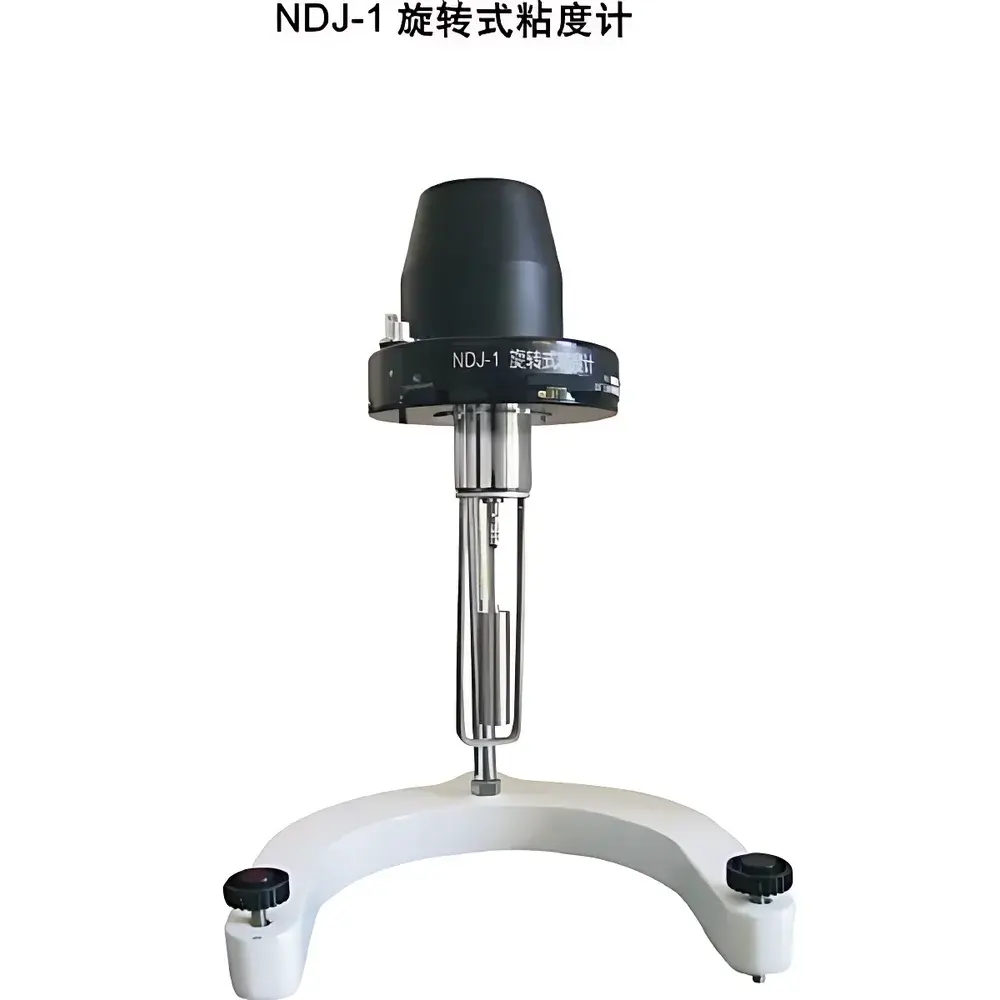
NDJ-1 Rotational Viscometer
| Origin | Shanghai, China |
|---|---|
| Manufacturer Type | Authorized Distributor |
| Origin Category | Domestic (China) |
| Model | NDJ-1 |
| Quotation | Available Upon Request |
| Viscosity Range | 10–100,000 mPa·s |
| Rotors | Four interchangeable spindles (No. 1–4) |
| Speed Settings | 6, 12, 30, and 60 rpm |
| Accuracy | ±5% for Newtonian liquids |
| Power Supply | 220 V ±10%, 50 Hz ±0.5 Hz |
| Operating Environment | 5–35 °C, ≤80% RH |
| Dimensions (L×W×H) | 300 × 300 × 450 mm |
| Net Weight | 1.5 kg (excluding stand) |
Overview
The NDJ-1 Rotational Viscometer is a mechanically driven, analog-scale instrument engineered for reliable measurement of dynamic viscosity in Newtonian and near-Newtonian liquids. Based on the principle of rotational drag torque—where a spindle rotates at a fixed speed within the sample and the resisting torque is translated into viscosity via calibrated spring deflection—the NDJ-1 delivers direct, real-time analog readouts without digital signal processing or temperature compensation. Its design follows classical Couette flow geometry, with concentric cylindrical geometry between the rotating spindle and stationary sample cup, enabling reproducible shear-rate-dependent characterization under controlled mechanical conditions. While not suitable for complex fluid rheology (e.g., yield stress, thixotropy, or time-dependent behavior), the NDJ-1 provides consistent baseline viscosity data for routine QC applications across industrial laboratories where cost-effectiveness, operational simplicity, and mechanical robustness are prioritized over advanced rheological modeling.
Key Features
- Mechanically robust analog gauge system with zero-backlash pointer mechanism for stable, drift-free readings
- Four standardized spindles (No. 1–4) optimized for progressive viscosity ranges—enabling coverage from low-viscosity solvents to medium-thick pastes
- Discrete-speed motor drive with four fixed rotational speeds (6, 12, 30, and 60 rpm), ensuring repeatable shear rate selection without variable-frequency electronics
- Self-contained benchtop configuration with integrated leveling feet and detachable support stand for flexible lab placement
- No software dependency or firmware updates required—ideal for environments with restricted IT infrastructure or legacy compliance requirements
- Compliance-ready mechanical architecture: All calibration traceability paths align with ISO 2555 and ASTM D2196 standard practices for rotational viscometry
Sample Compatibility & Compliance
The NDJ-1 accommodates liquid and semi-liquid samples with minimal thermal sensitivity and no volatile or corrosive constraints—provided they remain stable during static immersion and mechanical agitation. Compatible sample types include mineral oils, alkyd resins, aqueous polymer solutions, edible oils, pharmaceutical syrups, and adhesive preforms. Sample volume requirement is 20–30 mL depending on spindle geometry. The instrument meets general laboratory safety standards per IEC 61010-1 and is routinely deployed in settings requiring adherence to GLP documentation protocols. While the NDJ-1 itself does not generate electronic audit trails, its analog output supports manual recording in paper-based or hybrid QC logbooks compliant with FDA 21 CFR Part 11 Annex 11 (when paired with defined SOPs for operator verification and calibration logging). It is widely accepted in ISO/IEC 17025-accredited testing labs for routine viscosity verification where full digital traceability is not mandated.
Software & Data Management
The NDJ-1 operates entirely without embedded software, firmware, or connectivity interfaces. All measurements are recorded manually using the front-panel analog scale calibrated in mPa·s. Users maintain data integrity through standardized lab notebooks, printed calibration certificates (traceable to national metrology institutes), and periodic mechanical verification using certified silicone oil standards (e.g., Cannon N47, N100, N500). For labs transitioning toward digital workflows, third-party optical digitization tools (e.g., high-resolution camera + OCR-assisted reading systems) may be employed—but such integration lies outside the instrument’s native scope. Calibration frequency follows ISO 17025 Clause 6.5 guidelines: recommended every 6 months or after 200 operational hours, whichever occurs first.
Applications
- Quality control of lubricating oils and hydraulic fluids in petrochemical refineries
- Batch consistency verification of paint and coating formulations prior to spray application
- Viscosity screening of food-grade emulsions (e.g., salad dressings, chocolate masses) under ambient processing conditions
- Routine assessment of topical pharmaceutical gels and ointments per USP guidance
- Educational use in university physical chemistry and materials science laboratories for introducing fundamental viscometric principles
- Pre-screening of adhesive viscosity before dispensing system setup in electronics assembly lines
FAQ
Is the NDJ-1 suitable for non-Newtonian fluid characterization?
No. The NDJ-1 assumes linear viscosity-shear rate relationships and lacks programmable shear ramping or oscillatory capabilities required for yield stress, creep, or viscoelastic analysis.
Can it be calibrated against NIST-traceable standards?
Yes—certified reference oils (e.g., Cannon, Lovis, or Brookfield standard oils) with documented uncertainty budgets are used for two-point verification across the 10–100,000 mPa·s range.
What maintenance is required beyond routine cleaning?
Annual mechanical inspection of the torsion spring, bearing play, and gear train alignment is recommended; spindle threads must be cleaned after each use to prevent cross-contamination.
Does it comply with current GMP documentation requirements?
It supports GMP when used within a validated SOP framework—including defined calibration intervals, operator training records, and manual entry logs reviewed by QA personnel.
Is temperature control integrated?
No. External water baths or Peltier-controlled sample holders must be used for temperature-dependent measurements; the instrument itself has no thermal regulation capability.



