
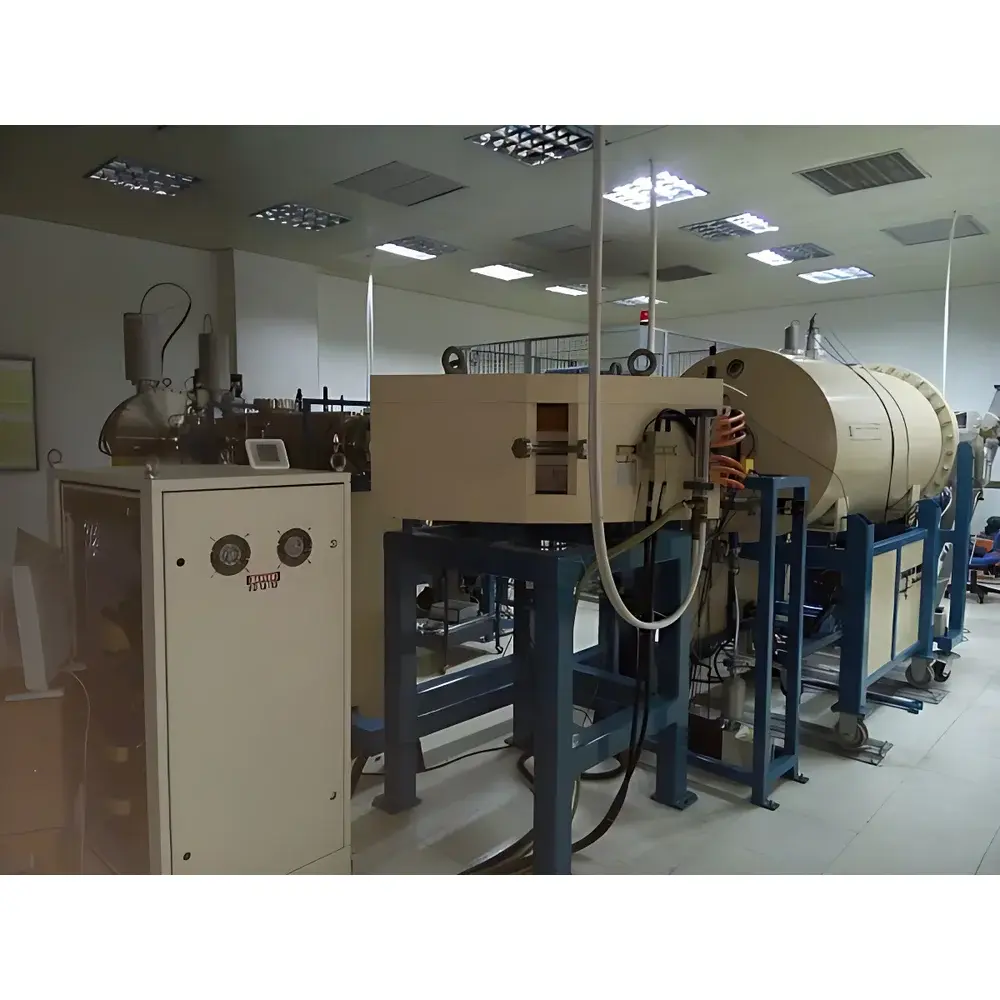
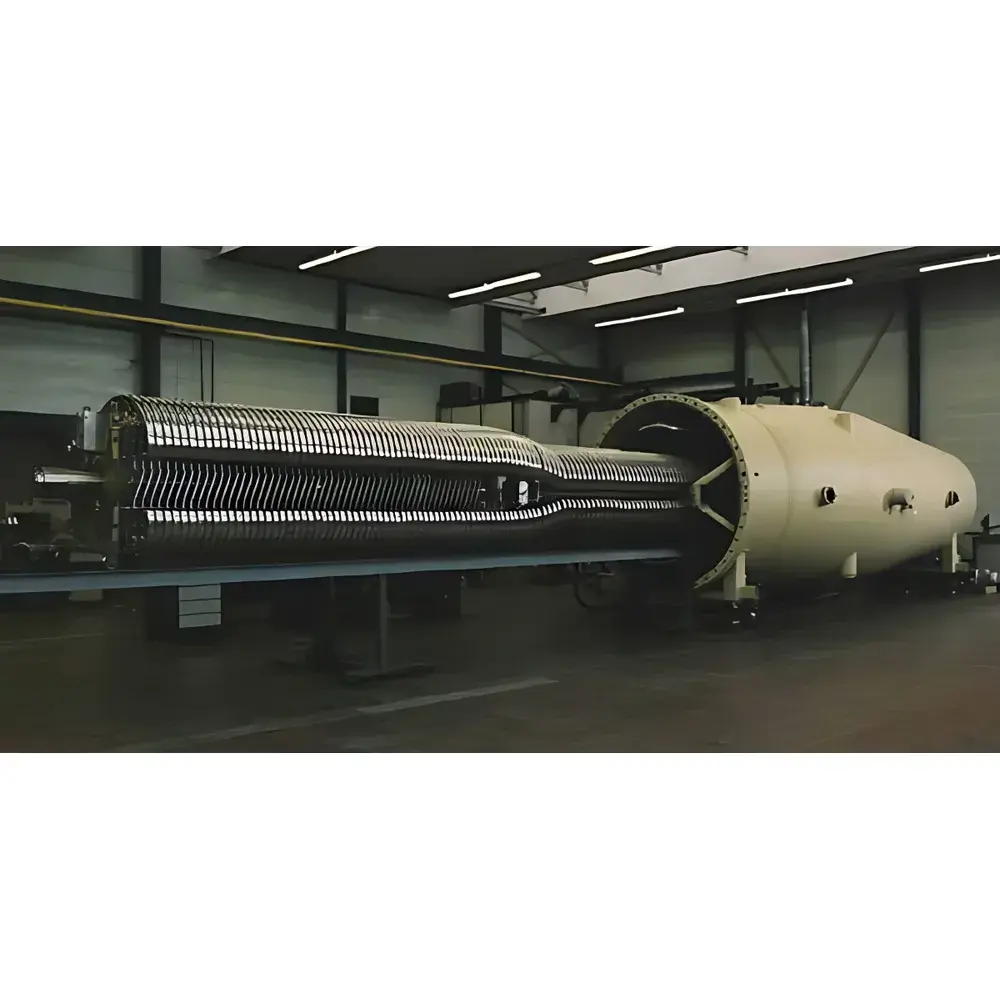
NEC CAMS 1.5SDH-1 Tandem Electrostatic Accelerator
| Origin | USA |
|---|---|
| Manufacturer Type | Authorized Distributor |
| Origin Category | Imported |
| Model | CAMS 1.5SDH-1 |
| Price | USD $3,000,000 |
| Acceleration Voltage | 0.6 MV (rated), >0.5 MV (stable operation) |
| Ion Species | ¹³C⁺, ¹⁴C⁺, ²⁶Al, ¹⁰Be, ³⁶Cl, Si, SiO₂, gaseous elements (e.g., CO₂, CH₄) |
| Energy Resolution (FWHM) | ≤500 V at 0.5 MV terminal voltage |
| Beam Current | 0.3 µA (¹³C⁺, acceptance test), up to 1.0 µA (pulsed mode, 0.5 MV) |
| Isotopic Ratio Precision | >0.3% for both ¹³C/¹²C and ¹⁴C/¹³C |
| Vacuum Requirements | SF₆ insulation at 80 psig (5.62 kg/cm²) |
| Dimensions (Accelerator Tank) | 2.10 m (L) × 0.92 m (D) |
| Volume | 1.27 m³ |
| Operating Pressure | 125 psig (8.79 kg/cm²) |
| Mass | 498 kg (tank), 1814 kg (full system) |
| Power Supply | 120/208 VAC, 3-phase, 5-wire, neutral-grounded |
| Total Load | 15.0 KVA (HE beamline + analysis subsystems) |
| Cooling | 15.5 L/min glycol-water mix @ ≤20 °C (ion source injector) |
Overview
The NEC CAMS 1.5SDH-1 is a high-stability tandem electrostatic accelerator engineered for ultra-trace isotopic ratio measurement via Accelerator Mass Spectrometry (AMS). Unlike conventional mass spectrometers, the 1.5SDH-1 employs a two-stage acceleration architecture: negative ions are generated in a Cs-sputter ion source, pre-accelerated toward a high-voltage terminal (up to 0.6 MV), stripped of electrons in a gas or foil stripper to produce positively charged atomic or molecular ions, then post-accelerated to final energies sufficient for nuclear charge-state separation and isotopic discrimination. This design enables suppression of isobaric interferences (e.g., ¹⁴N vs. ¹⁴C) and molecular fragments (e.g., ¹³CH vs. ¹⁴C), achieving detection limits below 10⁻¹⁶ for radiocarbon and sub-attomole sensitivity for cosmogenic nuclides such as ¹⁰Be and ²⁶Al. The system operates under strict voltage stability control (<1 kV drift over 24 h) and low ripple conditions (≤500 V FWHM at 0.5 MV), ensuring reproducible ion transmission and energy definition essential for quantitative AMS.
Key Features
- Electrostatic tandem architecture with insulated column rated at 0.6 MV, optimized for long-term voltage stability and low voltage ripple.
- Dual-mode ion optics: magnetic injection analyzer (MIA) coupled with electrostatic deflection for high-transmission, low-aberration beam formation.
- Modular high-energy beamline incorporating 90° analyzing magnet (0.61 m × 0.80 m × 1.80 m), electrostatic analyzer (ESA), and Faraday cup/detector array for simultaneous multi-isotope monitoring.
- Cs-sputter ion source with programmable sample wheel (up to 40 targets), compatible with solid graphite, AgCl, Fe₃O₄, and gaseous CO₂/CH₄ feed systems.
- Integrated SF₆ pressure regulation (80 psig) and redundant vacuum interlocks compliant with ANSI Z535.4 and IEC 61000-6-4 for electromagnetic compatibility.
- Real-time beam diagnostics including beam current monitors (picoammeter resolution ≤10 fA), position-sensitive profile scanners, and terminal voltage telemetry.
Sample Compatibility & Compliance
The 1.5SDH-1 supports diverse sample matrices critical to geochronology, environmental forensics, biomedicine, and nuclear safeguards. Solid samples include graphitized carbon (for ¹⁴C), Al₂O₃/BeO (for ¹⁰Be), quartz (for ²⁶Al), and AgCl precipitates (for ³⁶Cl). Gaseous inputs—CO₂, CH₄, SF₆—are introduced via cryo-trapped inlet lines with pressure-controlled dosing. All sample handling conforms to ASTM D6866 (radiocarbon dating of bio-based content), ISO 17025:2017 (competence of testing laboratories), and USP (validation of analytical procedures). The system’s hardware and firmware architecture support audit-ready data logging aligned with FDA 21 CFR Part 11 requirements, including electronic signatures, immutable timestamps, and user-access-tiered permissions.
Software & Data Management
Control and acquisition are managed by NEC’s proprietary CAMS Control Suite v4.x, running on a real-time Linux OS with deterministic I/O scheduling. The software provides synchronized control of high-voltage supply, magnet currents, ion source parameters, and beamline apertures via IEEE-488.2 GPIB and EtherCAT interfaces. Raw spectra are stored in HDF5 format with embedded metadata (sample ID, operator, timestamp, HV setpoint, stripper gas flow, detector gain). Quantitative analysis leverages peak-fitting algorithms based on Voigt convolution models and internal standard normalization (e.g., oxalic acid II for ¹⁴C). Export modules generate ASTM-compliant reports (CSV, PDF) with uncertainty propagation per GUM (JCGM 100:2018). Data archives are encrypted and compatible with LIMS integration via RESTful API.
Applications
- Archaeological & Geological Dating: High-precision ¹⁴C measurements on sub-milligram charcoal, bone collagen, and speleothem calcite; ²⁶Al/¹⁰Be burial dating of fluvial sediments and glacial till.
- Climate Science: Tracing anthropogenic CO₂ uptake using atmospheric ¹⁴CO₂ and fossil fuel-derived ¹⁴C-depleted signals in tree rings and ice cores.
- Nuclear Environmental Monitoring: Detection of ultra-low-level ¹²⁹I (t₁/₂ = 15.7 Myr) and ²³⁶U in seawater and soil near nuclear reprocessing sites.
- Biomedical Tracer Studies: Quantification of ⁴¹Ca and ²⁶Al pharmacokinetics in human metabolic trials using microdose AMS protocols.
- Materials Activation Analysis: Depth profiling of implanted isotopes (e.g., ¹⁸F, ⁶⁴Cu) in semiconductor and battery electrode materials.
FAQ
What is the minimum detectable activity (MDA) for ¹⁴C in graphite samples?
The MDA is instrument- and chemistry-dependent; typical values range from 0.1–0.3 pMC (percent modern carbon) for 1 mg graphite with 10-minute counting time, assuming background-corrected ¹⁴C/¹²C ratios ≥1×10⁻¹⁵.
Can the 1.5SDH-1 operate under GLP or GMP conditions?
Yes—the system includes full audit trail functionality, electronic signature capability, and configurable user roles per 21 CFR Part 11 Annex 11, enabling compliance with GLP (OECD 1998) and pharmaceutical GMP frameworks.
Is remote operation supported?
Full remote control, monitoring, and diagnostics are available via TLS-secured VNC and SSH tunnels; however, physical access remains required for target loading, maintenance, and high-voltage chamber servicing.
What cooling infrastructure is mandatory?
A closed-loop chiller delivering 15.5 L/min at ≤20 °C (ΔT ≤ 3 °C) to the ion source and 3.8 L/min to the accelerator column is required; ambient lab temperature must be stabilized between 20–24 °C with ±0.5 °C tolerance.
How often does the SF₆ gas require replenishment?
Under normal operation and leak-tight conditions, SF₆ top-up is needed only annually; integrated pressure sensors and auto-shutdown logic trigger alerts at <75 psig to prevent dielectric breakdown.





