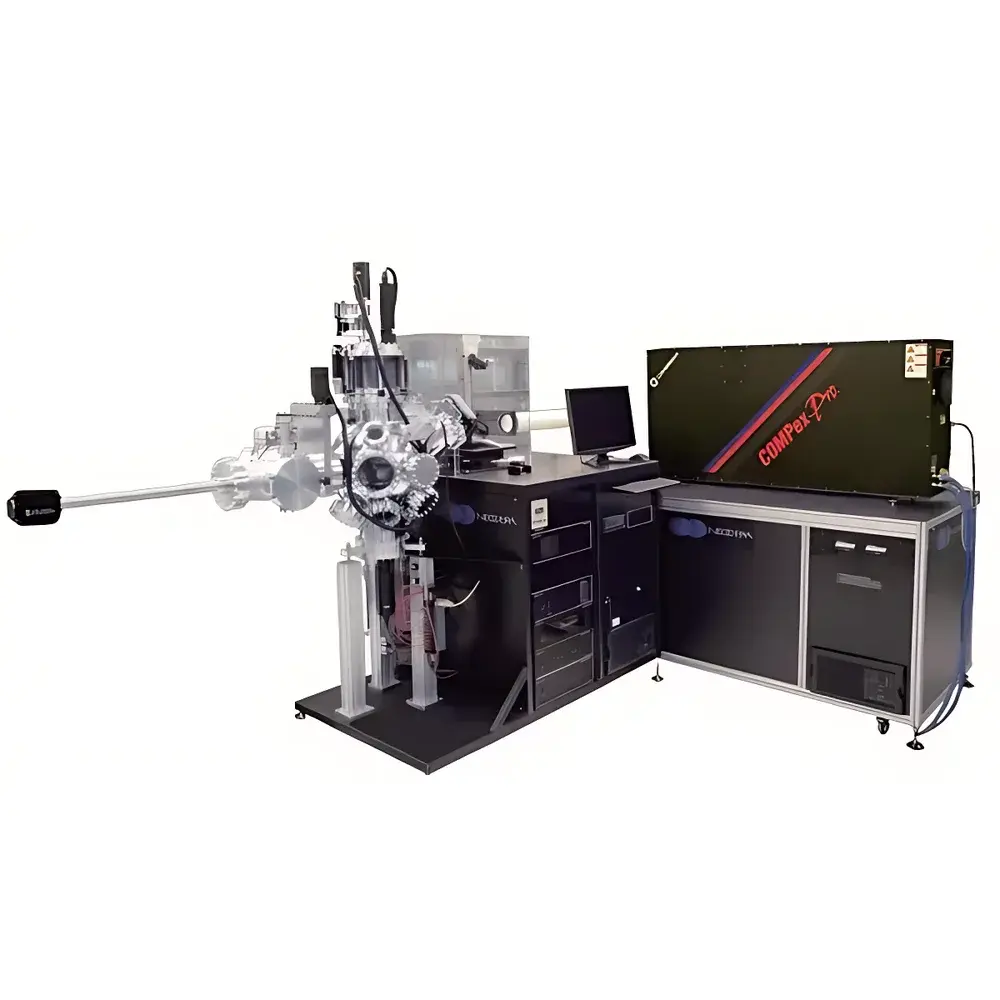
Neocera Pioneer 180 PLD System
| Brand | Neocera |
|---|---|
| Origin | USA |
| Model | Pioneer 180 PLD System |
| Vacuum Base Pressure | ≤5×10⁻⁹ Torr |
| Chamber Diameter | 18 in |
| Max Substrate Size | 6 in |
| Max Target Capacity | 6×1″ or 3×2″ |
| Substrate Heater | Radiant, O₂-compatible up to 1 atm (760 Torr) |
| Max Substrate Temperature | 850 °C (upgradable to 1000 °C) |
| Turbo Pump Speed | 400 L/s (software-controlled) |
| In-situ Diagnostics Support | RHEED, LAXS, IES |
| Load-Lock Compatible | Yes |
| Multi-Source Integration Options | PED, RF/DC Sputtering, DC Ion Gun |
| UHV Cluster Integration Ready | XPS, ARPES, MBE |
Overview
The Neocera Pioneer 180 PLD System is a high-vacuum, turnkey pulsed laser deposition platform engineered for the reproducible growth of epitaxial thin films, multilayer heterostructures, and artificial superlattices on substrates up to 6 inches in diameter. Operating on the fundamental principle of laser ablation—where a high-energy pulsed laser beam (typically KrF excimer, 248 nm) irradiates a solid target material to generate a transient plasma plume—the system enables stoichiometric transfer of complex oxides, nitrides, chalcogenides, and metallic compounds onto heated substrates under precisely controlled reactive gas environments. Its design emphasizes UHV integrity (base pressure ≤5×10⁻⁹ Torr), thermal stability under oxidizing conditions, and modular expandability for advanced process integration. Unlike conventional PLD systems limited by chamber geometry or oxygen compatibility, the Pioneer 180 integrates an O₂-tolerant radiant heater capable of sustained operation at ambient pressure (760 Torr O₂) during deposition, post-deposition annealing, and controlled cooldown—critical for thermodynamically sensitive oxide epitaxy such as SrTiO₃, YBCO, or LSMO.
Key Features
- O₂-compatible radiant substrate heater rated for continuous operation at 1 atm O₂, enabling true in-situ oxidation-coupled growth and annealing protocols.
- Automated multi-target carousel with software-selectable positioning (6×1″ or 3×2″ targets), synchronized with laser firing and shutter control for precise multilayer and superlattice sequencing.
- Closed-loop pressure regulation via mass flow controllers (MFCs), supporting stable process pressures from UHV (10⁻⁹ Torr) to high-pressure O₂ (760 Torr) with ±0.1% setpoint accuracy.
- 360° continuous substrate rotation with programmable angular velocity, ensuring uniform film thickness and compositional homogeneity across 6-inch wafers.
- Integrated load-lock capability for air-free substrate transfer, minimizing contamination and enabling cross-platform integration with adjacent UHV tools (e.g., sputter deposition, XPS, ARPES).
- Modular source expansion architecture supporting hybrid deposition: optional integration of pulsed electron deposition (PED), RF/DC magnetron sputtering, and DC ion guns for ion-assisted PLD (IBAD) or combinatorial synthesis.
Sample Compatibility & Compliance
The Pioneer 180 accommodates standard semiconductor and oxide substrates—including Si, SrTiO₃, MgO, LaAlO₃, Al₂O₃, and flexible metallic foils—within a 6-inch maximum diameter constraint. All internal surfaces are electropolished stainless steel, passivated per ASTM A967, and qualified for UHV service per ISO 14644-1 Class 4 (cleanroom-equivalent particulate control). The system conforms to CE machinery directives (2006/42/EC) and electromagnetic compatibility standards (2014/30/EU). For regulated environments, the LabVIEW-based control architecture supports audit-trail logging, user-access levels, and electronic signature functionality aligned with FDA 21 CFR Part 11 requirements when deployed in GLP/GMP-compliant laboratories.
Software & Data Management
Control and automation are implemented through a Windows 7–based LabVIEW 2013 environment, providing deterministic real-time coordination of substrate temperature ramping, target indexing, chamber pressure modulation, turbo pump sequencing, and Q-switched laser triggering (TTL or analog sync). All operational parameters—including heater power, MFC setpoints, rotation speed, and vacuum gauge readings—are logged at user-defined intervals (minimum 100 ms resolution) into timestamped binary files (.tdms), exportable to CSV or MATLAB formats. The software includes preconfigured recipe templates for common oxide systems (e.g., PZT, BFO, STO), with full scripting support for custom deposition logic, conditional branching, and interlock-driven safety protocols.
Applications
The Pioneer 180 serves as a primary tool for academic and industrial research in oxide electronics, quantum materials, and energy-related thin films. It is routinely employed in the fabrication of high-Tc superconducting Josephson junctions, ferroelectric tunnel barriers, topological insulator heterostructures, and solid-state electrolyte layers for microbatteries. Its compatibility with in-situ RHEED enables real-time monitoring of surface reconstruction and layer-by-layer growth mode verification. When integrated into UHV cluster systems, it supports sequential deposition–analysis workflows—such as PLD growth followed immediately by angle-resolved photoemission spectroscopy (ARPES) or X-ray photoelectron spectroscopy (XPS)—without breaking vacuum, preserving pristine surface chemistry and interfacial sharpness.
FAQ
What vacuum level can the Pioneer 180 achieve, and how is base pressure maintained?
The system achieves a base pressure of ≤5×10⁻⁹ Torr using a 400 L/s turbomolecular pump backed by a dry scroll pump, with all-metal seals and bake-out capability up to 150 °C.
Is the system compatible with in-situ RHEED, and what are the port configurations?
Yes—it features two 6-inch CF flanged viewports (one axial, one radial) optimized for RHEED installation; additional ports support LAXS, IES, and residual gas analysis (RGA).
Can the Pioneer 180 be upgraded to support larger substrates or higher temperatures?
The standard configuration supports 6-inch substrates and 850 °C heating; an optional upgrade extends temperature capability to 1000 °C and adds compatibility with 8-inch handling via chamber retrofit.
How does the O₂-compatible heater differ from conventional resistive heaters?
It uses radiation-based heating with ceramic-insulated tungsten filaments and O₂-stable refractory shielding, eliminating hot-filament oxidation and enabling stable thermal profiles under 1 atm pure oxygen without arcing or degradation.
What documentation and validation support is provided for regulated environments?
Neocera supplies IQ/OQ documentation packages, traceable calibration certificates for all critical sensors (thermocouples, capacitance manometers), and a 21 CFR Part 11 readiness add-on module for electronic records and signatures.
Related Products