
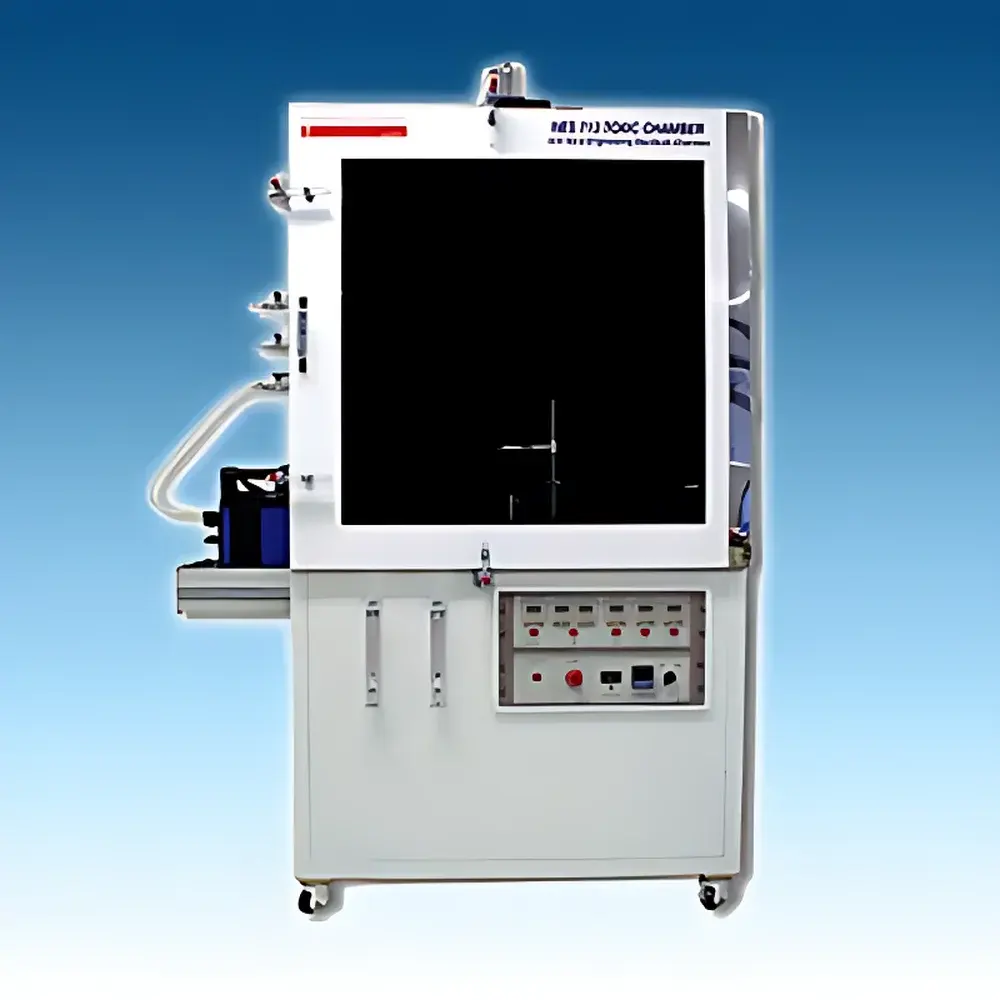
NES 713 Smoke Toxicity Test Chamber
| Brand | MOTIS |
|---|---|
| Origin | Jiangsu, China |
| Model | NES 713 |
| Compliance Standard | NES 713 (Naval Engineering Standard) |
| Operating Temperature | 800 °C |
| Chamber Volume | V m³ (user-specified per configuration) |
| Sample Mass | 100 g (standard test mass) |
| Toxicity Index Calculation | Σ(C₈ᵢ / Cfᵢ), i = 1 to n |
| Observation Window | Reinforced PTFE-coated polycarbonate viewport |
| Exhaust Control | Timer-actuated automatic purge mode |
| Test Modes | Manual and programmable automatic cycle |
| Chamber Lining | PTFE-bonded stainless steel interior |
| Door Mechanism | Positive-seal dual-latch system |
| Ignition System | Electric spark ignition with auto-shutoff |
Overview
The NES 713 Smoke Toxicity Test Chamber is an engineered laboratory instrument designed for quantitative assessment of acute inhalation toxicity of combustion gases generated from polymeric cable materials under controlled thermal decomposition conditions. It operates in strict accordance with the Naval Engineering Standard NES 713 — a specification originally developed by the UK Ministry of Defence for evaluating the hazard potential of smoke effluents during fire scenarios aboard naval vessels. The chamber employs a defined pyrolysis protocol: a 100 g specimen is combusted at a stabilized furnace temperature of 800 °C in a sealed, inert-atmosphere-compatible test volume. Gaseous effluents are quantitatively sampled via calibrated airflow extraction and subsequently analyzed using validated wet-chemical or instrumental methods (e.g., ion chromatography, GC-MS, or UV-Vis spectrophotometry) to determine concentrations of key toxicants including CO, HCN, HCl, HF, SO₂, NOₓ, and aldehydes. The resulting Toxicity Index (TI) is calculated as the dimensionless sum Σ(C₈ᵢ/Cfᵢ), where C₈ᵢ denotes the measured concentration (ppm) of each identified toxic gas in the chamber atmosphere, and Cfᵢ represents its published 30-minute LC₅₀ threshold concentration for human exposure (per ISO 13571 and ASTM E1354 Annex A5). This index enables direct comparison of material hazard ranking across product development and regulatory qualification workflows.
Key Features
- PTFE-bonded stainless steel chamber interior — minimizes adsorption, condensation, and chemical corrosion from acidic or reactive combustion by-products
- Reinforced polycarbonate observation viewport with integrated PTFE anti-fouling coating — permits real-time visual monitoring without compromising containment integrity
- Dual-mode operation — supports both manual intervention and fully automated sequences governed by programmable timer logic
- Electric spark ignition system with fail-safe auto-extinguish function — activated only during designated test phase; de-energized upon completion
- Timer-controlled exhaust management — initiates post-test purge cycle to evacuate residual smoke and condensables before door unlocking
- Closed-loop recirculation option — enables extended residence time for equilibrium-based gas-phase analysis when required by method adaptation
- Positive-seal, dual-latch door mechanism — ensures leak-tight closure during high-temperature operation and meets pressure containment requirements per EN 61000-4-2
Sample Compatibility & Compliance
The NES 713 accommodates flat or cylindrical cable insulation/jacket specimens up to 100 g dry mass, with dimensional constraints compatible with standard IEC 60332-1-2 and BS 6387 CWZ test fixtures. It is routinely deployed in compliance-driven environments requiring documentation traceability to NES 713 Rev. 4 (2019), MIL-STD-2031A, and IMO FTP Code Annex 1 Part 2. While not inherently certified to UL 94 or NFPA 262, its output data may be submitted as supporting evidence in broader fire safety dossiers subject to third-party interpretation. Instrument calibration and operational verification follow internal SOPs aligned with ISO/IEC 17025:2017 principles, including annual thermocouple validation, volumetric chamber verification, and flowmeter recalibration against NIST-traceable standards.
Software & Data Management
The NES 713 operates as a hardware-controlled platform without embedded firmware or proprietary software. All timing, ignition, and exhaust actuation functions are managed through industrial-grade electromechanical timers compliant with IEC 60730-1 Class B safety requirements. Users maintain full procedural control via external lab notebooks or LIMS-integrated electronic records. For audit readiness, laboratories commonly pair the chamber with validated data acquisition systems logging thermocouple readings, airflow rates, and timer status flags — ensuring full GLP-compliant traceability per 21 CFR Part 11 when coupled with appropriate electronic signature protocols. No cloud connectivity or remote access functionality is provided or supported.
Applications
- Qualification testing of halogen-free low-smoke (LSOH/LSZH) cable compounds for marine, rail, and underground infrastructure projects
- Comparative toxicity screening during polymer formulation development — e.g., phosphinate vs. melamine cyanurate flame retardant systems
- Root cause analysis of smoke-related equipment failure in enclosed military platforms
- Supporting technical submissions to classification societies (Lloyd’s Register, DNV, ABS) requiring NES 713 conformance data
- Academic research on combustion toxicology kinetics, particularly for nitrogen- and sulfur-containing polymers
FAQ
Does the NES 713 include integrated gas analyzers?
No. The chamber provides conditioned, quantified gas samples suitable for off-line analysis using user-supplied instrumentation.
Is chamber volume standardized across all NES 713 units?
Chamber volume is configurable per customer specification (typically 0.5–2.0 m³); final value must be documented in test reports per NES 713 Section 5.2.
Can the system be used for non-cable materials such as gaskets or insulation foams?
Yes — provided specimens meet the 100 g mass requirement and do not generate excessive soot or particulate that compromises optical path or sensor function.
What maintenance intervals are recommended for PTFE chamber coating integrity?
Visual inspection prior to each test series; recoating advised after 200 cumulative test cycles or upon visible etching or delamination.
Is third-party certification available for this instrument?
MOTIS does not provide UKAS or DAkkS accreditation for the NES 713 unit itself; however, accredited test labs may issue ISO/IEC 17025-certified test reports using this apparatus.
Related Products



