
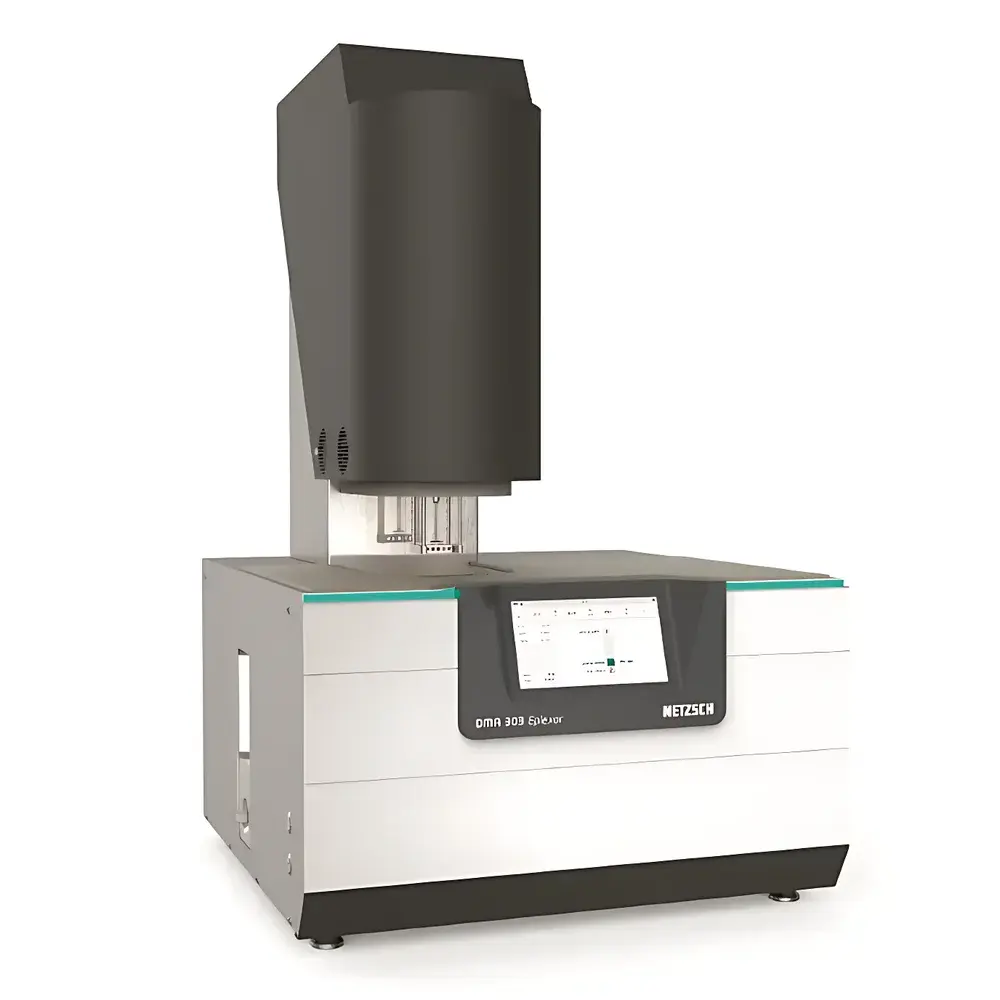
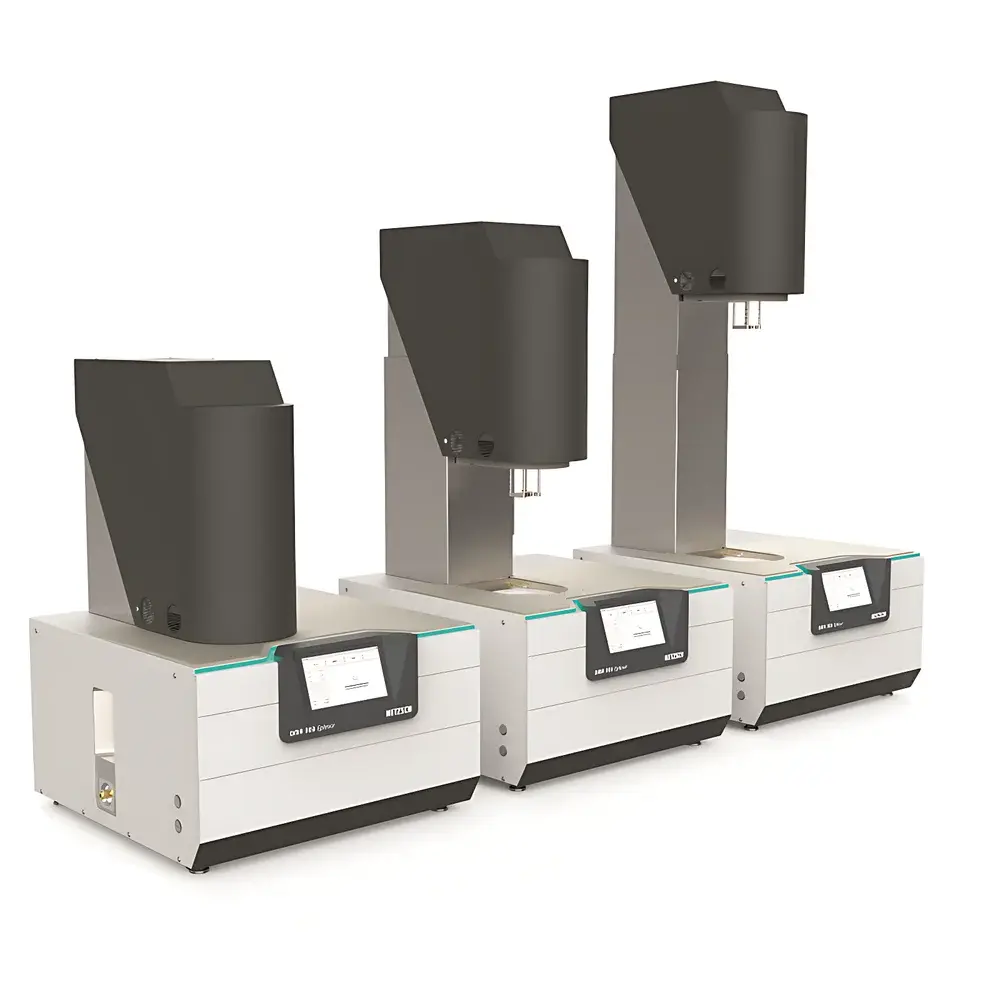
Netzsch DMA 303 Eplexor Dynamic Mechanical Analyzer
| Brand | Netzsch |
|---|---|
| Origin | Germany |
| Model | DMA 303 Eplexor |
| Instrument Type | Dynamic Mechanical Analyzer (DMA/DMTA) |
| Temperature Range | −170 °C to 800 °C |
| Temperature Accuracy | ±0.1 °C |
| Force Range | 1 mN to 50 N |
| Displacement Range | 30 mm |
| Frequency Range | 0.001 Hz to 150 Hz |
Overview
The Netzsch DMA 303 Eplexor is a high-performance dynamic mechanical analyzer engineered for precision viscoelastic characterization of solid and semi-solid materials under controlled thermal and mechanical stimuli. Operating on the principle of forced oscillatory deformation, it applies a sinusoidal stress (or strain) to a sample while simultaneously monitoring the resulting strain (or stress) response across a defined temperature, time, or frequency domain. This enables quantitative determination of fundamental linear viscoelastic parameters—including storage modulus (E′), loss modulus (E″), loss factor (tan δ), coefficient of linear expansion (CTE), and relaxation/creep compliance—under rigorously reproducible conditions. Designed for research laboratories and industrial quality control environments, the DMA 303 Eplexor supports comprehensive thermomechanical profiling of polymeric systems, elastomers, composites, ceramics, metals, and thin-film architectures over an exceptionally broad operational envelope.
Key Features
- Ultra-wide temperature range from −170 °C to +800 °C, enabled by integrated liquid nitrogen cooling and high-temperature furnace options with active temperature homogeneity control.
- High-resolution force actuation system spanning 1 mN to 50 N, supporting both low-force measurements for delicate films and high-load testing of rigid ceramics or metal alloys.
- Precision displacement sensing with ±0.1 µm resolution over a 30 mm stroke, ensuring accurate dimensional tracking during thermal expansion or creep events.
- Dynamic frequency sweep capability from 0.001 Hz to 150 Hz, facilitating time–temperature superposition (TTS) analysis via Williams–Landel–Ferry (WLF) master curve construction.
- Modular measurement modes: standard tension/compression/bending, plus optional creep–relaxation, stress–strain amplitude sweeps, and isothermal frequency scans.
- Integrated real-time data acquisition with synchronized thermal, mechanical, and environmental parameter logging at up to 100 Hz sampling rate.
Sample Compatibility & Compliance
The DMA 303 Eplexor accommodates diverse geometries—including rods, films, fibers, powders (via compression fixtures), and molded specimens—across ASTM D4065, ISO 6721, ISO 11359, and DIN 53445 standards. Its modular fixture system supports dual-cantilever, single-cantilever, 3-point bending, tension, compression, and shear configurations. All thermal calibration protocols adhere to ISO/IEC 17025 traceable reference material procedures. The instrument architecture complies with GLP/GMP documentation requirements, including full audit trail functionality, user access control, and electronic signature support in accordance with FDA 21 CFR Part 11 when operated with compliant software configuration.
Software & Data Management
Controlled via NETZSCH Proteus® software, the DMA 303 Eplexor delivers seamless experiment design, real-time visualization, and advanced post-processing. Proteus supports multi-parameter plotting (e.g., E′, E″, tan δ, CTE vs. temperature/frequency/time), automatic peak detection for transition identification (Tg, Tm, Tβ), Cole–Cole plot generation, activation energy calculation via Arrhenius or Vogel–Fulcher–Tammann modeling, and full WLF master curve construction with horizontal/vertical shift factors. Data export conforms to ASTM E131 and ISO/IEC 11171 formats; raw datasets are stored in vendor-neutral HDF5 containers with embedded metadata for long-term archival and third-party interoperability.
Applications
- Characterization of glass transition behavior, secondary relaxations, and crystallinity effects in thermoplastics and thermosets.
- Evaluation of damping performance and stiffness retention in automotive elastomers and vibration-damping composites.
- Thermal expansion analysis of microelectronic packaging substrates and thin-film coatings under thermal cycling conditions.
- Creep resistance assessment of high-temperature ceramics and refractory metals for aerospace applications.
- Structure–property correlation studies in biodegradable polymers, hydrogels, and pharmaceutical excipients.
- Quality assurance and batch-to-batch consistency verification in polymer manufacturing per ISO 9001 and IATF 16949 frameworks.
FAQ
What sample geometries are supported by the DMA 303 Eplexor?
Standard configurations include rectangular bars (tension/compression), rectangular beams (bending), and cylindrical rods (torsion). Custom fixtures are available for fibers, films, and powder compacts.
Is time–temperature superposition (TTS) analysis natively supported?
Yes—Proteus software includes automated WLF fitting, shift factor calculation, and master curve generation with manual or algorithmic optimization.
Can the instrument operate under inert or reactive gas atmospheres?
Yes—equipped with sealed furnace modules and gas inlet/outlet ports compatible with N2, Ar, He, air, or forming gas environments.
Does the system meet regulatory requirements for pharmaceutical or medical device testing?
When configured with validated Proteus software, 21 CFR Part 11 compliance features—including electronic signatures, audit trails, and role-based access—are fully enabled.
What is the typical calibration interval recommended for routine operation?
Netzsch recommends annual traceable calibration using certified reference materials (e.g., indium, aluminum, quartz) in accordance with ISO/IEC 17025 laboratory practices.



