
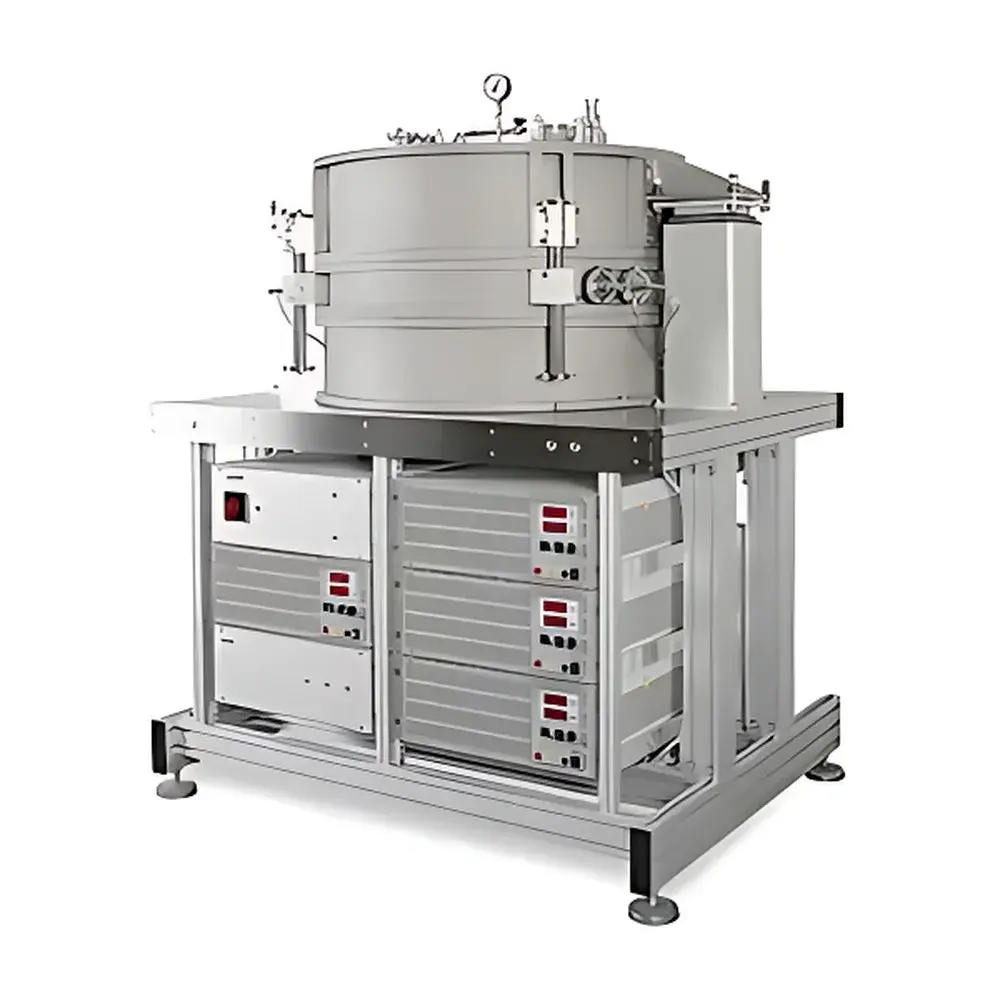
Netzsch GHP456 Titan Guarded Hot Plate Thermal Conductivity Analyzer
| Brand | Netzsch |
|---|---|
| Origin | Germany |
| Model | GHP456 Titan |
| Measurement Principle | Guarded Hot Plate Method |
| Applicable Standards | ISO 8302, DIN EN 12667, DIN EN 12939, DIN EN 13163, ASTM C177, GB 10294 |
| Temperature Range | −160 °C to 600 °C |
| Sample Dimensions | 300 mm × 300 mm (max thickness 100 mm) |
| Thermal Conductivity Range | 0–2 W/(m·K) |
| Accuracy | ±2% |
| Repeatability | ±1% |
| Vacuum Capability | Yes |
| Control Sensors | 29 Pt-100 resistance thermometers |
| Footprint (L×W×H) | 3000 mm × 1500 mm × 2000 mm |
| Operating Environment | Ambient temperature laboratory conditions |
| Sample Throughput | Multi-sample sequential testing supported |
Overview
The Netzsch GHP456 Titan is a high-precision guarded hot plate (GHP) thermal conductivity analyzer engineered for absolute measurement of steady-state thermal transport properties in low-conductivity insulating materials. Based on the fundamental principle of one-dimensional Fourier heat conduction under controlled boundary conditions, the GHP456 Titan establishes a uniform, axially directed heat flux across a flat, homogeneous sample sandwiched between precisely regulated hot and cold plates. Its guarded hot plate configuration actively suppresses lateral heat losses via a concentric, independently controlled guard ring—ensuring that >99.5% of the generated heat flows strictly perpendicular to the sample surface. This architecture enables primary-standard-level traceability without reliance on calibration references, making it suitable for accreditation-critical applications in national metrology institutes, building material certification labs, and R&D centers developing next-generation aerogels, vacuum insulation panels (VIPs), and cryogenic insulation systems.
Key Features
- Full compliance with ISO 8302, ASTM C177, DIN EN 12667/12939/13163, and GB 10294—validated for use in ISO/IEC 17025-accredited laboratories.
- World’s only commercially available guarded hot plate system capable of operation under high vacuum (≤10⁻² mbar), eliminating convective and gaseous conduction artifacts—critical for VIP and nanoporous silica characterization.
- 29 integrated Pt-100 resistance thermometers distributed across hot plate, cold plate, guard ring, and sample interfaces enable spatially resolved temperature mapping and real-time thermal gradient validation.
- Active thermal guarding with dynamic PID compensation ensures axial heat flux dominance; measured lateral losses remain below 0.3% of total power input.
- Modular chamber design supports interchangeable cold plate assemblies for liquid nitrogen cooling (−160 °C) or electrically heated configurations up to +600 °C—enabling full-range thermal diffusivity mapping across cryogenic to high-temperature regimes.
- Rigid granite base and vibration-damped structural frame minimize mechanical drift; thermal stability maintained at ±0.01 K over 24-hour measurement cycles.
Sample Compatibility & Compliance
The GHP456 Titan accommodates rigid and semi-rigid flat specimens measuring 300 mm × 300 mm, with thicknesses from 5 mm to 100 mm. Compatible material classes include mineral wool, expanded/polystyrene foams, phenolic boards, calcium silicate, aerogel monoliths, and multilayer composite insulation systems. All measurements adhere to GLP-aligned data integrity protocols: audit trails record operator ID, timestamp, environmental chamber conditions (humidity, ambient T), sensor calibration status, and raw thermocouple/Pt-100 voltage readings. System documentation satisfies FDA 21 CFR Part 11 requirements for electronic records and signatures when configured with optional validation packages.
Software & Data Management
NETZSCH ThermControl™ v5.2 provides fully automated test sequencing, real-time convergence monitoring, and ISO-compliant uncertainty quantification per GUM (Guide to the Expression of Uncertainty in Measurement). The software calculates thermal conductivity λ using the validated equation λ = Q·d / (A·ΔT), where Q is net heater power (corrected for guard ring leakage), d is average sample thickness (measured via motorized micrometer with ±0.5 µm resolution), A is effective area (300 mm × 300 mm, corrected for edge effects), and ΔT is the mean temperature difference across the sample (derived from ≥12 symmetrically distributed Pt-100 pairs). Export formats include CSV, PDF test reports with digital signatures, and XML files compatible with LIMS integration. Optional IQ/OQ/PQ documentation kits support GMP-regulated environments.
Applications
- Building physics: Certification of thermal resistance (R-value) for façade insulation, roof membranes, and passive house components per EN ISO 10456.
- Aerospace: Characterization of ceramic matrix composites and ablative heat shields under simulated re-entry thermal gradients.
- Cryogenics: Validation of thermal performance for LNG tank insulation and superconducting magnet cryostats.
- Standards laboratories: Primary reference measurements supporting national calibration hierarchies (e.g., PTB, NIST, NIM).
- Material development: In-process QA for aerogel drying optimization and VIP core density profiling.
FAQ
What standards does the GHP456 Titan directly support?
ISO 8302, ASTM C177, DIN EN 12667, DIN EN 12939, DIN EN 13163, and GB 10294—all verified via interlaboratory round-robin studies.
Can the system measure below ambient temperature without external cryogens?
No—sub-ambient operation requires connection to a chiller or liquid nitrogen supply; the cold plate is passively cooled but not self-refrigerating.
Is vacuum operation mandatory for standard testing?
No—vacuum is optional and applied only when characterizing gas-filled or porous media where convection must be eliminated; atmospheric-pressure mode is standard for most building insulation tests.
How is sample thickness measured during testing?
Using a motorized precision micrometer with capacitive displacement sensors, calibrated traceably to NIST standards, and integrated into the thermal equilibrium algorithm.
Does the system support unattended overnight measurements?
Yes—fully autonomous operation with thermal convergence criteria, automatic power ramping, and failure-triggered emergency shutdown protocols compliant with IEC 61000-4-30.



