
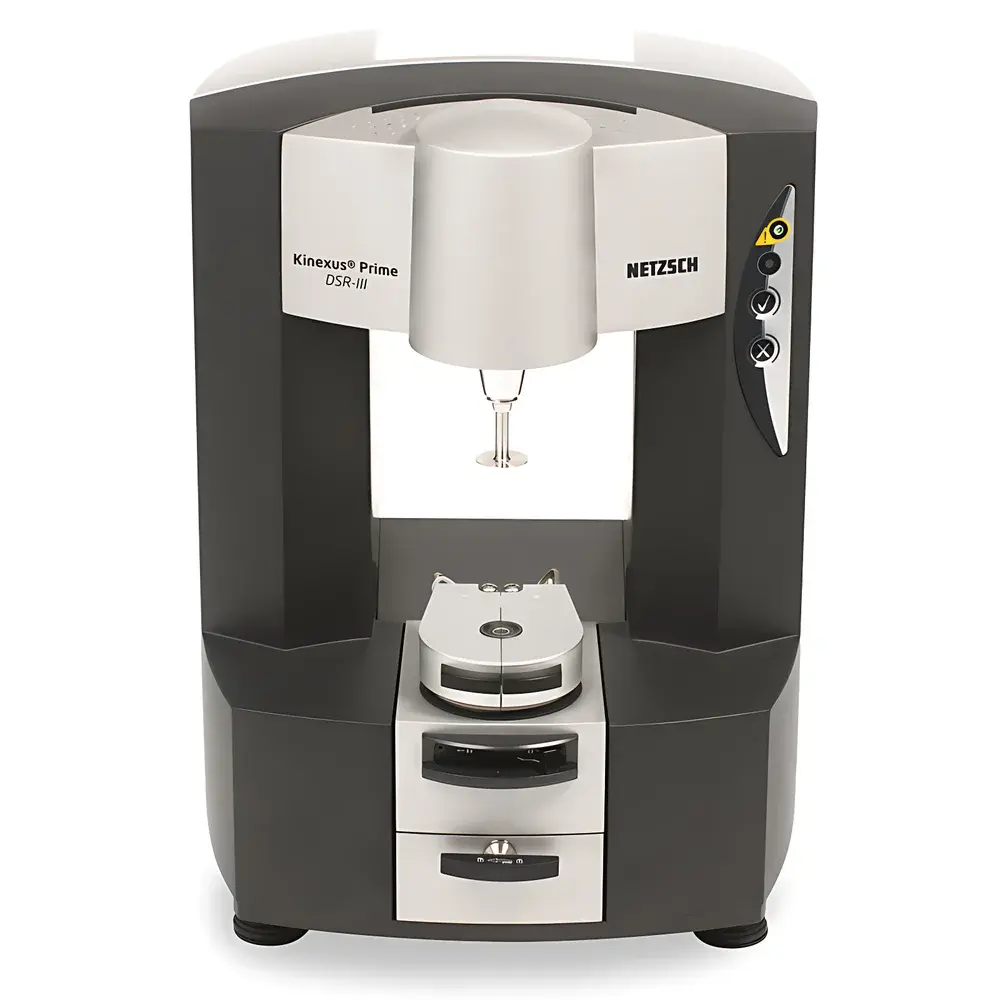
Netzsch Kinexus DSR-III Advanced Rotational Rheometer
| Brand | Netzsch |
|---|---|
| Origin | Germany |
| Model | Kinexus DSR-III |
| Instrument Type | Rotational Rheometer |
| Motor Bearing | Air Bearing |
| Minimum Angular Velocity | 10 nrad/s |
| Maximum Angular Velocity | 200 rad/s |
| Frequency Range | 1 µHz – 100 Hz |
| Maximum Torque | 150 mNm |
| Torque Resolution | 0.1 nNm |
| Normal Force Range | 0.01 N – 20 N |
| Normal Force Response Time | <10 ms |
| Vertical Travel Speed | 0.1 µm/s – 20 mm/s |
| Vertical Travel Distance | 230 mm |
| Gap Resolution | 0.1 µm |
| Motor Inertia | 12 µN·m·s² |
| Torque Range (Rate/Stress Control) | 0.1 µNm – 150 mNm |
| Torque Range (Strain/Stress Control) | 0.1 µNm – 150 mNm |
| Fixture Identification | RFID-enabled Smart Recognition |
| Environmental Control Unit | Plug-and-Play with Auto-Detection |
Overview
The Netzsch Kinexus DSR-III Advanced Rotational Rheometer is a high-precision, modular rheological testing platform engineered for fundamental and applied viscoelastic characterization of complex fluids and soft solids. Based on the Couette principle and controlled-strain/stress rotational measurement architecture, it delivers exceptional sensitivity and dynamic range across both steady-state and oscillatory regimes. Designed specifically for demanding applications in asphalt binder evaluation, polymer melt processing, pharmaceutical formulations, coatings, and food science, the DSR-III enables rigorous compliance with ASTM D7175 (DSR test for asphalt binders), AASHTO T315, ISO 6721, and EN 1427. Its air-bearing motor system eliminates mechanical friction, ensuring true torque-free rotation and enabling ultra-low torque measurements down to 0.1 µNm — critical for characterizing weak gel structures or highly diluted dispersions.
Key Features
- Ultra-low-inertia air-bearing motor with 12 µN·m·s² inertia and optical encoder-based position sensing (sub-nanoradian resolution) for precise angular displacement control
- Integrated normal force control system with real-time acquisition of vertical displacement, velocity, and normal force data; response time <10 ms ensures accurate gap maintenance during transient deformation
- RFID-enabled smart fixture recognition: automatic loading of geometry-specific calibration constants, thermal expansion coefficients, and historical validation records upon mounting
- Plug-and-play environmental control units (ECUs) with auto-detection and parameter auto-configuration — compatible with Peltier, liquid-circulating, and convection oven modules
- Intelligent gap alignment algorithm with 0.1 µm resolution and automated zero-gap calibration routine, minimizing operator-induced variability
- Unified software interface supporting both SOP-driven workflows and fully customizable experimental protocols, including multi-step amplitude sweeps, frequency sweeps, and time sweeps under controlled temperature ramps
Sample Compatibility & Compliance
The Kinexus DSR-III accommodates a broad spectrum of sample geometries — including parallel plates, cone-and-plate, concentric cylinders, and vane geometries — enabling rheological analysis of liquids, gels, pastes, melts, and filled composites. Its wide torque range (0.1 µNm to 150 mNm) and extended frequency bandwidth (1 µHz to 100 Hz) support both linear viscoelastic region (LVR) determination and nonlinear flow behavior assessment. The system meets key regulatory and quality assurance requirements: full audit trail functionality compliant with FDA 21 CFR Part 11, GLP/GMP-ready data integrity features, and traceable calibration paths aligned with ISO/IEC 17025 standards. All firmware and software updates are version-controlled and documented per ICH Q9 risk management principles.
Software & Data Management
Kinexus software (v4.x or later) provides a unified environment for instrument control, real-time visualization, and post-acquisition analysis. It supports automated reporting templates aligned with ASTM and AASHTO formats, including master curve generation via time–temperature superposition (TTS). Raw data files are stored in vendor-neutral HDF5 format with embedded metadata (sample ID, operator, temperature, geometry, calibration history), ensuring long-term archival integrity. Export options include CSV, Excel, and universal rheological data exchange (RheoML) schema. Role-based user access control, electronic signatures, and secure database backup protocols fulfill laboratory information management system (LIMS) integration requirements.
Applications
- Asphalt binder grading and performance prediction per Superpave specifications
- Rheological profiling of thermoplastic elastomers and polyolefin melts during extrusion process development
- Yield stress and thixotropic recovery quantification in pharmaceutical suspensions and topical gels
- Structural breakdown and reformation kinetics in food emulsions and dairy products
- Viscoelastic characterization of battery electrode slurries and ceramic pastes for additive manufacturing
- Quality control of industrial lubricants, adhesives, and sealants across batch production cycles
FAQ
What is the minimum measurable torque for the Kinexus DSR-III?
The instrument achieves a torque resolution of 0.1 nNm and a lower torque limit of 0.1 µNm in both rate- and stress-controlled modes.
Does the system support automated compliance with ASTM D7175?
Yes — pre-configured test sequences, reporting templates, and temperature ramp profiles are included for full DSR compliance testing of asphalt binders.
How does the RFID fixture recognition improve measurement reproducibility?
Each smart fixture stores its unique geometry parameters, calibration coefficients, and usage history; the system auto-applies corrections, eliminating manual entry errors and reducing inter-operator variability.
Can the Kinexus DSR-III operate under inert atmosphere or vacuum conditions?
When equipped with optional environmental enclosures and gas purge adapters, the system supports controlled-atmosphere rheology for oxidation-sensitive samples.
Is remote monitoring and operation supported?
The instrument supports secure remote access via TLS-encrypted network connection, enabling real-time status checks, queue management, and supervised operation from off-site locations.



