
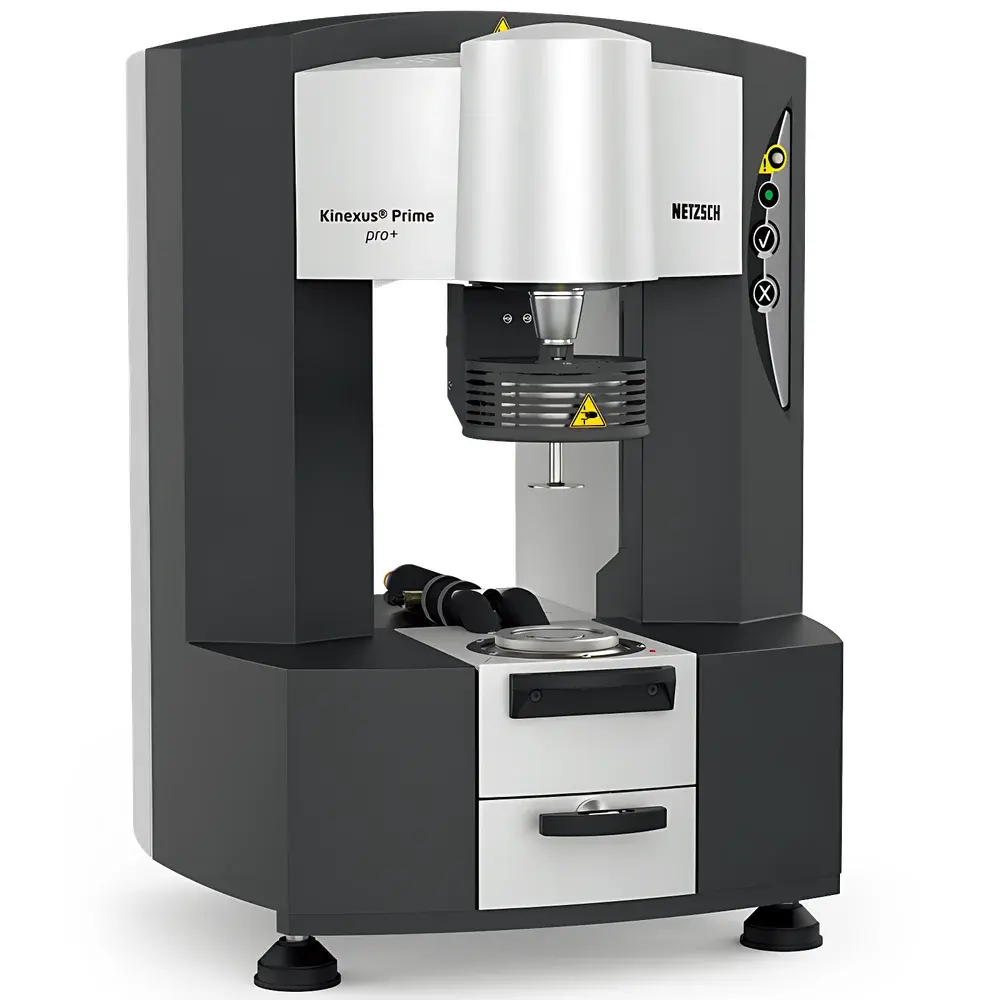
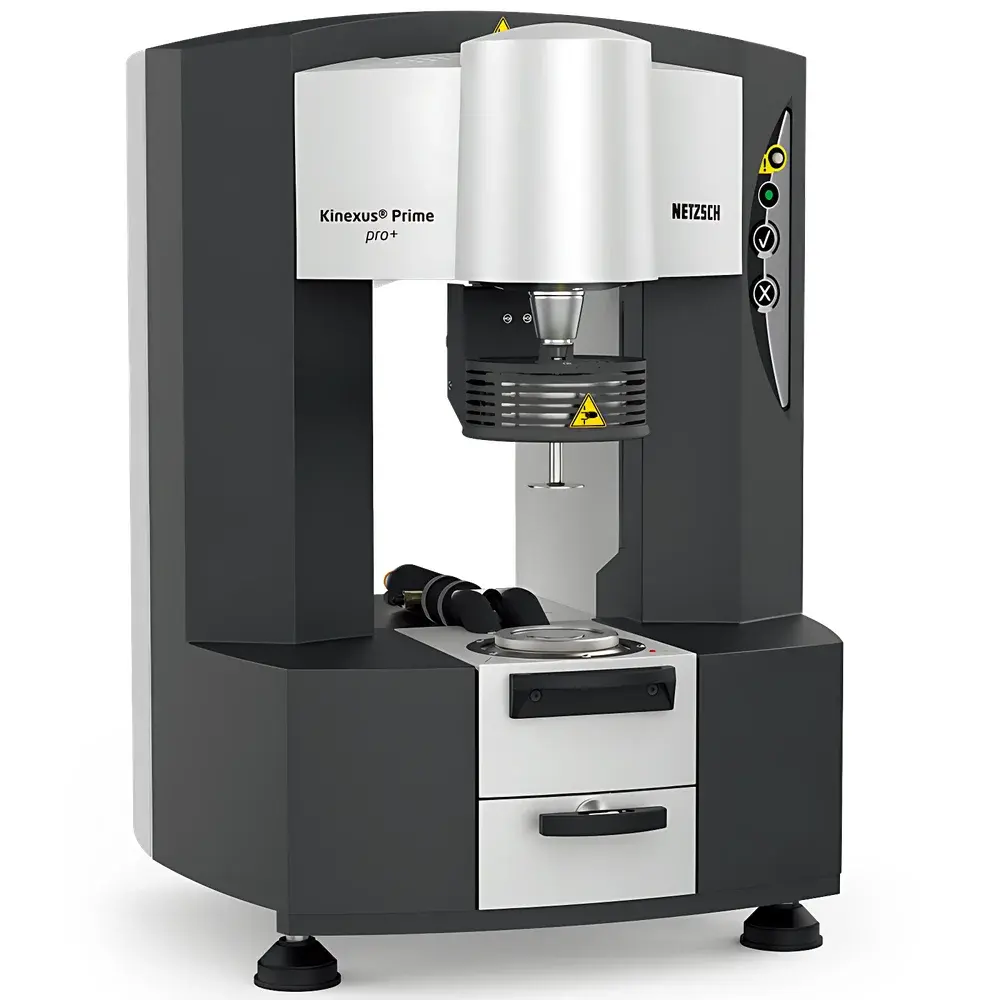
Netzsch Kinexus pro+ Advanced Rotational Rheometer
| Brand | Netzsch |
|---|---|
| Origin | Germany |
| Model | Kinexus pro+ |
| Instrument Type | Rotational Rheometer |
| Motor Bearing | Air Bearing |
| Minimum Angular Velocity | 1 nrad/s |
| Maximum Angular Velocity | 500 rad/s |
| Frequency Range | 1 µHz – 150 Hz |
| Maximum Torque | 225 mNm |
| Torque Resolution | 0.1 nNm |
| Normal Force Range | 0.001 N – 50 N |
| Normal Force Response Time | <10 ms |
| Vertical Travel Speed | 0.1 µm/s – 35 mm/s |
| Vertical Travel Distance | 230 mm |
| Gap Resolution | 0.1 µm |
| Motor Inertia | 12 µN·m·s² |
| Torque Range (Steady-State) | 0.005 µNm – 225 mNm |
| Torque Range (Oscillatory) | 0.001 µNm – 225 mNm |
Overview
The Netzsch Kinexus pro+ Advanced Rotational Rheometer is a research-grade, modular rheological testing platform engineered for precision characterization of complex fluids and soft solids under controlled mechanical and thermal conditions. Based on Couette and cone-plate rheometry principles, it employs a high-fidelity air-bearing motor system coupled with optical encoder-based position sensing to deliver exceptional angular resolution and torque sensitivity. Its design supports both steady-state (flow) and dynamic oscillatory measurements—including amplitude sweeps, frequency sweeps, time sweeps, and temperature ramps—enabling comprehensive viscoelastic profiling of materials across decades of time and frequency scales. The instrument is purpose-built for laboratories requiring traceable, reproducible data in compliance with ISO 6721, ASTM D4440, ASTM D3835, and ISO 3219 standards, particularly in polymer science, formulation development, and quality assurance environments.
Key Features
- Ultra-low-inertia air-bearing motor (12 µN·m·s²) enabling precise control from ultra-slow rotation (1 nrad/s) to high-speed shear (500 rad/s), critical for probing yield behavior and transient response.
- Optical encoder-based angular position detection with sub-nanoradian resolution, ensuring accurate strain and strain-rate application in both rotational and oscillatory modes.
- High-sensitivity normal force transducer (0.001–50 N range, <10 ms response time) with real-time vertical displacement tracking—essential for gap-controlled measurements and thixotropy analysis.
- RFID-enabled intelligent tooling system: all measurement geometries (cones, plates, concentric cylinders, vane tools) are auto-recognized; calibration history, geometry dimensions, and correction factors are loaded automatically.
- Plug-and-play environmental control units (Peltier, liquid-circulated, or furnace modules) with automatic parameter recognition and thermal profile synchronization to rheological protocols.
- Gap resolution of 0.1 µm and vertical travel of 230 mm support high-precision sample loading, solvent trapping, and multi-layer or interface studies.
Sample Compatibility & Compliance
The Kinexus pro+ accommodates a broad spectrum of sample types: thermoplastic and thermoset polymer melts, concentrated polymer solutions, colloidal dispersions (e.g., latexes, nanosuspensions), emulsions, paints and coatings, inks, food gels, pharmaceutical suspensions, and biological hydrogels. Its modular geometry system allows seamless transition between standard geometries (25 mm/40 mm parallel plates, cone-and-plate, cylindrical fixtures) and specialized configurations (slit dies, extensional fixtures via optional SER universal testing module). All hardware and software comply with GLP and GMP documentation requirements. Data acquisition and method execution support audit trails, electronic signatures, and 21 CFR Part 11–compliant user access control when deployed with optional compliance packages.
Software & Data Management
Kinexus software provides dual-mode operation: SOP-driven workflows for routine QC testing and fully customizable scripting for advanced research protocols. It features integrated method templates aligned with ISO and ASTM test standards, automated data validation (e.g., torque saturation checks, gap deviation alerts), and real-time visualization of raw sensor outputs (torque, normal force, angle, temperature). Raw data is stored in vendor-neutral HDF5 format with embedded metadata (geometry ID, calibration timestamp, environmental settings). Export options include CSV, Excel, and RheoML-compliant XML for third-party analysis (e.g., MATLAB, Python SciPy, or commercial rheology modeling tools). Version-controlled method libraries, role-based permissions, and cloud-synced backup ensure laboratory-wide consistency and regulatory readiness.
Applications
- Molecular weight and molecular weight distribution estimation via master curve construction and time–temperature superposition (TTS) of linear viscoelastic data.
- Processing window definition for extrusion, injection molding, and coating operations through melt fracture onset, extensional viscosity, and shear thinning analysis.
- Stability assessment of suspensions and emulsions using amplitude sweep (LVR limit, yield stress), frequency sweep (G′/G″ crossover), and recovery tests.
- Thermo-rheological characterization of curing systems (epoxies, acrylics) via isothermal gelation kinetics and vitrification mapping.
- Quality control of incoming raw materials (e.g., resin viscosity, filler dispersion homogeneity) and finished products (e.g., paint sag resistance, ink tack, food texture consistency).
FAQ
What is the difference between steady-state and oscillatory rheological testing on the Kinexus pro+?
Steady-state tests apply constant shear rate or shear stress to determine viscosity flow curves and yield stress; oscillatory tests impose sinusoidal strain/stress to quantify storage (G′) and loss (G″) moduli, revealing viscoelastic structure and relaxation dynamics.
Can the Kinexus pro+ perform extensional rheology?
Yes—when equipped with the optional SER Universal Testing Module (UTM), it enables uniaxial extensional measurements on polymer melts and solutions using filament stretching techniques.
Is the instrument compatible with non-standard or custom geometries?
Yes—through its open API and manual gap override mode, users may integrate custom fixtures (e.g., microfluidic channels, porous media inserts) while retaining torque and normal force calibration integrity.
How does the system handle thermal expansion during temperature sweeps?
The intelligent gap control algorithm continuously compensates for thermal expansion of both sample and geometry using real-time normal force feedback and pre-loaded material-specific coefficients.
What level of data traceability does the software provide for regulated industries?
With the Compliance Pack enabled, Kinexus software delivers full ALCOA+ compliant data: attributable, legible, contemporaneous, original, accurate, complete, consistent, enduring, and available—with electronic signatures, change logs, and 21 CFR Part 11 audit trails.



