
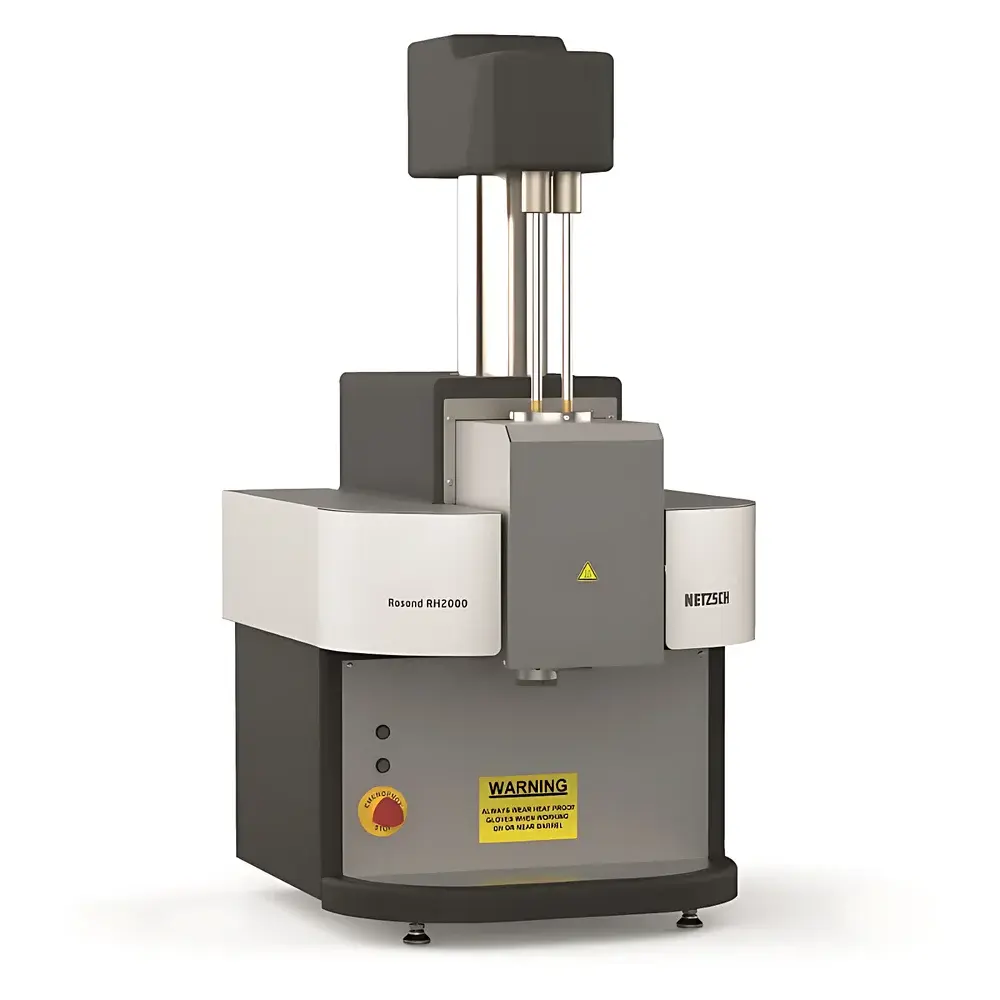
Netzsch Kinexus Rosand RH2000 Capillary Rheometer
| Brand | Netzsch |
|---|---|
| Origin | Germany |
| Model | Kinexus Rosand RH2000 |
| Instrument Type | Capillary Rheometer |
| Sample State | Liquid |
| Minimum Piston Speed | 10 µm/min |
| Maximum Piston Speed | 1200 mm/min |
| Maximum Load | 20 kN |
| Die Diameter Range | 0.5–3 mm |
| Barrel Diameter | 15 mm (standard), optional 9.5 / 12 / 19 / 24 mm |
| Barrel Material | Nitrided Steel (optional stainless steel or Hastelloy) |
| Die Material | Tungsten Carbide |
| Speed Dynamic Range | 240,000:1 |
| Compliance | ASTM D3835, ISO 11443, ISO 6721-6, USP <911> |
Overview
The Netzsch Kinexus Rosand RH2000 Capillary Rheometer is a high-precision, research-grade instrument engineered for the quantitative characterization of molten polymers, thermoplastic melts, concentrated suspensions, and other viscoelastic fluids under realistic processing shear conditions. Operating on the principle of capillary rheometry—measuring pressure drop across a precision-machined die while controlling piston displacement—the RH2000 delivers fundamental rheological data including apparent viscosity, shear stress, shear rate, melt elasticity (via die swell ratio), extensional viscosity (with optional draw-down or melt strength attachments), and thermal stability indicators such as melt fracture onset and thermal degradation thresholds. Its modular architecture supports both standard capillary extrusion and advanced configurations including slit dies, PVT (pressure-volume-temperature) measurement modules, nitrogen-purged environments, and laser-based die swell analysis—enabling direct correlation between laboratory measurements and industrial processes such as fiber spinning, blow molding, film extrusion, hot-melt coating, and high-speed additive manufacturing.
Key Features
- H-frame mechanical architecture delivering superior longitudinal stiffness (>10× higher than conventional cantilever or C-frame designs), minimizing deflection during high-load extrusion and ensuring measurement integrity at loads up to 20 kN.
- Dual-barrel measurement capability—simultaneous testing in long and short dies—enabling automatic Bagley correction without manual recalibration or sample reprocessing.
- Digital dual-mode speed control system offering seamless transition between displacement-controlled (for constant shear rate) and force-controlled (for constant stress) operation modes with real-time adaptive feedback.
- Intuitive Kinexus software interface featuring context-aware workflow guidance, step-by-step experimental setup validation, and integrated calibration traceability per ISO/IEC 17025 requirements.
- Modular die and barrel configuration: standard 15 mm barrel with optional diameters (9.5, 12, 19, 24 mm); tungsten carbide dies (0.5–3 mm); corrosion-resistant barrel options (stainless steel, Hastelloy) for aggressive formulations.
Sample Compatibility & Compliance
The RH2000 accommodates thermoplastic polymers (e.g., PE, PP, PET, PC), engineering resins (PA, PEEK), filled compounds, reactive hot-melts, ceramic/polymer suspensions, and pharmaceutical excipient melts. All measurements adhere to internationally recognized standards including ASTM D3835 (determination of apparent viscosity), ISO 11443 (determination of flow properties), ISO 6721-6 (dynamic mechanical properties), and USP (rheological evaluation of semisolid dosage forms). The system supports GLP-compliant audit trails, electronic signature enforcement, and 21 CFR Part 11–ready data archiving when deployed with validated Kinexus software configurations.
Software & Data Management
Kinexus software provides full experimental lifecycle management—from method definition and hardware initialization through real-time data acquisition, automated Bagley and Rabinowitsch corrections, and post-processing visualization. Raw pressure, temperature, position, and load signals are captured at ≥1 kHz sampling rates with 16-bit resolution. Export formats include CSV, HDF5, and proprietary .kdf files compatible with third-party analysis tools (e.g., MATLAB, Python SciPy, RheoTool). All data records include embedded metadata: operator ID, instrument serial number, calibration certificate IDs, environmental logs (ambient temperature/humidity), and version-stamped software build information—ensuring full traceability for regulatory submissions and internal quality audits.
Applications
- Processing simulation: prediction of extrudate swell, die entry pressure loss, and melt fracture limits in extrusion, injection molding, and thermoforming.
- Formulation development: comparative assessment of shear-thinning behavior, thermal stability, and elastic recovery across polymer grades or additive packages.
- Quality control: batch-to-batch consistency verification of melt flow index (MFI)-equivalent parameters under controlled shear histories.
- R&D of emerging materials: characterization of bio-based polymers, nanocomposites, and stimuli-responsive gels under high-shear, high-temperature conditions.
- Regulatory support: generation of rheological evidence for FDA submissions (e.g., ANDA, NDA), EMA dossiers, and ISO 13485–aligned medical device material qualification.
FAQ
What standards does the RH2000 comply with for capillary rheometry?
ASTM D3835, ISO 11443, ISO 6721-6, and USP —with full documentation of calibration procedures and uncertainty budgets available upon request.
Can the system perform extensional viscosity measurements?
Yes—when equipped with the optional Melt Strength Tester (MST) or laser-assisted draw-down module, enabling uniaxial extensional flow characterization per ISO 19940 and ASTM D8067.
Is nitrogen purge integration available for oxygen-sensitive samples?
Yes—the RH2000 supports configurable inert gas purging (N₂ or Ar) across the barrel, die assembly, and collection zone to prevent oxidative degradation during prolonged high-temperature tests.
How is Bagley correction implemented?
Through simultaneous dual-die measurement (long + short) within a single test run; correction coefficients are computed automatically in real time using the Kinexus software’s built-in rheological solver.
What level of software validation support is provided for regulated environments?
Netzsch offers IQ/OQ documentation packages, 21 CFR Part 11 compliance add-ons (including electronic signatures and audit trail review tools), and on-site validation assistance for GMP/GLP laboratories.



