
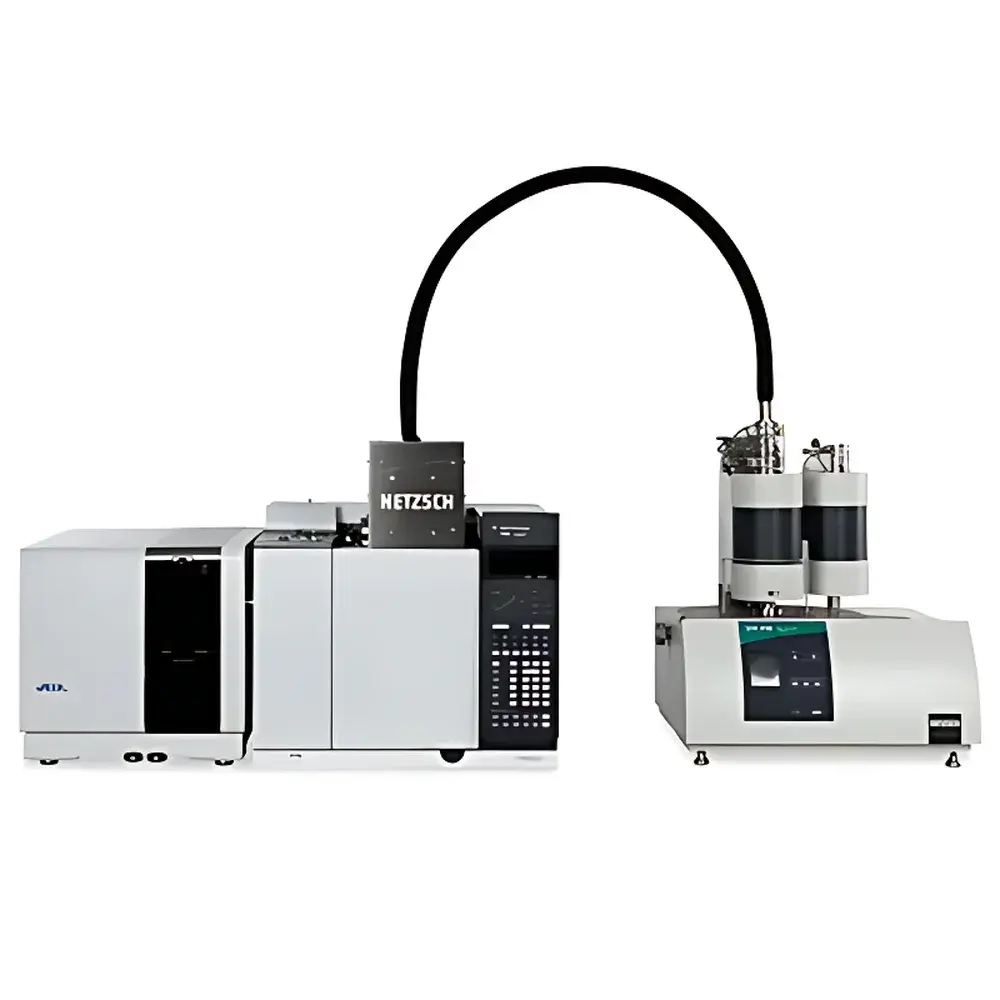
Netzsch STA-GC-MS Thermal Analysis Coupled System with Simultaneous TGA/DSC and Gas Chromatography-Mass Spectrometry
| Brand | Netzsch |
|---|---|
| Origin | Germany |
| Model | STA-GC-MS |
| Operating Temperature Range | RT to 350 °C |
| Coupling Interface | Heated Transfer Line (up to 350 °C) with Six-Port Valve Box |
| Trigger Mode | Event-Driven Synchronization |
| Software | Fully Integrated, Real-Time Hardware Synchronization |
| Standalone Operation | Yes (STA and GC-MS operate independently) |
| Compliance | Designed for GLP/GMP environments |
Overview
The Netzsch STA-GC-MS is a fully integrated thermal analysis coupled system that synchronizes simultaneous thermogravimetric analysis/differential scanning calorimetry (STA/TG-DSC) with gas chromatography–mass spectrometry (GC-MS). Engineered for precision in evolved gas analysis (EGA), this platform enables real-time identification and quantification of volatile and semi-volatile species released during thermal decomposition, oxidation, reduction, or desorption processes. The system operates on the principle of event-triggered coupling: thermal events—such as mass loss steps or exothermic peaks detected by the STA—are used as logical triggers to initiate GC injection, ensuring temporal correlation between thermal behavior and molecular speciation. This architecture eliminates time-lag artifacts common in sequential or manually timed off-gas analysis and provides unambiguous assignment of evolved compounds to specific reaction stages.
Key Features
- Vertical top-loading STA configuration with direct sample access—minimizes dead volume and ensures quantitative transfer of evolved gases without adsorption or condensation losses.
- Heated transfer pathway from STA furnace outlet to GC six-port valve box, maintained continuously at up to 350 °C; includes heated interface, fused-silica capillary transfer line, and temperature-controlled valve manifold.
- Event-driven synchronization engine embedded in Proteus® software: automatically initiates GC sequence upon detection of user-defined thermal thresholds (e.g., derivative mass loss rate > X µg/s, or DSC onset exceeding Y mW).
- Fully internalized control architecture: single software interface manages STA temperature ramping, GC oven programming, MS acquisition parameters, and data time-stamping—all synchronized via hardware-level triggers (TTL pulses).
- Dual operational mode: STA and GC-MS subsystems function independently for routine characterization or method development; coupling is activated only when EGA workflows are required.
- Modular design compliant with ISO/IEC 17025 laboratory infrastructure standards; supports calibration traceability to NIST-traceable reference materials for both thermal and mass spectral domains.
Sample Compatibility & Compliance
The STA-GC-MS accommodates solid, powder, and thin-film samples (typically 0.1–20 mg) across polymers, pharmaceuticals, catalysts, battery materials, ceramics, and inorganic precursors. It meets critical regulatory requirements for analytical method validation in regulated industries: full support for electronic signatures, audit trail logging, and secure user access control when configured with optional 21 CFR Part 11–compliant software modules. Data files conform to ASTM E2689 (Standard Guide for Evolved Gas Analysis) and ISO 11358-3 (Polymer thermogravimetry — Part 3: Determination of evolved gases). Instrument qualification documentation—including IQ/OQ protocols—is available per client-specific GxP implementation needs.
Software & Data Management
Proteus® software serves as the unified control and analysis environment. It features synchronized multi-channel data acquisition (TGA, DSC, DTG, GC total ion current, and selected ion monitoring traces), overlaid timeline visualization, and automated peak matching between thermal events and GC-MS chromatograms. Raw data are stored in vendor-neutral .tdf format (Thermo Fisher compatibility supported via conversion tools). Batch processing supports method templating, automatic baseline correction, and library-assisted compound identification using NIST MS Search with customizable spectral matching thresholds. All operations generate timestamped, immutable metadata logs suitable for GLP audits.
Applications
- Elucidation of decomposition pathways in energetic materials and flame retardants.
- Quantification of residual solvents (e.g., DMF, THF, acetone) in API intermediates per ICH Q3C guidelines.
- Identification of volatile organic impurities formed during polymer aging or photodegradation.
- Characterization of precursor-to-oxide conversion mechanisms in sol-gel synthesis.
- Real-time monitoring of catalytic coke formation and oxidative regeneration chemistry.
- Analysis of moisture, bound water, and structural hydroxyl release profiles in metal–organic frameworks (MOFs).
FAQ
Can the STA and GC-MS be operated separately?
Yes—the system is designed with electrically and thermally isolated subsystems; each instrument retains full standalone functionality without requiring coupling hardware activation.
What is the minimum detectable mass loss step resolvable by the event trigger?
Trigger sensitivity is configurable down to 0.1 µg/s in derivative thermogravimetry (DTG), subject to sample mass, heating rate, and baseline stability.
Is cryogenic trapping supported in the GC inlet?
No—this configuration relies on direct hot-gas transfer; cryo-trapping is incompatible with the heated interface design but may be implemented externally via optional add-on modules.
Does the system support hyphenated techniques beyond GC-MS?
The modular interface architecture allows integration with FTIR or quadrupole mass spectrometers (QMS); GC-MS coupling is the factory-configured and validated configuration.
Are application notes and method templates included?
Yes—Netzsch provides a comprehensive library of validated SOPs, including polymer degradation, pharmaceutical residual solvent, and catalyst deactivation workflows, all preloaded in Proteus®.



