
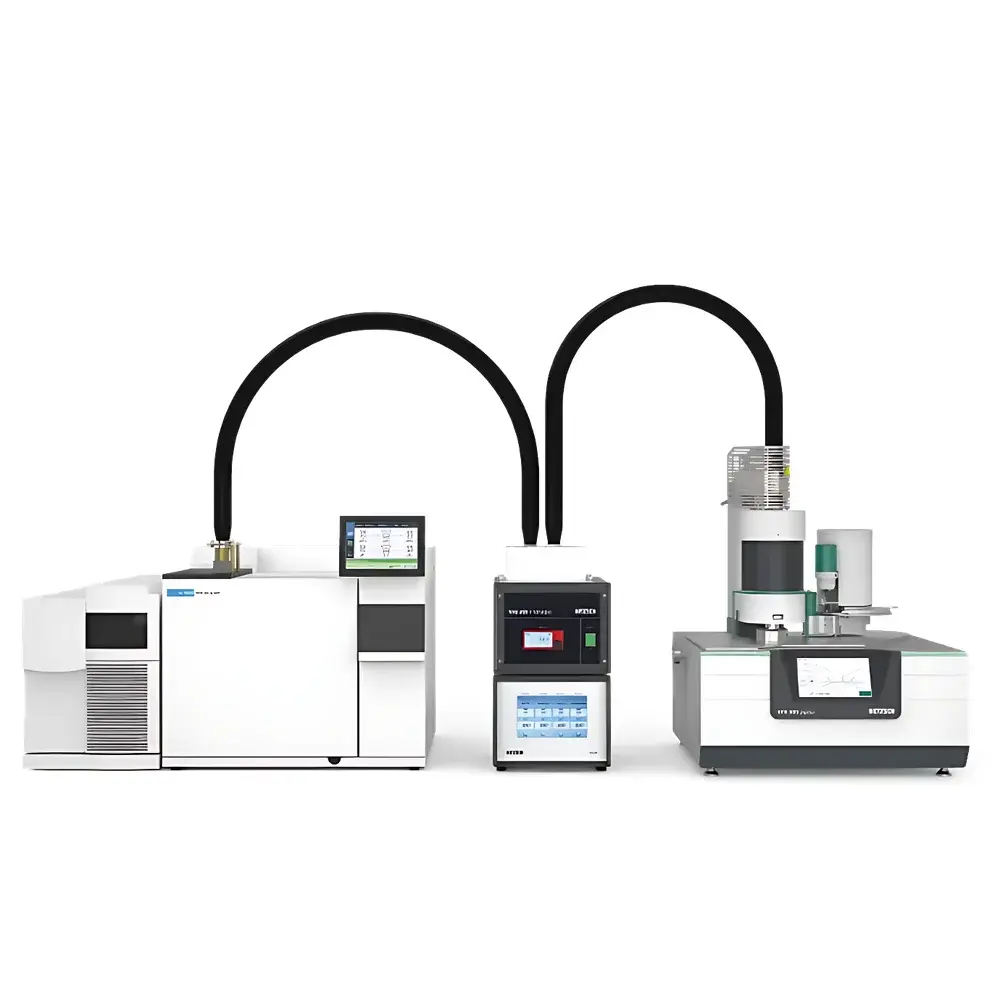
Netzsch STA/TG-FTIR-MS Hyphenated Thermal Analysis System
| Brand | Netzsch |
|---|---|
| Origin | Germany |
| Model | STA/TG-FTIR-MS |
| Mass Range | 1–300 amu |
| Transfer Line Temperature | RT to 350 °C |
| Gas Path | Heated, Condensation-Free |
| Detection Sensitivity | High |
| Gas Residence Time | Short |
| Carrier Gas Dilution Effect | Minimal |
| FTIR & MS Operation Modes | Simultaneous or Standalone |
Overview
The Netzsch STA/TG-FTIR-MS Hyphenated Thermal Analysis System is an integrated multi-technique platform engineered for real-time, molecular-level characterization of evolved gases during thermal decomposition, oxidation, reduction, and solid–gas reactions. It combines simultaneous thermogravimetric analysis (TGA) and differential scanning calorimetry (DSC) in a single synchronous measurement (Simultaneous Thermal Analysis, STA), coupled via a high-efficiency, temperature-controlled transfer line to both Fourier Transform Infrared (FTIR) spectroscopy and quadrupole mass spectrometry (MS). This hyphenation enables concurrent identification and quantification of volatile and semi-volatile species—such as H₂O, CO, CO₂, NOₓ, SO₂, NH₃, organic fragments, and residual solvents—based on their characteristic IR absorption bands and mass-to-charge (m/z) ratios. The system operates on the principle of evolved gas analysis (EGA), where thermal events measured by the STA unit are temporally and quantitatively correlated with spectral and mass spectral signatures, providing mechanistic insight into reaction pathways, kinetic modeling inputs, and compositional stability assessment under controlled heating profiles.
Key Features
- True parallel hyphenation: STA, FTIR, and MS operate synchronously with hardware-triggered data acquisition, ensuring temporal alignment of mass loss, heat flow, infrared absorbance, and ion current signals.
- Vertically oriented top-loading TGA furnace design minimizes gravitational loss of particulates and ensures complete transfer of evolved gases from sample crucible to interface.
- Heated transfer line (RT to 350 °C) with uniform temperature profile prevents condensation of high-boiling-point analytes—including oligomers, plasticizers, and metal-organic precursors—throughout the entire gas path.
- Independent, dedicated gas circuits for FTIR and MS eliminate cross-talk, pressure mismatch, and signal interference; each subsystem maintains optimal operating conditions without compromise.
- Fully integrated software architecture supports unified method setup, real-time spectral monitoring, automated peak deconvolution, and time-resolved 3D visualization (temperature vs. time vs. intensity).
- Modular configuration allows standalone operation of FTIR or MS for routine off-line screening, enhancing laboratory flexibility and instrument utilization efficiency.
Sample Compatibility & Compliance
The system accommodates solid, powder, and thin-film samples across diverse material classes—including polymers, pharmaceuticals, battery cathode precursors, catalysts, ceramics, and composites—within standard alumina, platinum, or gold crucibles (up to 100 mg capacity). Sample introduction is compatible with controlled atmosphere options (N₂, Ar, O₂, synthetic air, or custom gas mixtures) and optional humidity control modules. Data integrity and regulatory compliance are supported through audit-trail-enabled software compliant with FDA 21 CFR Part 11 requirements, including electronic signature management, user access levels, and immutable raw data archiving. Method validation aligns with ASTM E1131, ISO 11358, and USP for residual solvent analysis, facilitating GLP/GMP-aligned reporting in quality control and R&D environments.
Software & Data Management
NETZSCH Proteus® Software serves as the central control and evaluation environment, featuring synchronized multi-channel acquisition, automatic baseline correction, library-based spectral matching (Hummel IR library, NIST MS library), and kinetic analysis tools (e.g., Friedman, Ozawa–Flynn–Wall). All raw data files (.pro, .spc, .raw) are stored in vendor-neutral formats with embedded metadata (instrument parameters, calibration history, operator ID, timestamp). Export options include CSV, ASCII, and CDF for integration with third-party chemometric platforms (e.g., MATLAB, Python SciPy, Unscrambler). Data security protocols support networked deployment in validated IT infrastructures, with optional backup to NAS or cloud repositories meeting ISO/IEC 27001 standards.
Applications
- Mechanistic elucidation of thermal degradation pathways in flame-retardant polymers and biodegradable plastics.
- Quantification of bound water, crystallization solvents, and excipient–API interactions in pharmaceutical dosage forms per ICH Q5C guidelines.
- In-situ monitoring of precursor decomposition kinetics in Li-ion battery cathode synthesis (e.g., LiCoO₂, NMC, LFP).
- Identification of corrosive volatiles (HCl, HF, SO₂) released during halogenated polymer combustion for fire safety certification (UL 94, EN 45545).
- Characterization of catalyst deactivation via coke formation and sulfur poisoning in petrochemical feedstocks.
- Validation of thermal stability margins for aerospace-grade composites under simulated re-entry conditions.
FAQ
Can the FTIR and MS be operated independently of the STA unit?
Yes—each analytical module retains full standalone functionality with dedicated control interfaces and calibration routines.
What is the minimum detectable concentration for CO₂ using the MS channel?
Detection limits are method-dependent; typical values range from 10–50 ppmv under optimized dwell time and electron multiplier gain settings.
Is the transfer line heated uniformly along its entire length?
Yes—the line features zone-controlled heating with ±1 °C stability across its full 1.2 m length, verified by embedded thermocouple mapping.
Does the system support purge-and-trap or cryo-focusing for trace analyte enrichment?
Not natively; however, external cryo-trapping modules can be interfaced via the standardized 6-mm OD Swagelok inlet port.
How is calibration traceability maintained for quantitative evolved gas analysis?
Mass spectrometer calibration uses certified gas mixtures (e.g., Air Liquide Traceable Standards); FTIR employs polystyrene film and water vapor reference spectra traceable to NIST SRM 1921b.



