
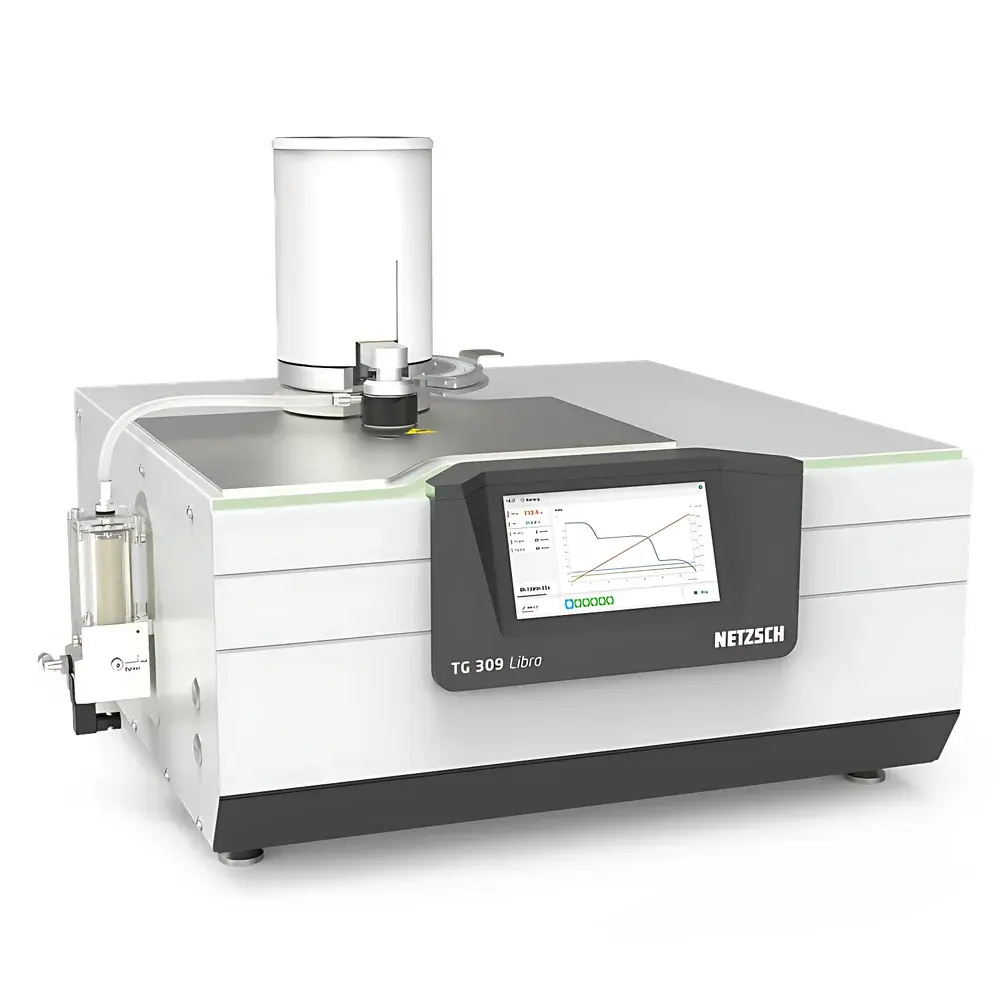
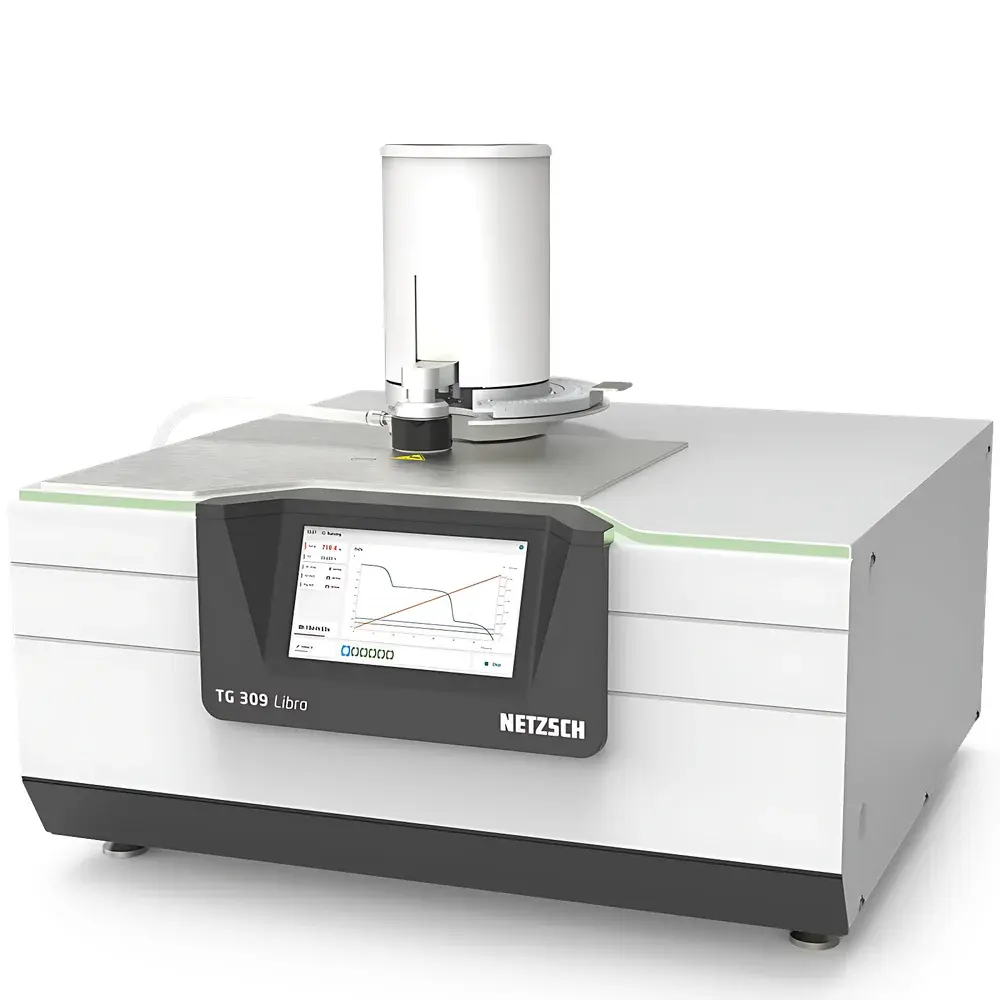
Netzsch TG 309 Libra Classic Thermogravimetric Analyzer
| Brand | Netzsch |
|---|---|
| Origin | Germany |
| Model | TG 309 Libra Classic |
| Temperature Range | 10 °C to 1025 °C |
| Temperature Accuracy | ±0.15 K |
Overview
The Netzsch TG 309 Libra Classic is a high-precision, modular thermogravimetric analyzer engineered for rigorous thermal stability, decomposition kinetics, and compositional analysis of solid and liquid materials under controlled atmospheric conditions. Operating on the fundamental principle of continuous mass measurement as a function of temperature or time in a defined gas environment, the instrument employs a high-resolution microbalance (with sub-microgram resolution) coupled with a precisely regulated horizontal furnace system. Its design adheres to core ISO 11358 and ASTM E1131 standards for thermogravimetric analysis, ensuring traceable, reproducible quantification of mass change events—including dehydration, oxidative degradation, polymer decomposition, filler content determination, and residual ash evaluation. The horizontal furnace geometry minimizes convection-induced buoyancy effects, enhancing baseline stability and measurement fidelity across extended heating ramps and isothermal holds.
Key Features
- Patented c_DTA® technology: Simultaneous acquisition of differential thermal analysis (DTA) signals alongside TGA data—enabling real-time temperature calibration, detection of endo-/exothermic transitions coincident with mass loss, and improved identification of overlapping thermal events.
- Super-Res® functionality (optional): Adaptive heating rate modulation that dynamically slows ramping near inflection points to resolve closely spaced mass-loss steps—critical for multi-component polymer blends, pharmaceutical hydrates, or composite materials.
- Temperature-modulated TGA (TMTGA, optional): Superimposes small-amplitude sinusoidal temperature oscillations onto linear ramps, allowing separation of kinetic and thermodynamic contributions to mass loss—particularly valuable for studying complex decomposition mechanisms.
- Advanced baseline correction algorithms: Automated drift compensation based on pre- and post-run inert reference segments, minimizing operator-dependent manual baseline fitting.
- Dual-signal derivative processing: On-the-fly calculation and annotation of first (DTG) and second derivatives of the TGA curve, with automated peak detection, onset/endpoint extrapolation (tangent intersection method), and quantitative residue reporting in both % and absolute mg units.
Sample Compatibility & Compliance
The TG 309 Libra Classic supports a broad spectrum of sample types—including powders, granules, films, fibers, gels, and viscous liquids—via interchangeable crucible systems (Al2O3, Pt/Rh, quartz, graphite, and Al). High-corrosion-resistant sample carriers accommodate aggressive halogenated or sulfur-containing compounds. Optional cryogenic cooling (via integrated recirculating chiller) extends operational range down to 10 °C, enabling low-temperature desorption studies and enhanced thermal shock resistance during rapid cooling cycles. Vacuum and controlled gas (N2, O2, Ar, synthetic air, forming gas) environments are fully programmable via mass flow controllers compliant with ISO 8573-1 purity classes. All configurations support GLP/GMP workflows, including full audit trails, electronic signatures, and 21 CFR Part 11–compliant software modules when paired with Proteus® Analysis Software.
Software & Data Management
Controlled exclusively through Netzsch’s Proteus® software suite, the system provides intuitive method setup, real-time monitoring, and comprehensive post-processing. Proteus® includes embedded calibration wizards aligned with ASTM E967 (temperature) and E1131 (mass) protocols, reference material databases (e.g., Ni, In, Zn, Al2O3) covering 10–1100 °C, and automated report generation compliant with ISO/IEC 17025 documentation requirements. Data export formats include ASCII, CSV, and universal .tdms for integration into LIMS or statistical process control platforms. Optional ASC (Automatic Sample Changer) enables unattended operation of up to 20 samples per run, with full scheduling, failure recovery, and QC flagging based on user-defined acceptance criteria.
Applications
- Quantitative determination of moisture, solvents, volatiles, and organic/inorganic content in polymers, pharmaceuticals, and composites.
- Kinetic modeling of thermal degradation (e.g., Flynn-Wall-Ozawa, Kissinger methods) using multi-heating-rate TGA datasets.
- Stability assessment of battery cathode/anode materials under inert and oxidative atmospheres.
- Residue and ash content validation per ASTM D3174, ISO 1171, and USP .
- Decomposition profiling of catalysts, zeolites, and metal-organic frameworks (MOFs).
- Quality control of incoming raw materials and finished products in regulated manufacturing environments.
FAQ
What is the standard temperature calibration protocol supported by the TG 309 Libra Classic?
The system utilizes certified reference materials (e.g., nickel, indium, zinc, aluminum oxide) traceable to NIST and PTB standards, following ASTM E967 procedures for multi-point temperature calibration across its full operating range.
Can the instrument perform isothermal TGA experiments at sub-ambient temperatures?
Yes—when equipped with the optional recirculating chiller and low-temperature furnace configuration, isothermal holds from 10 °C upward are fully supported with ±0.1 K stability over 24 hours.
Is c_DTA® functionality hardware-integrated or software-only?
c_DTA® is a proprietary hardware architecture integrating dual thermocouple sensing directly into the sample and reference positions—providing true simultaneous DTA signal acquisition without post-processing approximation.
Does the ASC (Automatic Sample Changer) require special crucible types or geometries?
No—the ASC is compatible with all standard Netzsch crucibles (including high-sensitivity c_DTA® crucibles) and accommodates both open and hermetic lid configurations without mechanical modification.
How does the system ensure long-term mass measurement stability during multi-day experiments?
Through active thermal management of the microbalance chamber (isolated from furnace heat radiation), continuous buoyancy correction algorithms, and periodic zero-point verification using internal reference weights—all implemented without interrupting data acquisition.



