
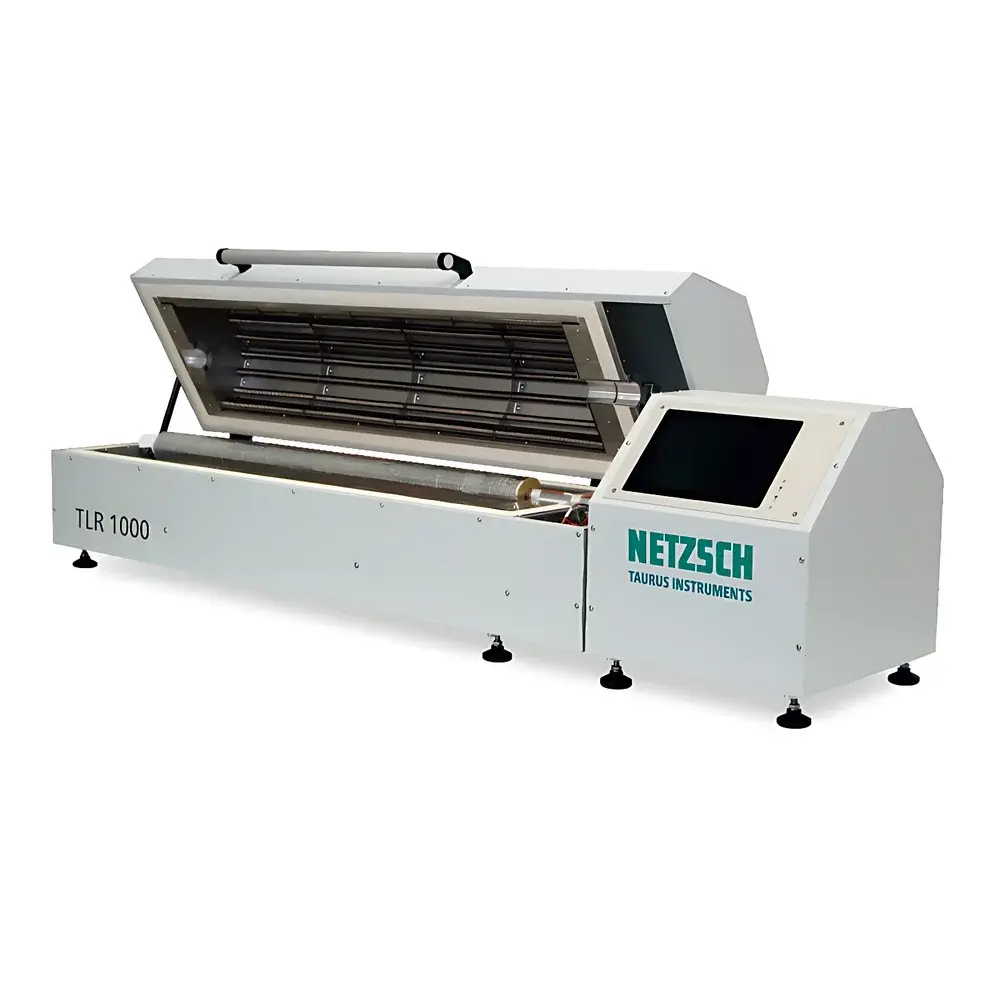
Netzsch TLR 1000 Guarded Hot Pipe Thermal Conductivity Analyzer
| Brand | Netzsch |
|---|---|
| Origin | Germany |
| Model | TLR 1000 |
| Measurement Principle | Guarded Hot Pipe Method |
| Standards Compliance | DIN EN ISO 8497, DIN EN 1946-5, DIN 52613, ASTM C 534, ASTM C 335 |
| Thermal Conductivity Range | 0.001–0.25 W/(m·K) |
| Accuracy | ±1.0% |
| Repeatability | ±0.5% |
| Sample ID | 18–89 mm |
| Sample OD | 30–220 mm |
| Test Chamber Temperature Range | −15 to +140 °C |
| Heating Pipe Temperature Range | 20 to +200 °C |
| Dimensions (H×W×D) | 45×185×50 cm |
| Sample Throughput | Multi-sample sequential operation |
| Operating Environment | Ambient laboratory conditions |
Overview
The Netzsch TLR 1000 is a precision-engineered guarded hot pipe thermal conductivity analyzer designed for the steady-state determination of thermal conductivity (λ) and thermal resistance (R) in low-conductivity insulating materials. Based on the guarded hot pipe principle—a variant of the guarded hot plate method adapted for cylindrical geometry—the instrument establishes a one-dimensional radial heat flow through annular or tubular specimens under controlled temperature gradients. This configuration eliminates edge losses and ensures high measurement fidelity for heterogeneous, anisotropic, or compressible insulation materials commonly encountered in building physics, industrial thermal management, and aerospace applications. Unlike transient methods (e.g., laser flash), the TLR 1000 delivers absolute, calibration-free results traceable to SI units via direct application of Fourier’s law, making it suitable for regulatory submissions, quality control audits, and R&D validation where metrological rigor is mandated.
Key Features
- Guarded hot pipe architecture with active lateral thermal guarding to suppress parasitic axial and radial heat losses—ensuring compliance with ISO 8497 and ASTM C 534 requirements for cylindrical specimen testing.
- Modular, variable-diameter hot pipe system: inner diameter adjustable from 18 mm to 89 mm, enabling characterization of diverse geometries including core samples, pipe insulation sleeves, and VIP edge sections.
- Integrated high-resolution touchscreen HMI with intuitive workflow navigation, real-time thermal gradient monitoring, and automated test sequence execution—including pre-conditioning hold, equilibrium verification, and multi-point thermal profiling.
- Top-access sample loading mechanism minimizes thermal disturbance during specimen exchange and supports rapid turnaround between measurements without chamber disassembly.
- Independent dual-zone temperature control: test chamber (−15 to +140 °C) and heating pipe (20 to +200 °C) operate with ±0.1 °C stability, facilitating low-temperature cryogenic insulation evaluation and high-temperature ceramic fiber assessment.
- Robust mechanical design with rigid aluminum frame and low-thermal-conductivity support fixtures to maintain geometric integrity and minimize measurement drift over extended test cycles.
Sample Compatibility & Compliance
The TLR 1000 accommodates a broad spectrum of low-density, low-thermal-conductivity materials in cylindrical or ring-shaped forms. Validated specimen types include mineral wool batts, glass fiber blankets, aerogel composites, polyurethane (PUR) and polyisocyanurate (PIR) foams, expanded (EPS) and extruded (XPS) polystyrene, polyimide foams, vacuum insulated panels (VIPs), multilayer reflective insulation systems, gypsum board cores, wood-based panels (MDF, OSB), fired clay bricks, and ceramic fiber modules. All measurements adhere strictly to international standard protocols: DIN EN ISO 8497 (thermal insulation—determination of steady-state thermal transmission properties of pipe insulation), DIN EN 1946-5 (building environment design—thermal performance of ductwork), ASTM C 534 (flexible cellular elastomeric insulation), and ASTM C 335 (high-temperature thermal insulation). Data outputs are structured to support GLP-compliant reporting and FDA 21 CFR Part 11–enabled electronic records when integrated with Netzsch’s validated software suite.
Software & Data Management
Control and analysis are performed using Netzsch’s proprietary THERMOSTEP software, which provides full IEC 61508–aligned operational safety, configurable user roles with password-protected access levels, and audit-trail logging of all parameter changes, calibration events, and measurement sessions. Raw thermal gradient data (ΔT), power input (Q), geometric inputs (ri, ro, L), and calculated λ values are stored in encrypted SQLite databases with timestamped metadata. Export options include CSV, PDF test reports compliant with ISO/IEC 17025 documentation requirements, and XML files compatible with LIMS integration. Optional 21 CFR Part 11 add-on enables electronic signatures, biometric authentication, and immutable record archiving for regulated environments.
Applications
- Building envelope certification: quantifying λ-values of insulation products for CE marking and EPBD (Energy Performance of Buildings Directive) compliance.
- R&D of next-generation aerogels and nano-porous composites under sub-ambient and elevated temperature conditions.
- Quality assurance in manufacturing lines for HVAC duct insulation, refrigeration panel cores, and fire-rated passive protection systems.
- Thermal modeling validation: generating benchmark datasets for CFD simulations of heat transfer in piping networks and structural sandwich panels.
- Academic research in material science departments focused on phonon transport mechanisms in disordered amorphous solids and fibrous networks.
FAQ
What standards does the TLR 1000 directly support?
The system is fully aligned with DIN EN ISO 8497, DIN EN 1946-5, DIN 52613, ASTM C 534, and ASTM C 335 for cylindrical and annular insulation specimens.
Can the TLR 1000 measure materials below 0.001 W/(m·K)?
No—the validated lower limit is 0.001 W/(m·K); for ultra-low-conductivity materials (e.g., evacuated aerogels < 0.001 W/(m·K)), supplementary vacuum chamber integration or alternative methods such as guarded hot plate with extended guard zones may be required.
Is sample thickness a critical variable in guarded hot pipe testing?
Yes—radial thickness (ro − ri) must be sufficient to ensure measurable temperature drop across the specimen while remaining within the instrument’s geometric constraints; recommended minimum radial thickness is ≥5 mm for reliable signal-to-noise ratio.
Does the TLR 1000 require external calibration references?
No—its primary calibration relies on traceable electrical power measurement and certified dimensional metrology; NIST-traceable reference materials (e.g., SRM 1450c Fibrous Glass Board) are optional for secondary verification and inter-laboratory comparison.
How is thermal contact resistance minimized during testing?
Through standardized surface preparation (flatness ≤ 0.05 mm), controlled axial compression (≤ 5 kPa for soft materials), and optional graphite-based thermal interface paste application per ASTM C 177 Annex A4 guidelines.



