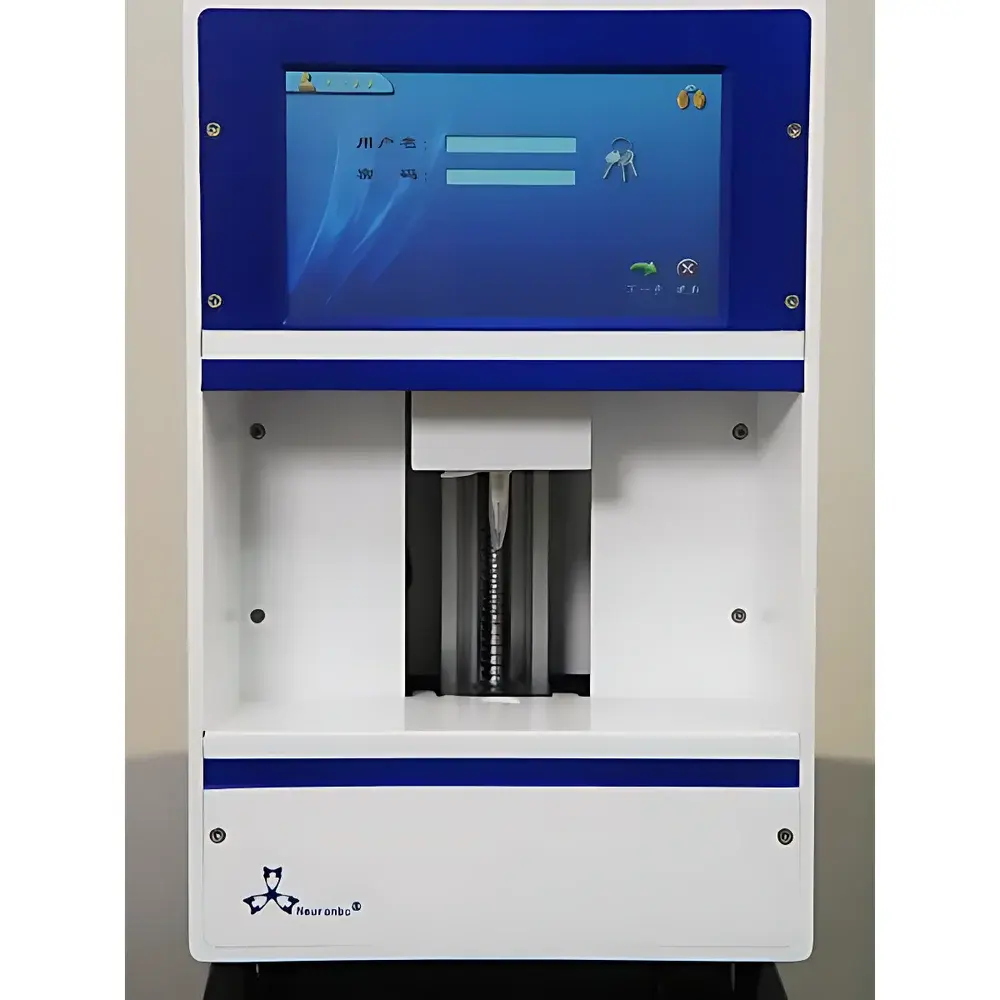
NeuronBC FPOSM-V2.0 Freezing Point Osmometer
| Brand | NeuronBC |
|---|---|
| Model | FPOSM-V2.0 |
| Measurement Principle | Freezing Point Depression (based on Raoult’s Law) |
| Measurement Range | 0–2000 mOsmol/kg |
| Sample Volume | 100 µL |
| Analysis Time | ≤3 min |
| Pre-cooling Time | ≤3 min |
| Accuracy | ≤±1% |
| Repeatability | ≤±1% |
| Linearity | ≤±1% |
| Operating Temperature | 0–30 °C (recommended 15–25 °C) |
| Relative Humidity | ≤60% RH |
| Power Supply | 220 V AC, 50 Hz, 150 VA |
| Dimensions | 225 × 275 × 345 mm |
| Weight | 15 kg |
| Compliance | Designed to support 21 CFR Part 11-compliant data integrity requirements (electronic signatures, user-level access control, audit-trail-ready data storage) |
Overview
The NeuronBC FPOSM-V2.0 Freezing Point Osmometer is a precision laboratory instrument engineered for accurate and reproducible determination of osmolality in aqueous solutions via the colligative property of freezing point depression. Grounded in Raoult’s law, the instrument quantifies the extent to which solute particles lower the freezing temperature of a solvent—directly proportional to the molal concentration of dissolved species. This thermodynamic principle provides a robust, non-destructive, and matrix-agnostic method for osmolality assessment, making it indispensable in pharmaceutical quality control, biologics formulation, clinical diagnostics, and regulatory-compliant stability studies. Unlike vapor pressure or membrane-based methods, freezing point depression offers superior sensitivity across low-to-high osmolality ranges (0–2000 mOsmol/kg), with minimal interference from volatile or non-ionic components.
Key Features
- High-precision platinum resistance temperature sensor (Pt1000 class A) with sub-millikelvin resolution for reliable ice-point detection.
- Dual-stage thermoelectric cooling system enabling rapid pre-cooling (≤3 min) and stable thermal equilibration—optimized for high-throughput labs requiring consecutive sample runs.
- Motorized linear actuation mechanism for temperature probe positioning, eliminating manual alignment and ensuring consistent sample immersion depth and thermal contact.
- 7-inch capacitive color touchscreen with intuitive Chinese/English bilingual GUI; supports role-based user management (administrator, operator, reviewer) and electronic signatures compliant with ALCOA+ principles.
- Onboard data storage retaining ≥3 years of measurement records—including timestamped osmolality values, freezing points, molal ratios, calibration logs, and operator IDs—with exportable CSV reports.
- Zero-liquid-coolant architecture: eliminates maintenance-intensive glycol or refrigerant loops, reducing downtime and long-term operational cost.
- Built-in pharmacopeial database containing >300 injectable drug monographs per Chinese Pharmacopoeia (ChP) Vol. IV, enabling rapid method setup and reference value lookup.
Sample Compatibility & Compliance
The FPOSM-V2.0 accommodates a broad spectrum of aqueous biological and pharmaceutical matrices, including but not limited to parenteral solutions, ophthalmic preparations, cell culture media, dialysates, urine, serum, and monoclonal antibody formulations. Its 100 µL minimum sample volume requirement minimizes material consumption—critical for precious biologics or early-stage development samples. The system adheres to fundamental metrological requirements outlined in USP <785>, EP 2.2.35, and ChP General Chapter 0632. While not certified as GMP-grade hardware, its software architecture supports configuration for GLP/GMP environments: full audit trail capability (user actions, parameter changes, result modifications), password-protected method locking, and time-stamped, immutable data archiving aligned with FDA 21 CFR Part 11 Subpart B expectations.
Software & Data Management
Firmware v2.0 integrates an embedded Linux-based operating system with deterministic real-time response. All measurements are tagged with ISO 8601 timestamps, instrument ID, sensor calibration status, and environmental monitoring (ambient temperature/humidity). Data files conform to ICH M5-compliant metadata standards and include raw thermogram traces, derivative curves, and phase-transition identification markers. Export options include USB flash drive transfer and network-enabled secure FTP push to LIMS or ELN systems. Calibration routines support single-point verification or multi-point (up to 31 points) linearity validation using NIST-traceable osmotic standards (e.g., 0, 100, 200, 300, 500, 1000, and 2000 mOsmol/kg NaCl solutions). Calibration certificates are auto-generated with uncertainty budgets per ISO/IEC 17025 guidelines.
Applications
- Final container release testing of sterile injectables per ChP, USP, and EP compendial requirements.
- Osmolality profiling during formulation development of lyophilized products, liposomal suspensions, and ADC buffer systems.
- In-process monitoring of dialysate solutions in renal care manufacturing and hospital pharmacy settings.
- Stability-indicating assay for detecting degradation-induced ionic shifts in protein therapeutics.
- Quality-by-Design (QbD) studies supporting design space definition for freeze-thaw cycles and concentration processes.
- Academic research in cryobiology, plant physiology, and renal physiology where precise solute activity quantification is essential.
FAQ
Does the FPOSM-V2.0 support 21 CFR Part 11 compliance out-of-the-box?
Yes—the system includes configurable electronic signature workflows, hierarchical user permissions, and immutable audit trails for all critical data events.
Can it measure viscous or particulate-containing samples?
It is optimized for clear, low-viscosity aqueous solutions; turbid or highly viscous samples require centrifugation or filtration prior to analysis to avoid sensor fouling and thermal lag artifacts.
Is external calibration verification required before each batch?
No—routine use requires only daily system suitability checks using a single reference standard; full multi-point calibration is recommended weekly or after maintenance.
What is the expected service life of the thermoelectric cooler?
Rated for >50,000 operational cycles under continuous lab use, with mean time between failures (MTBF) exceeding 8 years at 25 °C ambient.
How does the instrument handle ambient temperature fluctuations?
An integrated environmental compensation algorithm adjusts baseline correction dynamically using real-time chamber temperature feedback, maintaining accuracy within specification across 0–30 °C operating range.