
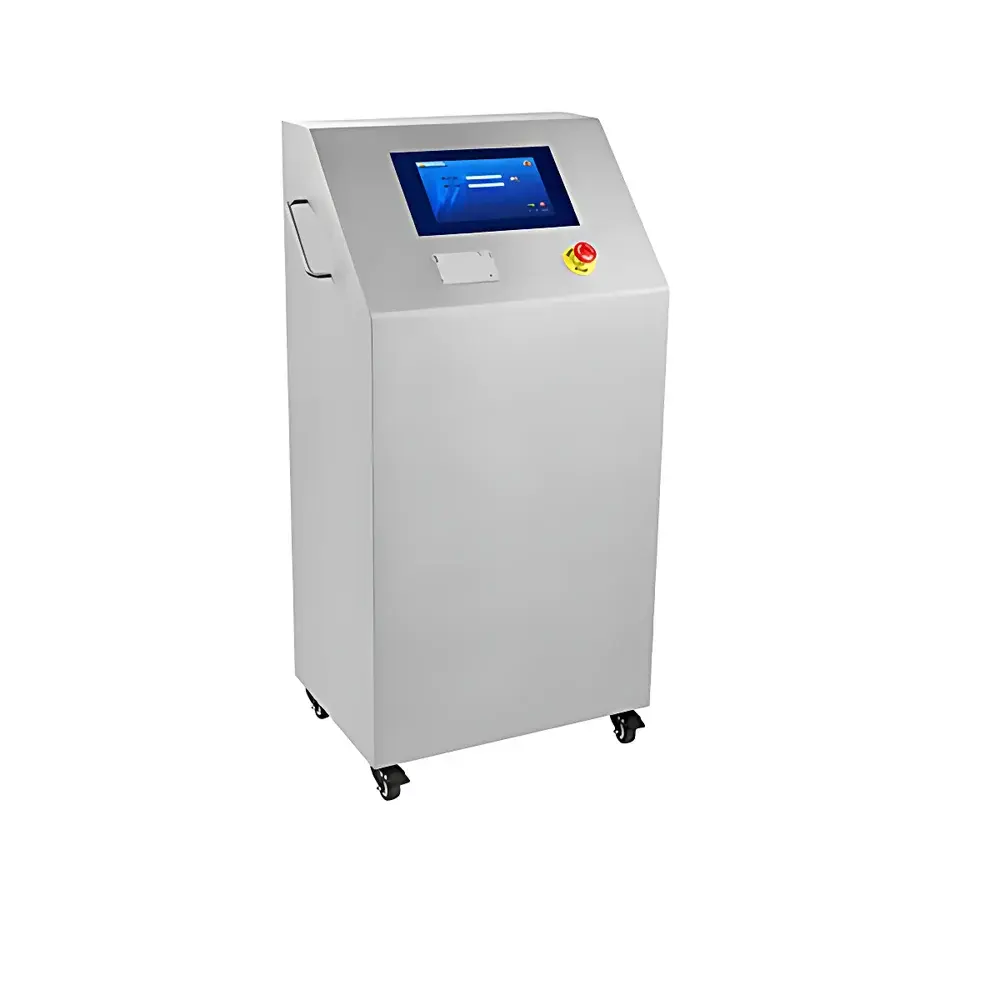
NeuronBC GT-5.0 Online Glove Integrity Tester
| Brand | NeuronBC |
|---|---|
| Origin | Beijing, China |
| Model | GT-5.0 |
| Power Supply | AC 220 V, 50 Hz |
| Rated Power | 120 W |
| Test Duration | 2–8 min |
| Pressure Range | 500–5000 Pa |
| Pressure Resolution | ≤50 Pa |
| Operating Noise | ≤50 dB(A) |
| Maximum Seal Pressure | ≤0.8 MPa |
| Data Storage Capacity | ≥10,000 test records |
| Gas Supply | Compressed air, nitrogen, or inert gas |
| Tray Configuration | Up to 6 glove trays (customizable) |
| Compliance | Designed per GB/T 25915.7–2010 / ISO 14644-7:2004 |
| Regulatory Alignment | 21 CFR Part 11–ready (electronic signatures, audit trail, user access control) |
| Optional Features | USB data export, audit trail module, backup data archiving |
Overview
The NeuronBC GT-5.0 Online Glove Integrity Tester is an engineered solution for real-time, non-destructive integrity verification of isolator and RABS glove systems in aseptic pharmaceutical manufacturing environments. It operates on the positive-pressure decay principle defined in ISO 14644-7:2004 and its Chinese national adoption GB/T 25915.7–2010. Unlike offline bubble or dye penetration methods, the GT-5.0 performs quantitative pressure decay analysis directly on installed gloves—eliminating disassembly, minimizing downtime, and preserving glove sterility. The instrument applies controlled pressurization to the glove interior via a sealed tray interface, then monitors pressure stability over a user-defined dwell period (2–8 minutes). A decay rate exceeding the validated threshold indicates micro-leakage, triggering a “Fail” result. Its architecture integrates precision pneumatic regulation, low-drift pressure transduction, and closed-loop feedback control—ensuring high reproducibility across repeated tests under variable ambient conditions.
Key Features
- Positive-pressure decay methodology compliant with ISO 14644-7:2004 and GB/T 25915.7–2010 for objective, quantitative pass/fail determination
- Modular glove tray system supporting up to six simultaneous test positions—configurable to standard and extended-length gloves (e.g., 300 mm, 500 mm cuffs)
- Intelligent pressure delivery algorithm: small-volume, frequent gas pulses ensure uniform internal pressurization—preventing glove distortion or false positives from transient deformation
- 7-inch full-color capacitive touchscreen with intuitive workflow navigation, real-time pressure curve visualization, and automatic protocol selection based on glove geometry and material compliance history
- Onboard thermal printer for immediate hard-copy documentation; all test reports include timestamp, operator ID, tray ID, pressure setpoint, decay rate, pass/fail status, and environmental metadata
- Robust mechanical design with integrated casters and compact footprint (W × D × H: 520 × 480 × 320 mm), enabling rapid deployment between isolators without facility modification
Sample Compatibility & Compliance
The GT-5.0 accommodates standard elastomeric glove materials including chloroprene, nitrile, butyl rubber, and fluorosilicone—commonly used in Grade A/B cleanrooms. Each tray features adjustable sealing gaskets and torque-limited clamping to ensure consistent contact pressure across varying glove thicknesses (0.3–1.2 mm). All firmware and operational software are structured to meet ALCOA+ data integrity principles. Electronic signatures, role-based user authentication (admin/operator/auditor), and immutable audit trails satisfy FDA 21 CFR Part 11 requirements for electronic records. System validation documentation—including IQ/OQ protocols, traceable calibration certificates (NIST-traceable pressure sensor), and risk assessment reports—is provided upon installation. The device supports GLP/GMP-aligned workflows through configurable retention policies and secure export of raw pressure vs. time datasets in CSV format.
Software & Data Management
Firmware version 2.3.1 includes embedded database management with capacity for ≥10,000 test records stored locally on industrial-grade flash memory. Each record contains full parametric traceability: operator credentials, glove serial number (manually entered or scanned), test duration, initial pressure, final pressure, calculated decay rate (Pa/min), environmental temperature/humidity (optional external sensor input), and digital signature. USB 2.0 port enables encrypted data export for third-party LIMS integration or regulatory submission. Optional audit trail module logs all system events—including parameter changes, user logins, report generation, and firmware updates—with timestamps and initiating user IDs. Backup archives can be scheduled daily/weekly and retained for up to 12 months per site policy.
Applications
- Routine pre-use and post-use integrity verification of isolator gloves in sterile API and finished dosage form manufacturing
- Periodic requalification testing during preventive maintenance cycles per EU Annex 1 and USP <1116> guidance
- Root cause investigation of contamination excursions where glove breach is suspected
- Supporting qualification of new glove batches prior to commissioning in critical process areas
- Integration into automated monitoring systems via Modbus TCP or optional RS-485 interface for centralized SCADA reporting
FAQ
What gas sources are compatible with the GT-5.0?
Compressed air (oil-free, Class 1 purity per ISO 8573-1), nitrogen, or other inert gases meeting GMP-grade specifications may be used. Inlet pressure must not exceed 0.5 MPa.
Does the system require external calibration equipment?
No—pressure sensors are factory-calibrated with NIST-traceable standards and include self-diagnostics. Annual recalibration by an accredited service provider is recommended per ISO/IEC 17025.
Can test data be exported to a Laboratory Information Management System (LIMS)?
Yes. Raw CSV files containing full pressure-time series and metadata are exportable via USB. Optional OPC UA or Modbus TCP gateways support real-time integration.
Is the GT-5.0 suitable for use in classified cleanroom environments?
Yes. It meets IP54 ingress protection rating and generates ≤50 dB(A) noise—compliant with ISO 14644-8 acoustic limits for Grade A/B zones.
How is user access controlled to prevent unauthorized parameter changes?
Three-tier permission structure (Admin/Operator/Auditor) enforces separation of duties. Critical functions—including pressure range modification, audit trail deletion, and calibration reset—require dual electronic signatures.






