
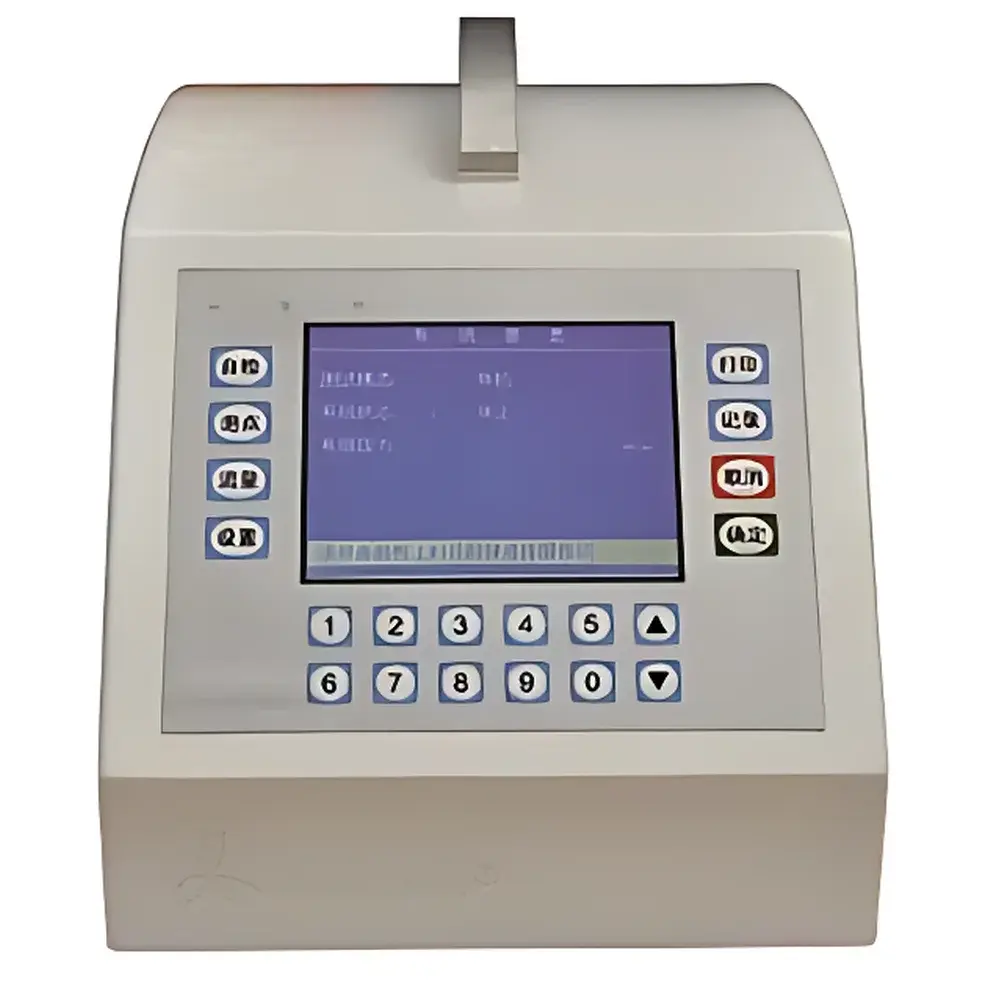
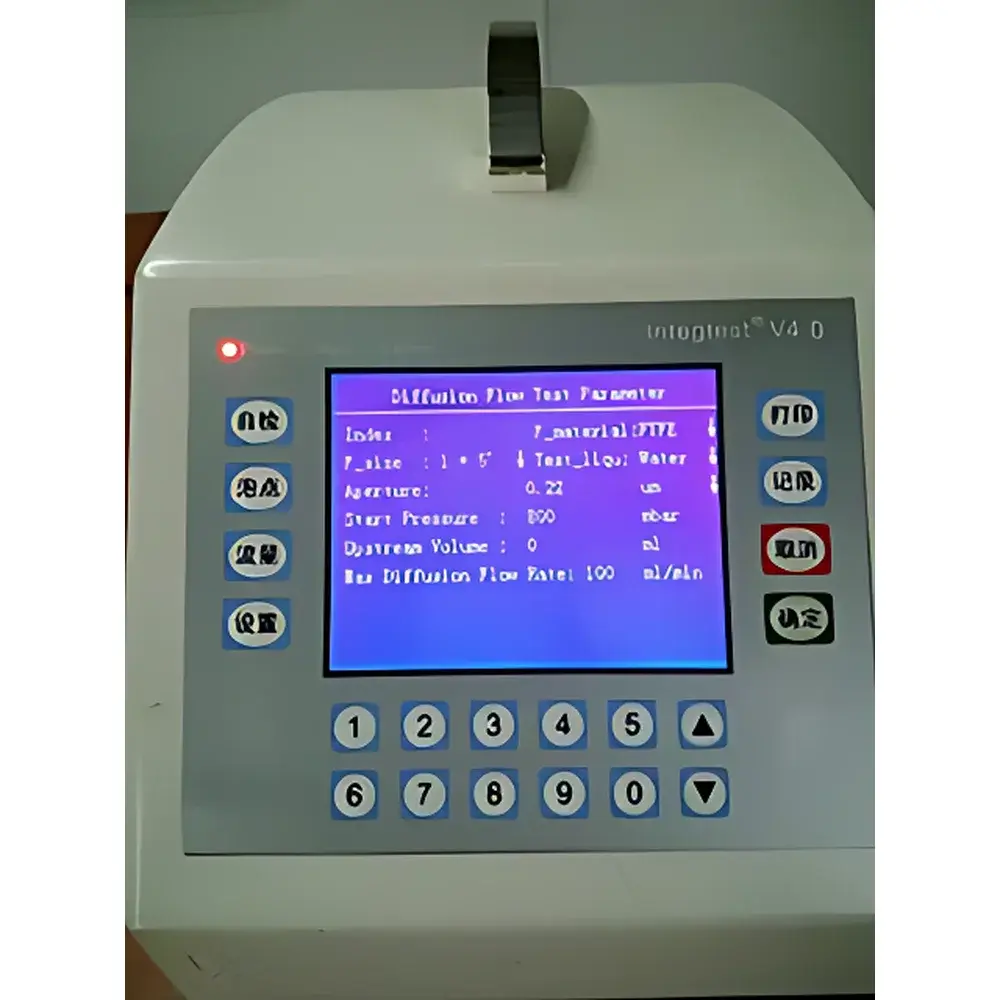
NeuronBC Integtest V4.0 Water Intrusion Integrity Tester
| Brand | NeuronBC |
|---|---|
| Origin | Beijing, China |
| Model | Integtest V4.0 |
| Power Supply | 100–240 VAC, 50 Hz, 120 W |
| Operating Pressure Range | 100–8000 mbar (115 psi) |
| Environmental Operating Conditions | 5–40 °C, 10–80% RH |
| Dimensions (L×W×H) | 400 × 240 × 270 mm (base) + 220 mm (height extension) |
| Weight | 7.5 kg |
| Display | 5.7″ monochrome TFT LCD with backlight |
| Data Storage | 500 test records |
| Interface | RS232 serial port |
| Language Support | English & Chinese |
| Test Modes | Manual Bubble Point, Standard Bubble Point, Enhanced Bubble Point, Diffusion Flow, Water Intrusion |
| Accuracy | Net Volume ±4%, Bubble Point ±50 mbar, Diffusion Flow ±4%, Water Intrusion ±0.01 mL |
| Measurement Ranges | Bubble Point 590–6900 mbar, Diffusion Flow 1–180 mL/min, Water Intrusion 0.01–30 mL/min |
| Print Output | Integrated thermal micro-printer |
| Filter Compatibility | Symmetric & asymmetric membranes, syringe filters, capsule filters, flat-sheet filters, cartridge filters (≤3 elements, ≤20 inches) |
| Compliance | Designed for ISO 13408-2, ASTM F838-22, and USP <1207> water intrusion method validation |
| Application Context | Offline and online integrity verification in Grade B cleanroom environments |
Overview
The NeuronBC Integtest V4.0 Water Intrusion Integrity Tester is a fully automated, regulatory-aligned instrument engineered for deterministic non-destructive integrity verification of hydrophobic membrane filters used in sterile pharmaceutical manufacturing. Unlike traditional gas-based methods (e.g., forward flow or bubble point), the water intrusion technique applies controlled pressurized air to the upstream side of a pre-wetted hydrophobic filter while monitoring liquid displacement volume — a principle grounded in capillary pressure theory (Young–Laplace equation) and validated per USP Chapter “Integrity Testing of Porous Packaging and Filtration Systems”. This method eliminates reliance on surface tension assumptions inherent in diffusion-based tests and provides unambiguous pass/fail criteria for filters with pore sizes ≥0.2 µm, especially critical for compressed gas lines, vent filters, and lyophilization chamber exhausts where residual moisture must be excluded without compromising sterility assurance.
Key Features
- Automated pneumatic control system ensures precise, repeatable pressure ramping and stabilization — eliminating operator-induced variability during water intrusion measurement.
- Real-time upstream volume calibration via integrated volumetric sensor enables traceable net-volume quantification, improving result reproducibility across laboratories (±4% accuracy as verified per internal protocol QM-IT-V4-002).
- Dual-height mechanical design accommodates both benchtop operation and integration into laminar flow hoods or isolator interfaces; compact footprint (400 × 240 mm) suits constrained Grade B cleanroom workspaces.
- Thermal micro-printer outputs GLP-compliant hardcopy reports including timestamp, operator ID, filter ID, test parameters, raw data traces, and pass/fail conclusion — supporting 21 CFR Part 11 audit readiness when paired with optional software logging.
- RS232 serial interface enables bidirectional communication with LIMS or MES platforms for automated data archival and trending analysis (e.g., diffusion drift over filter lifecycle).
- Intuitive 5.7″ monochrome TFT display with adjustable backlight supports bilingual (English/Chinese) navigation — optimized for glove-compatible interaction in controlled environments.
Sample Compatibility & Compliance
The Integtest V4.0 is validated for use with all standard hydrophobic membrane formats: syringe filters (13–25 mm), capsule filters (≤10 inches), flat-sheet discs (47–90 mm), and multi-element cartridge assemblies (up to 3 elements, max 20-inch length). Its pressure range (100–8000 mbar) covers typical service conditions for polytetrafluoroethylene (PTFE), polyvinylidene fluoride (PVDF), and polypropylene (PP) membranes rated at 0.2 µm and 0.45 µm. Instrument performance aligns with ISO 13408-2:2021 Annex C (water intrusion methodology), ASTM F838-22 Section 7.4.2, and USP Section 4.2. All firmware logic enforces mandatory parameter locks (e.g., minimum wetting time, maximum ramp rate) to prevent out-of-spec execution — a requirement under EU GMP Annex 1 §8.42 for filter integrity test equipment qualification.
Software & Data Management
While the Integtest V4.0 operates autonomously via embedded firmware, its RS232 interface supports external data capture using compliant third-party applications (e.g., LabArchives ELN, DeltaV DCS historian modules). Each stored record includes ISO 8601 timestamps, unique test identifiers, environmental metadata (ambient temperature/humidity), and full pressure-vs.-time and volume-vs.-time datasets. The onboard memory retains 500 complete test histories with overwrite protection enabled by default — satisfying ALCOA+ principles for attributable, legible, contemporaneous, original, and accurate data per WHO TRS 996 Annex 6. Optional CSV export functionality allows statistical process control (SPC) charting of intrusion volumes across filter batches.
Applications
- Final sterilizing-grade filter validation prior to aseptic processing campaigns.
- Post-use integrity confirmation of vent filters in bioreactor exhaust trains.
- Qualification of hydrophobic gas filters in HVAC systems serving Grade A/B zones.
- Trending diffusion drift and water intrusion baseline shifts across multiple filter lots to support PQ justification.
- Supporting root cause analysis during sterility failure investigations per ICH Q5A(R2) section 5.3.2.
FAQ
What distinguishes water intrusion testing from traditional bubble point or diffusion methods?
Water intrusion relies on direct volumetric measurement of displaced water under controlled pressure, avoiding assumptions about gas solubility or membrane tortuosity that affect diffusion-based interpretations.
Can the Integtest V4.0 perform both offline and online integrity testing?
Yes — its modular pneumatic architecture supports connection to filter housings via standard 1/4″ NPT fittings; online configuration requires optional pressure isolation valves and bypass manifolds per site-specific P&ID review.
Is the instrument suitable for use in Grade A environments?
No — it is qualified for Grade B ambient conditions only; however, test samples may be prepared and loaded within Grade A hoods prior to transfer to the tester located outside the critical zone.
How is measurement traceability maintained?
All pressure transducers are factory-calibrated against NIST-traceable standards; calibration certificates (including uncertainty budgets) are supplied with each unit and must be renewed annually per ISO/IEC 17025 requirements.
Does the device comply with FDA 21 CFR Part 11?
The hardware itself does not include electronic signature capability; however, when integrated with validated third-party software meeting Part 11 Annex A controls (audit trail, role-based access, electronic signatures), full compliance is achievable.






