
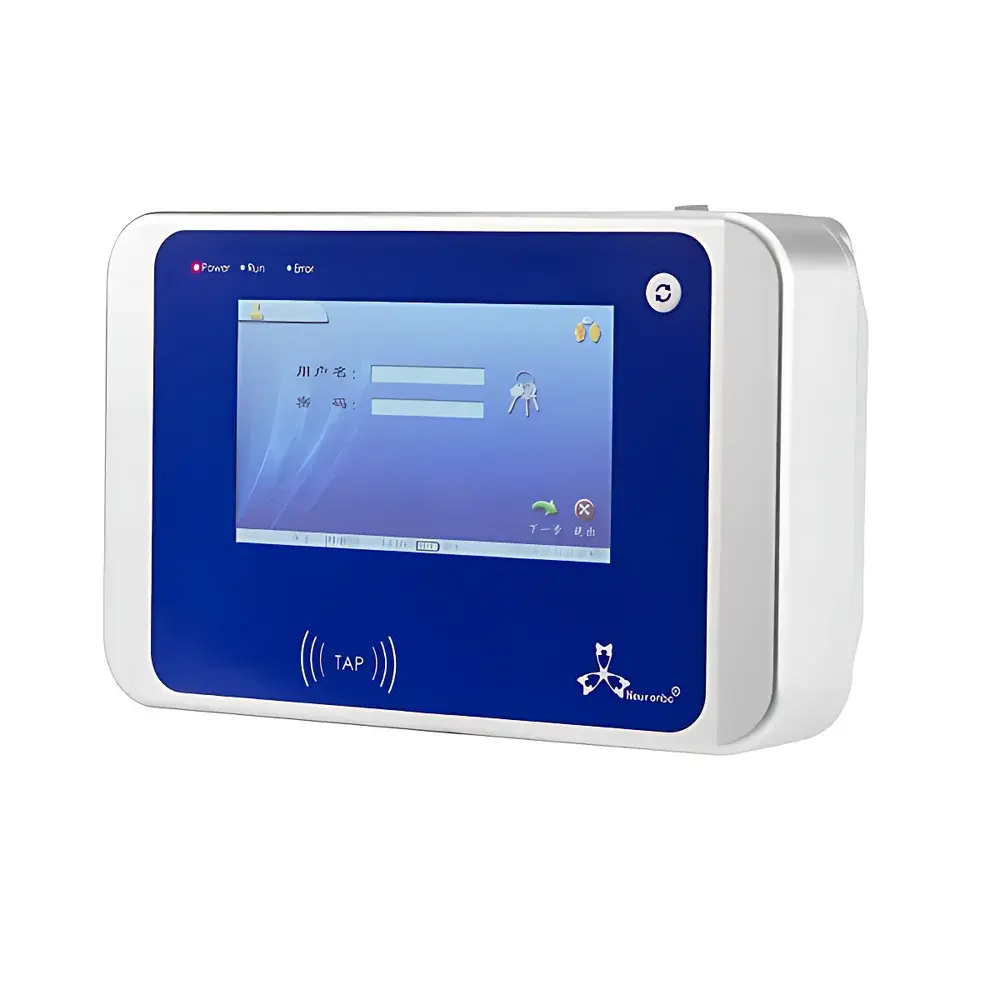
Neuronbc RIT-1000 RTP Integrity Tester
| Brand | Neuronbc |
|---|---|
| Origin | Beijing, China |
| Model | RIT-1000 |
| Compliance | FDA 21 CFR Part 11, EU Annex 11, GAMP 5 |
| Test Principle | Pressure Decay Method |
| Port Compatibility | Universal RTP interface (ISO 14644-3 compliant flange dimensions) |
| Sensitivity | ≤0.1 Pa/s pressure decay detection threshold |
| Operating Environment | ISO Class C/D cleanrooms |
| Form Factor | Portable benchtop unit with integrated pressure sensor and vacuum pump |
Overview
The Neuronbc RIT-1000 RTP Integrity Tester is a dedicated, portable pressure-decay-based verification system engineered for quantitative assessment of Rapid Transfer Port (RTP) integrity in aseptic pharmaceutical manufacturing environments. It operates on the fundamental principle of controlled pressurization or evacuation of the sealed RTP chamber, followed by high-resolution monitoring of pressure change over time. This method directly quantifies leakage rates—expressed as pressure decay per second (Pa/s)—and correlates them to volumetric leak flow under defined test conditions, in accordance with ISO 14644-3 Annex B and USP <1207> guidance on container closure integrity testing (CCIT). Unlike qualitative smoke or bubble tests, the RIT-1000 delivers objective, traceable, and auditable pass/fail results essential for regulatory submissions and routine qualification of isolator-RTP interfaces. Its design supports both pre-use and post-use integrity verification, ensuring that the physical barrier between classified zones (e.g., ISO Class A isolator interior and ISO Class C/D background room) remains intact prior to material transfer.
Key Features
- Integrated high-stability differential pressure transducer with ±0.05% full-scale accuracy and real-time drift compensation
- Onboard vacuum/pressure generation module capable of achieving ±5 kPa test pressure range with programmable ramp rates
- Touchscreen HMI with multilingual support (English, German, Chinese), intuitive workflow navigation, and context-sensitive help
- Automatic test sequence execution: seal verification → pressurization/evacuation → stabilization → decay measurement → pass/fail classification per user-defined limits
- Compact footprint (W320 × D280 × H210 mm) and lightweight chassis (<12 kg) enabling deployment across multiple isolator bays without fixed installation
- Quick-connect pneumatic interface compatible with standard ISO 11140-1 flange geometries (DN100–DN200), supporting both single- and dual-RTP configurations
- Embedded audit trail with timestamped operator ID, test parameters, raw pressure vs. time data, and result signature—fully compliant with FDA 21 CFR Part 11 requirements
Sample Compatibility & Compliance
The RIT-1000 is validated for use with all commercially available RTP systems featuring metallic gasketed flanges meeting ISO 14644-3 dimensional tolerances. It does not require calibration against reference leaks for routine operation; however, annual verification using NIST-traceable leak standards (e.g., 1×10⁻⁶ mbar·L/s) is recommended per ASTM E2979-14. The device conforms to IEC 61000-6-3 (EMC) and IEC 61010-1 (safety). All firmware and software modules are developed following GAMP 5 Category 4 principles, with documented risk assessments, configuration management, and version-controlled release notes. Data export supports CSV and PDF formats with embedded digital signatures, satisfying EU Annex 11 requirements for electronic records and signatures in GMP environments.
Software & Data Management
Firmware v3.2+ includes an embedded database supporting ≥10,000 test records with automatic archiving to internal eMMC storage and optional USB export. Each record contains full metadata: RTP serial number, operator credentials, environmental temperature/humidity (via optional external probe), test duration, applied pressure, measured decay rate, pass/fail status, and deviation flags. The system enforces role-based access control (RBAC) with three permission tiers: Operator (test execution only), Supervisor (parameter editing and report generation), and Administrator (user management and system configuration). Audit trails are immutable and cannot be edited or deleted—consistent with ALCOA+ principles (Attributable, Legible, Contemporaneous, Original, Accurate, Complete, Consistent, Enduring, Available). Optional integration with LIMS or MES via OPC UA or RESTful API enables automated data ingestion into enterprise quality systems.
Applications
- Pre-transfer qualification of RTPs connecting isolators to filling lines, lyophilizers, or depyrogenation tunnels
- Periodic requalification during campaign execution per EU GMP Annex 1 and PIC/S PI 036-2 recommendations
- Root cause analysis following out-of-specification (OOS) environmental monitoring events near RTP interfaces
- Supporting regulatory inspections by providing fully documented, reproducible integrity evidence for FDA, EMA, or PMDA review
- Validation of RTP modifications—including gasket replacement, torque verification, or interlock ring refurbishment
- Facilitating transition from RABS to isolator-based operations through robust, low-risk transfer port assurance
FAQ
What pressure decay threshold is considered acceptable for RTP integrity?
Regulatory guidance does not prescribe a universal numeric limit; acceptable decay rates must be justified via risk assessment and correlation to microbial ingress potential. Typical operational limits range from 0.05–0.2 Pa/s at 2.5 kPa test pressure, validated per specific RTP geometry and gasket material.
Can the RIT-1000 be used for negative-pressure RTPs (vacuum mode)?
Yes—the instrument supports bidirectional testing: positive-pressure hold (for detecting inward leakage) and vacuum-decay mode (for detecting outward leakage), selectable via the HMI.
Is third-party calibration required before first use?
No. The RIT-1000 ships with factory calibration certificate traceable to NPL (UK) standards. Users must perform initial operational qualification (IQ/OQ) per their site’s validation protocol prior to GMP use.
Does the device support multi-RTP sequential testing?
Yes—through configurable test templates and batch mode, up to six RTPs can be tested consecutively with auto-generated summary reports.
How is data integrity maintained during power interruption?
All active test sessions are saved to non-volatile memory every 2 seconds; interrupted tests resume from last stable checkpoint upon reboot without data loss.





