
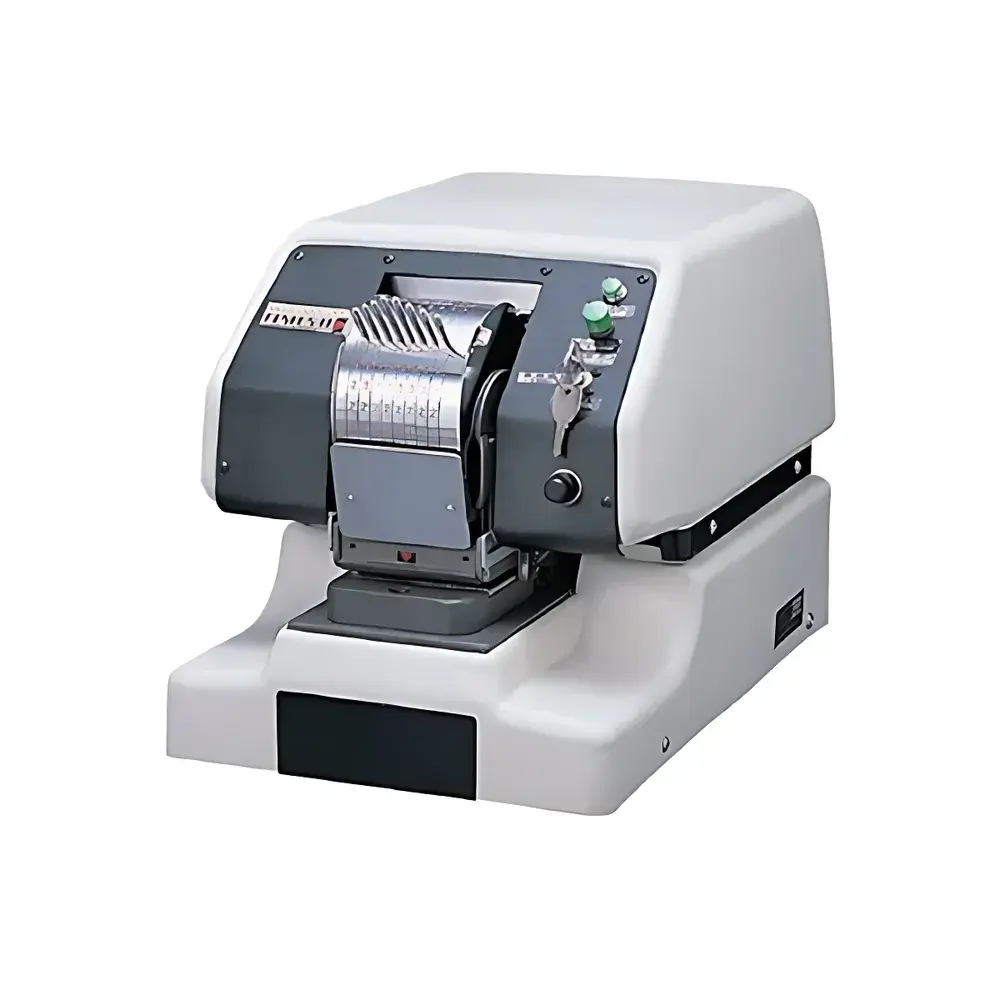
NEWKON 10-905 Date & Number Embossing Punch
| Brand | ADVANTEC (Yan Hua Dong Yang) |
|---|---|
| Origin | Japan |
| Model | 10-905 |
| Type | Manual Date/Number Embossing Punch |
| Max. Sheet Capacity | 10 sheets (64 g/m² paper, 8-digit imprint) |
| Cycle Time | 1.5 s/cycle (50 Hz) / 1.2 s/cycle (60 Hz) |
| Dimensions | 214 × 295 × 485 mm |
| Weight | 12.7 kg |
| Die Block Compatibility | MOLE 905-208 |
| Power Supply | None (Manual Operation) |
Overview
The NEWKON 10-905 Date & Number Embossing Punch is a precision-engineered mechanical document authentication tool designed for high-integrity timestamping and sequential numbering of paper-based records. Unlike ink-based stamping systems, this device employs cold embossing — a pressure-driven deformation process that permanently indents alphanumeric characters into paper fibers without ink, solvents, or thermal activation. This physical imprinting method ensures tamper-evident, non-erasable, and non-alterable markings, making it suitable for applications where auditability, legal defensibility, and long-term archival stability are critical. The 10-905 model is a manually operated unit optimized for controlled-volume environments such as government offices, financial institutions, and quality assurance departments handling official certificates, delivery notes, application forms, manufacturing logs, and medical imaging documentation. Its design adheres to fundamental principles of mechanical traceability: each impression is physically irreversible, inherently time-bound when paired with date dies, and fully compatible with ISO 15489-1 (Information and documentation — Records management) requirements for evidence integrity.
Key Features
- True embossing mechanism: Creates raised, tactile impressions via hardened steel die blocks — no ink, no smudging, no bleed-through, and zero risk of solvent migration or fading.
- Manual operation: Eliminates dependency on electrical infrastructure, ensuring consistent performance in off-grid, low-power, or regulated environments (e.g., cleanrooms, archival vaults).
- Configurable date/number dies: Interchangeable MOLE 905-208 die blocks support customizable layouts including fixed-date, rotating-date, sequential numbering, and hybrid formats (e.g., DD-MM-YYYY + serial code).
- High sheet capacity: Rated for up to 10 sheets of standard 64 g/m² office paper per cycle — significantly exceeding manual stamp throughput while maintaining registration accuracy.
- Robust mechanical architecture: Cast iron frame and precision-ground cam system ensure >100,000-cycle durability under routine administrative use; minimal maintenance required beyond periodic die cleaning.
- Ergonomic lever design: Optimized mechanical advantage reduces operator fatigue during extended batch processing; consistent force transmission guarantees uniform indentation depth across all layers.
Sample Compatibility & Compliance
The 10-905 is validated for use with uncoated, lightly coated, and recycled papers ranging from 50–120 g/m² — including thermal paper (non-heat-activated), carbonless multipart forms, and archival-grade rag paper. It does not support laminated, plastic-coated, or metallic substrates. From a regulatory standpoint, embossed markings meet evidentiary criteria under multiple frameworks: they satisfy the “original record” definition in FDA 21 CFR Part 11 Annex A (for non-electronic records), align with ISO/IEC 27001 Annex A.8.2.3 (integrity of information), and support GLP/GMP documentation practices requiring immutable audit trails. No calibration certificate is required, but users must maintain die block inventory logs and perform visual verification of imprint legibility per internal SOPs.
Software & Data Management
As a standalone mechanical device, the 10-905 operates independently of software or digital interfaces. However, its output integrates seamlessly into hybrid documentation workflows: embossed dates/numbers serve as physical anchors for scanned image metadata, enabling OCR-assisted indexing in document management systems (DMS) compliant with ISO 27887 or DoD 5015.2. For organizations implementing electronic record retention, embossed identifiers can be cross-referenced with digital timestamps in audit logs, satisfying dual-control requirements under ISO 14721 (OAIS reference model). Optional die block serialization allows traceability back to specific operators or workstations — supporting accountability mapping in multi-user deployments.
Applications
- Government & public administration: Certification of receipt, issuance, and processing dates on permits, tax filings, land registry documents, and judicial affidavits.
- Healthcare & life sciences: Timestamping of radiographic films (X-ray, MRI hardcopy), laboratory requisition forms, and clinical trial source documents per ICH-GCP E6(R3).
- Manufacturing & food safety: Indelible marking of production batch labels, raw material inspection reports, and alcohol beverage bottling logs — compliant with FSSC 22000 Clause 8.5.2.
- Financial services: Authentication of loan disbursement vouchers, KYC verification sheets, and trade finance instruments where handwritten or stamped dates lack forensic robustness.
- Academic & cultural institutions: Provenance tracking of archival manuscripts, museum accession slips, and thesis submission forms requiring permanent, machine-readable temporal markers.
FAQ
Is the 10-905 compatible with carbonless copy paper sets?
Yes — its mechanical embossing applies uniform pressure across multi-layer forms without damaging carbon coatings or compromising NCR functionality.
Can die blocks be customized with company-specific logos or symbols?
No — only standardized alphanumeric and date-format dies (MOLE 905-208 series) are supported per NEWKON’s certification and mechanical tolerance specifications.
Does embossing affect subsequent scanning or OCR accuracy?
Embossed characters enhance OCR reliability on flatbed scanners by increasing contrast and edge definition; however, avoid using on highly textured or fibrous papers where relief may cause shadow artifacts.
How often should die blocks be replaced?
Under normal use (≤500 impressions/day), MOLE 905-208 dies retain dimensional integrity for ≥5 years; replacement is recommended only upon visible wear or inconsistent impression depth.
Is operator training required for compliance purposes?
Yes — documented training on die installation, impression verification, and logbook entry is recommended to satisfy ISO 9001:2015 Clause 7.2 and internal quality audit requirements.



