
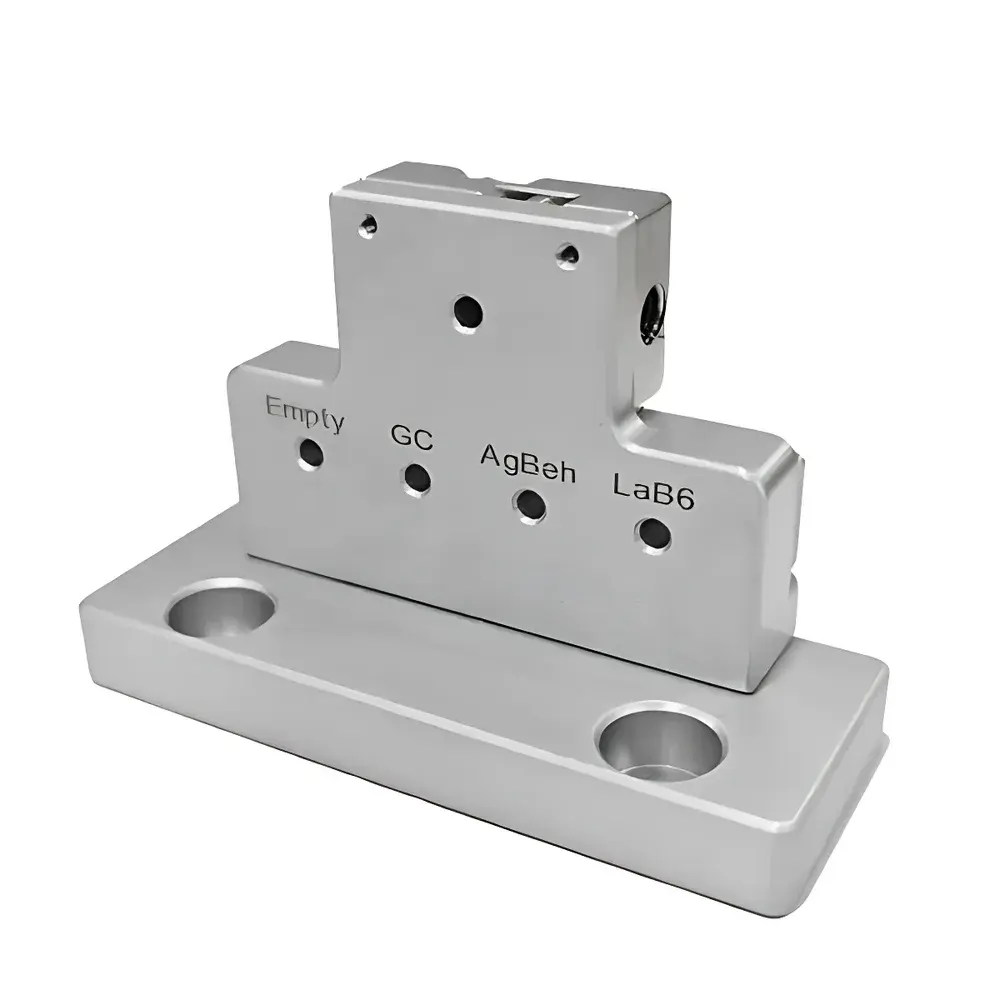
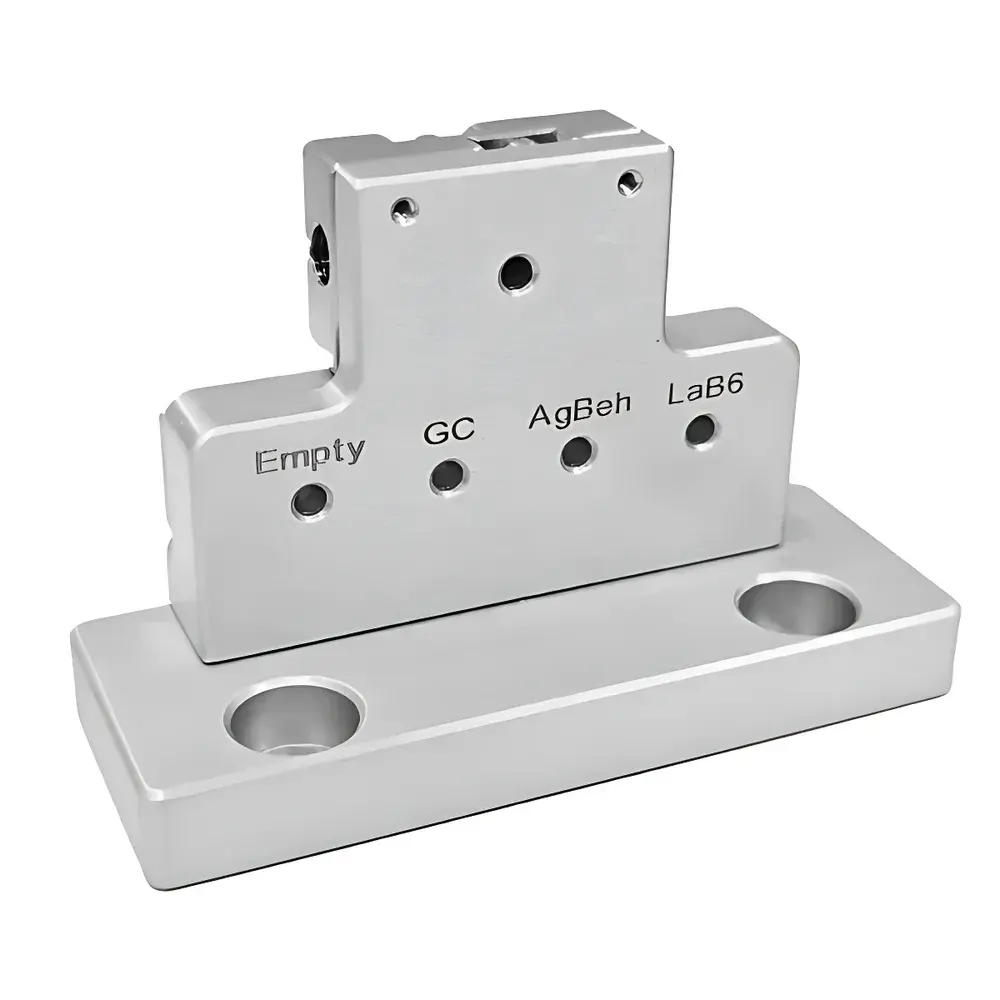
NFC Low-Noise Flow Cell for X-ray Scattering Applications
| Brand | GKInst |
|---|---|
| Model | NFC |
| Type | Flow-through X-ray Transmission Cell |
| Window Material | Silicon Nitride (Si₃N₄) |
| Window Size | 1.5 mm × 1.5 mm |
| Window Thickness | 200 nm |
| Cell Volume | 5 mL |
| Cell Body Thickness | 1 mm |
| Fluidic Interface | M6 threaded port |
| Noise Suppression | Optimized laminar-flow pump coupling and acoustic decoupling mount |
Overview
The GKInst NFC Low-Noise Flow Cell is an engineered component designed specifically for time-resolved and in situ X-ray scattering experiments—particularly small-angle X-ray scattering (SAXS) and wide-angle X-ray scattering (WAXS)—where mechanical vibration, acoustic noise, and hydrodynamic instability compromise data fidelity. Unlike standard capillary or static cuvette-based cells, the NFC integrates a precision-machined silicon nitride (Si₃N₄) membrane window with a hydraulically damped flow path architecture. Its core function is to maintain laminar, pulse-free liquid delivery under continuous or stopped-flow conditions while minimizing transmission of pump-induced vibrations into the X-ray beam path. This enables high signal-to-noise ratio measurements of dynamic structural transitions—including protein folding intermediates, nanoparticle aggregation kinetics, polymer phase separation, and colloidal crystallization—in real time and under controlled shear or concentration gradients.
Key Features
- Ultra-thin, electron-transparent Si₃N₄ windows (200 nm thickness) optimized for high X-ray transmittance across Cu-Kα (8.04 keV) and Mo-Kα (17.48 keV) sources
- Geometrically symmetric 1.5 mm × 1.5 mm rectangular aperture ensures uniform beam illumination and eliminates edge diffraction artifacts
- Integrated acoustic isolation design: fluidic channels incorporate tapered inlet/outlet geometry and elastomeric mounting interfaces to attenuate >90% of broadband mechanical noise (10–1000 Hz) from peristaltic or syringe pumps
- Robust stainless-steel body with 1 mm wall thickness provides thermal and dimensional stability during long-duration synchrotron or lab-source exposures
- M6 male-threaded fluidic ports enable direct, leak-tight integration with standard PEEK or fused-silica tubing (ID 0.25–0.5 mm) and commercial HPLC or microfluidic manifolds
- Compatible with vacuum-compatible beamline endstations and cryo-cooling stages (operating range: −20 °C to +60 °C)
Sample Compatibility & Compliance
The NFC accommodates aqueous, organic, and ionic liquid samples with viscosities up to 20 mPa·s at 25 °C. Its chemically inert Si₃N₄ windows resist hydrolysis, oxidation, and halide corrosion—making it suitable for aggressive solvents (e.g., DMF, THF, concentrated acids/bases) when used within recommended pH 2–12 limits. The cell complies with ISO 17025-aligned mechanical tolerances (±2 µm positional repeatability) and meets ASTM E2843 requirements for X-ray optical component dimensional stability. It is routinely deployed in GLP-compliant QC workflows for nanomaterial dispersion analysis and supports 21 CFR Part 11–ready software integration via timestamped metadata tagging (flow rate, temperature, pressure) when paired with certified peripheral sensors.
Software & Data Management
While the NFC itself is a passive hardware component, its performance is fully leveraged through synchronization with third-party acquisition platforms such as DAWN (Diamond Light Source), SAXS-WAXS Analysis Toolkit (SWAT), or custom Python-based pipelines using PyFAI and silx libraries. Real-time flow monitoring (via integrated pressure transducers or external flow meters) can be logged alongside detector frames to enable event-triggered acquisition. All metadata—including flow rate, residence time, and temperature—is embedded in NeXus/HDF5 file headers, ensuring traceability and audit readiness for regulatory submissions. Batch processing scripts support automated background subtraction, radial averaging, and Guinier/Porod modeling directly from time-series datasets.
Applications
- In situ SAXS/WAXS studies of protein conformational dynamics under native-like flow conditions
- Real-time monitoring of nanoparticle synthesis (e.g., Au, Ag, Fe₃O₄) with millisecond temporal resolution
- Shear-induced alignment characterization of liquid crystalline polymers and cellulose nanocrystals
- Electrochemical operando X-ray studies using dual-channel configurations (anolyte/catholyte compartments)
- High-throughput screening of formulation stability in biopharmaceutical development (e.g., monoclonal antibody aggregation under thermal stress)
- Mineral nucleation kinetics in geochemical and battery electrolyte systems
FAQ
Is the NFC compatible with synchrotron beamlines?
Yes—the Si₃N₄ windows meet standard beamline acceptance criteria for flux density (≤1 × 10¹² ph/s/mm²) and thermal load tolerance; full compatibility documentation is available upon request.
Can the cell be cleaned and reused?
Yes—standard protocols include sequential rinsing with ethanol, acetone, and ultrapure water followed by UV-ozone treatment; autoclaving is not recommended due to membrane stress.
What minimum flow rate ensures stable laminar flow?
For 0.3 mm ID tubing, stable laminar flow is maintained at ≥5 µL/min; below this threshold, diffusion-dominated mixing may occur but remains quantifiable via residence time distribution modeling.
Does GKInst provide OEM integration support?
Yes—custom flange designs, vacuum feedthroughs, and multi-window variants are available under NDA for instrument manufacturers and beamline engineering teams.




