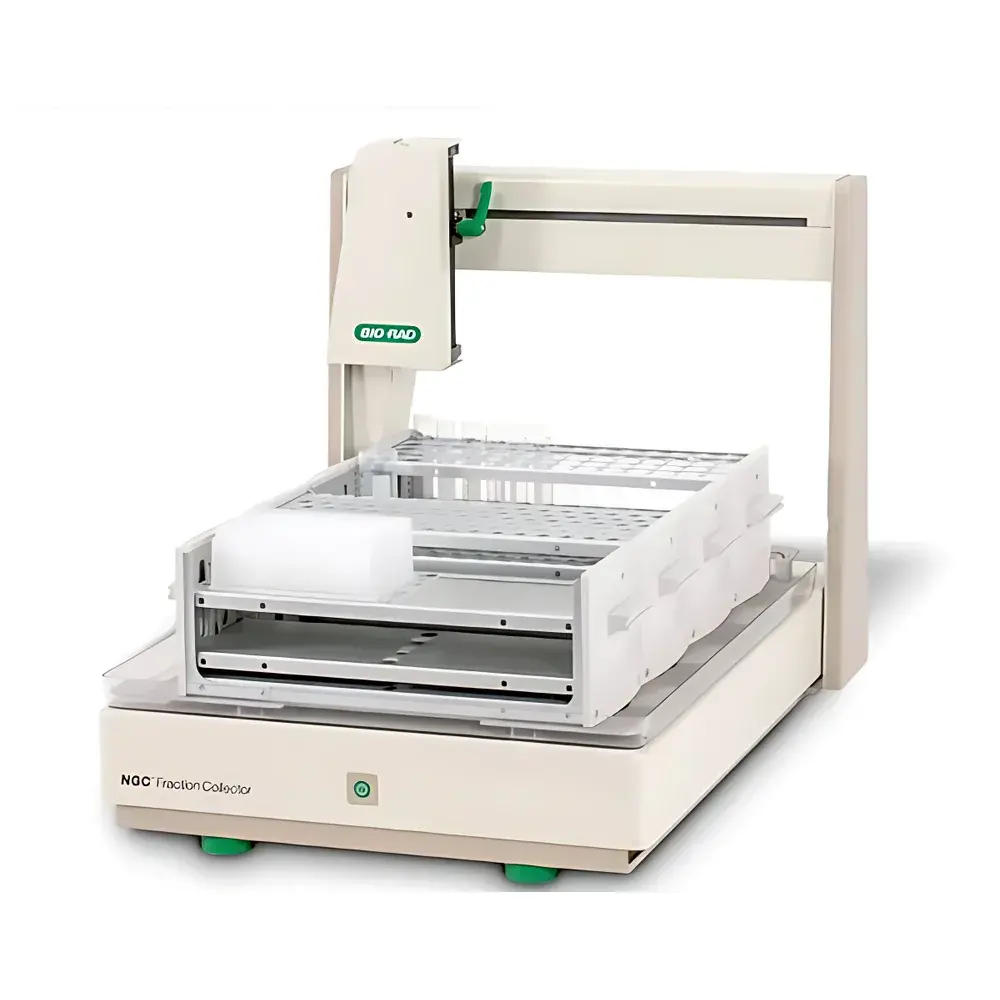
NGC NFC Next-Generation Fraction Collector
| Brand | BIO-RAD |
|---|---|
| Origin | USA |
| Model | NGC NFC |
| Max Flow Rate | 200 mL/min |
| Collection Vessel Compatibility | 96-well plates, microcentrifuge tubes, conical tubes, glass vials, and custom containers |
| Optional Features | Peltier-based cooling (4–25 °C), automated calibration routine |
| Regulatory Compliance | Designed for GLP/GMP-aligned workflows, supports audit trail generation per FDA 21 CFR Part 11 requirements (when used with compliant NGC Chromatography Software) |
| Vendor Type | Authorized Distributor |
Overview
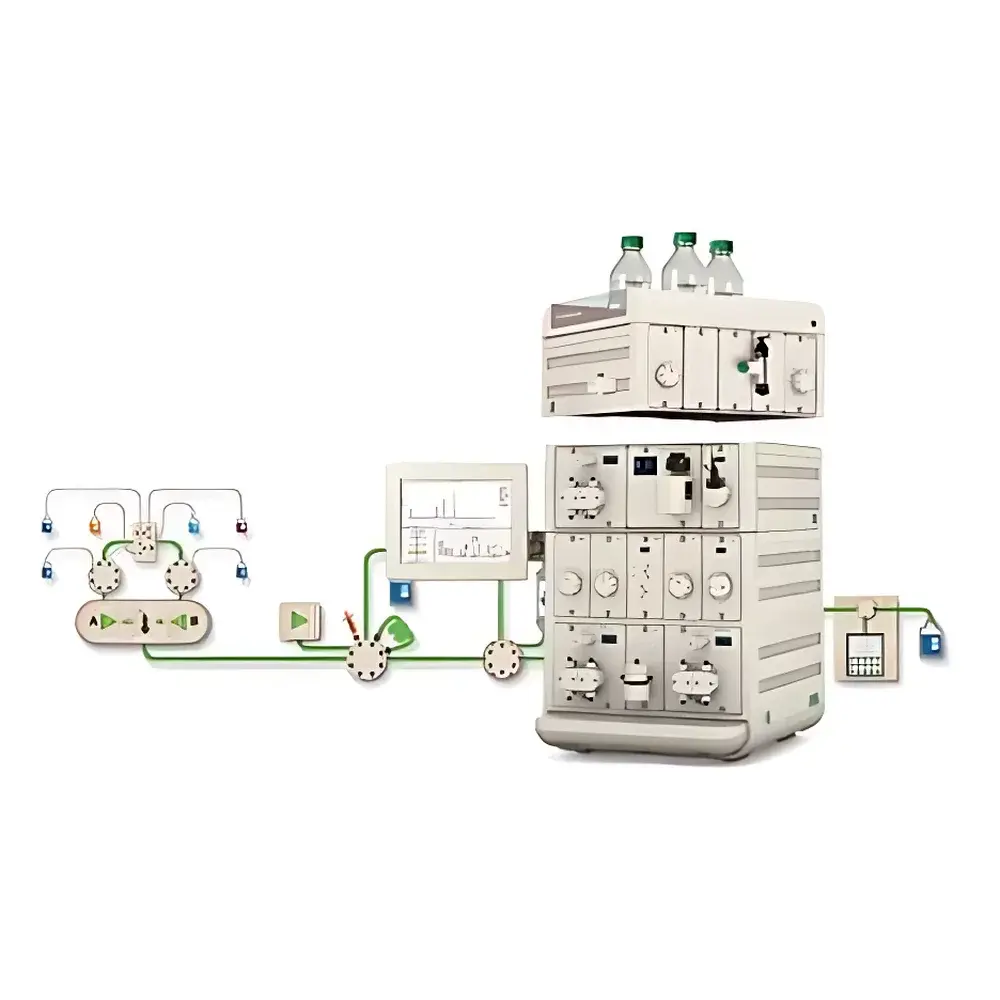
The NGC NFC Next-Generation Fraction Collector is an integrated, high-precision component of the BIO-RAD NGC Chromatography System platform, engineered specifically for automated, reproducible collection of eluted fractions during liquid chromatography purification workflows. It operates on a programmable fraction-triggering architecture—accepting TTL, analog, or software-defined triggers from UV/absorbance, conductivity, pH, or other inline detectors—to ensure temporal alignment between chromatographic peaks and physical sample capture. Unlike legacy fraction collectors reliant on fixed time or volume thresholds, the NFC employs real-time signal processing to initiate collection at user-defined threshold crossings or peak inflection points, minimizing cross-contamination and maximizing recovery of target protein species. Its modular design integrates seamlessly with NGC Scout, Discover, and Quest systems, supporting both analytical-scale screening and preparative-scale purification across affinity, ion exchange, size exclusion, and hydrophobic interaction chromatography methods.
Key Features
- High-throughput collection capability up to 200 mL/min, enabling compatibility with both low-pressure and medium-pressure chromatography systems without flow restriction or backpressure accumulation.
- Universal rack recognition system with auto-detection of vessel geometry—supports standard 96-well microplates (SBS format), 0.5–50 mL centrifuge tubes, 4–20 mL glass or polypropylene vials, and custom trays via configurable rack profiles.
- Simultaneous multi-vessel collection mode: allows heterogeneous container types and volumes to be addressed within a single method—e.g., collecting early-eluting contaminants into waste vials while directing target peaks into chilled 96-well plates.
- Integrated Peltier cooling module (optional) maintains collection temperature between 4 °C and 25 °C with ±0.5 °C stability, critical for thermolabile proteins, enzyme assays, or multi-step purification protocols requiring cold-chain continuity.
- Self-calibrating positioning system eliminates manual alignment drift; performs automatic homing and optical verification of tray position prior to each run, ensuring sub-millimeter accuracy across >10,000 fraction cycles.
- Robust stainless-steel fluid path and chemically resistant seals compatible with common aqueous and organic mobile phases—including 8 M urea, 6 M guanidine HCl, 100% acetonitrile, and 1 M NaOH for CIP (clean-in-place) validation.
Sample Compatibility & Compliance
The NGC NFC accommodates biological samples ranging from clarified cell lysates and column effluents to concentrated eluates post-desalting or buffer exchange. Its open-tube design avoids capillary clogging and enables direct integration with fraction loops, divert valves, and in-line filters (0.22 µm or 0.45 µm). All wetted materials comply with USP Class VI and ISO 10993 biocompatibility standards. When operated with NGC Chromatography Software v10.5 or later, the system generates electronic records meeting ALCOA+ principles—full audit trails, electronic signatures, role-based access control, and immutable data archiving aligned with FDA 21 CFR Part 11, EU Annex 11, and ICH GCP guidelines. Routine IQ/OQ documentation packages are available for laboratory qualification under ISO/IEC 17025 and GMP environments.
Software & Data Management
Control and method development occur exclusively through NGC Chromatography Software—a validated, Windows-based application supporting method cloning, parameter inheritance, and version-controlled protocol storage. Fraction metadata—including timestamp, detector signal value at trigger, collected volume, rack ID, well/tube position, and ambient temperature—is embedded directly into .fra and .csv output files. Raw chromatograms and fraction maps synchronize automatically in the software’s integrated viewer, enabling retrospective re-analysis of peak boundaries and re-collection decisions. Data export conforms to MIAME and MIAPE-compliant formats for downstream integration with LIMS (e.g., LabVantage, STARLIMS) and ELN platforms (e.g., Benchling, LabArchives).
Applications
- Monoclonal antibody purification: precise collection of Fc-fusion protein monomers from aggregate and fragment peaks in SEC runs.
- His-tagged protein isolation: timed fractionation across imidazole gradient elution to separate bound, partially bound, and unbound species.
- Multi-step process development: parallel collection into 96-well plates for rapid SDS-PAGE screening or activity assays without manual redistribution.
- Virus-like particle (VLP) purification: cold-collection of labile assemblies using Peltier-cooled racks to preserve structural integrity.
- Process analytical technology (PAT): closed-loop feedback integration where fraction decisions are dynamically updated based on real-time MALS or DLS measurements.
FAQ
Can the NGC NFC operate independently of the NGC chromatography system?
No—it requires synchronization via Ethernet or USB with NGC Chromatography Software and relies on detector signals or software commands for triggering; it is not a standalone timer-based collector.
Is third-party rack support available?
Yes—custom rack definitions can be imported via XML templates; users may define dimensions, well spacing, and orientation for non-standard trays.
What maintenance intervals are recommended?
Optical sensor cleaning every 6 months; Peltier module performance verification annually; full IQ/OQ requalification recommended every 2 years or after major hardware service.
Does the NFC support fraction pooling based on peak area integration?
Yes—software-defined pooling rules allow grouping of contiguous fractions whose combined UV280 absorbance exceeds a defined threshold, with automatic recalculated volume tracking.
How is leak detection handled during high-flow operation?
The system includes pressure-sensing firmware that monitors flow-induced vibration signatures; abnormal acoustic patterns trigger immediate pump stoppage and alert logging in the audit trail.