
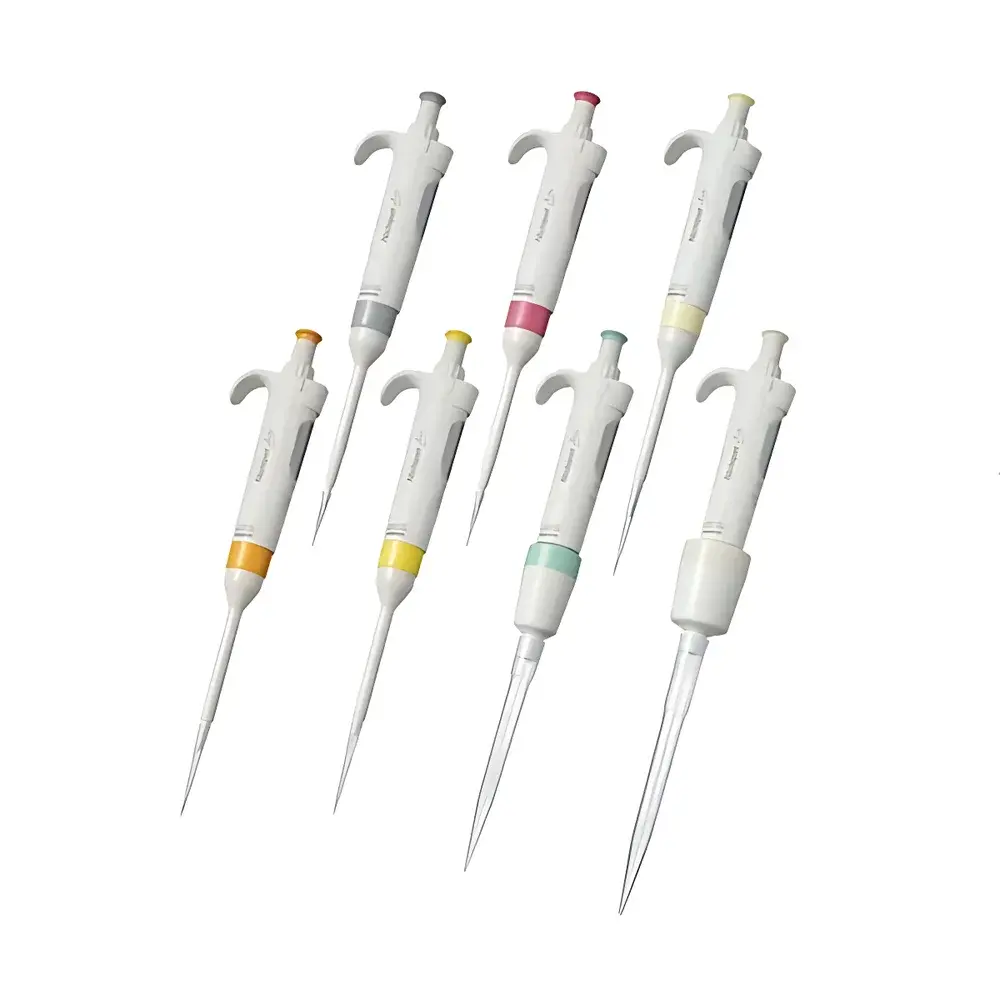
Nichipet Air Single-Channel Manual Pipette
| Brand | Nichipet (Nichiryo) |
|---|---|
| Origin | Japan |
| Type | Air-displacement single-channel manual pipette |
| Channels | 1 |
| Volume Range | 0.1–2 µL, 0.5–10 µL, 2–20 µL, 10–100 µL, 20–200 µL, 100–1000 µL, 500–5000 µL, 1000–10000 µL |
| Maximum Capacity | 10 mL |
| Accuracy (at lowest range) | ±0.002 µL (for 0.1–2 µL setting) |
| Weight | 70 g |
| Actuation Force Reduction | Up to 70% vs. conventional models |
| Calibration | Tool-free adjustment via volume dial and locking fixture |
| Color-Coded Volume Ranges | Yes |
| Compliance | Designed for ISO 8655-compliant operation and GLP/GMP laboratory workflows |
Overview
The Nichipet Air Single-Channel Manual Pipette is a precision-engineered air-displacement pipetting instrument developed by Nichiryo (Japan), designed for high-reproducibility liquid handling in analytical, clinical, pharmaceutical, and research laboratories. Built upon ISO 8655 principles—governing performance requirements, calibration methodology, and metrological traceability—the Nichipet Air series delivers consistent volumetric accuracy across its eight discrete volume ranges (0.1–2 µL to 1000–10000 µL). Its core mechanism relies on controlled piston displacement within an airtight chamber to aspirate and dispense aqueous and low-viscosity liquids without direct contact between sample and internal components. This architecture ensures minimal carryover, reduced risk of cross-contamination, and long-term stability under routine use. The pipette is intended for manual operation in environments where regulatory compliance (e.g., ISO/IEC 17025, CLIA, FDA 21 CFR Part 11–aligned documentation practices) and ergonomic sustainability are critical.
Key Features
- Ergonomic Lightweight Design: Weighing only 70 g—56% lighter than predecessor models—the pipette features a slender, balanced body geometry that reduces operator fatigue during high-throughput workflows involving repetitive pipetting cycles.
- Reduced Actuation Force: Optimized mechanical linkage and spring dynamics lower plunger depression force by up to 70% compared to conventional manual pipettes, improving user comfort and minimizing risk of repetitive strain injury (RSI).
- Tool-Free Calibration: Volume adjustment is achieved by rotating the volume dial to the target setting; final fine-tuning and lock-in are performed using an integrated calibration fixture aligned with the scale line—no external tools or disassembly required.
- Color-Coded Volume Identification: Each volume range is assigned a distinct, internationally recognized color band (e.g., grey for 0.1–2 µL, yellow for 10–100 µL), enabling rapid visual verification and reducing misselection errors in multi-user lab settings.
- High-Accuracy Low-Volume Handling: At the 0.1–2 µL range, the pipette achieves an accuracy specification of ±0.002 µL—validated per ISO 8655-2 protocols—making it suitable for applications requiring nanoliter-scale precision, including qPCR master mix preparation and microfluidic assay setup.
- Durable Construction: Manufactured from high-grade polypropylene and stainless-steel components, the pipette maintains structural integrity and chemical resistance against common laboratory solvents, alcohols, and dilute acids/bases.
Sample Compatibility & Compliance
The Nichipet Air pipette is validated for use with aqueous solutions, buffers, saline, ethanol/water mixtures, and other low-to-moderate viscosity liquids (≤30 mPa·s). It is not recommended for viscous, volatile, or highly corrosive substances (e.g., concentrated HCl, DMSO >50%, glycerol >30%) without appropriate tip selection and procedural adaptation. All models conform to ISO 8655 standards for metrological performance, including accuracy, repeatability, and temperature-dependent error limits. Units are supplied with factory calibration certificates traceable to JCSS (Japanese Calibration Service System) standards. For regulated environments, users may implement internal calibration schedules aligned with ISO/IEC 17025 clause 6.4 or USP guidelines on analytical instrument qualification.
Software & Data Management
As a manually operated, non-electronic device, the Nichipet Air pipette does not incorporate onboard software, Bluetooth connectivity, or digital data logging. However, its design supports full integration into electronic lab notebook (ELN) and laboratory information management system (LIMS) workflows through standardized calibration record templates, maintenance logs, and user training documentation. Laboratories operating under GxP frameworks may configure audit-trail-capable systems to track pipette assignment, calibration history, usage frequency, and preventive maintenance events—ensuring alignment with FDA 21 CFR Part 11 requirements for attributable, legible, contemporaneous, original, and accurate (ALCOA+) data governance.
Applications
- Quantitative nucleic acid dilution and qRT-PCR reaction setup
- Cell culture media and reagent dispensing in sterile biosafety cabinets
- Standard curve preparation for ELISA, HPLC, and mass spectrometry workflows
- Microplate-based assays requiring precise sub-10 µL transfers
- Calibration of automated liquid handlers using gravimetric verification
- Teaching laboratories emphasizing metrological fundamentals and pipetting technique validation
FAQ
Is the Nichipet Air pipette autoclavable?
No—this model is not designed for autoclaving. Sterilization should be performed using 70% ethanol wipe-down or UV irradiation; disposable filtered tips provide primary contamination control.
What calibration standard is used for factory certification?
All units undergo gravimetric calibration per ISO 8655-6 using Class E2 stainless-steel weights and certified reference fluids (e.g., distilled water at 20 °C), with traceability to JCSS-accredited national standards.
Can I use third-party tips with this pipette?
Yes—Nichipet Air is compatible with universal-fit, low-retention, filtered tips meeting ISO 8655-3 dimensional specifications; however, optimal accuracy is guaranteed only with Nichiryo-branded consumables.
Does the pipette include a calibration certificate?
Each unit ships with a printed calibration report listing tested volume points, observed deviations, and pass/fail status against ISO 8655 tolerance limits.
How often should I recalibrate the pipette?
Recalibration frequency depends on usage intensity and risk assessment; ISO 8655 recommends verification before each shift for critical applications, and full calibration every 3–6 months—or after impact, disassembly, or environmental change—as part of a documented IQ/OQ/PQ protocol.
Related Products



