
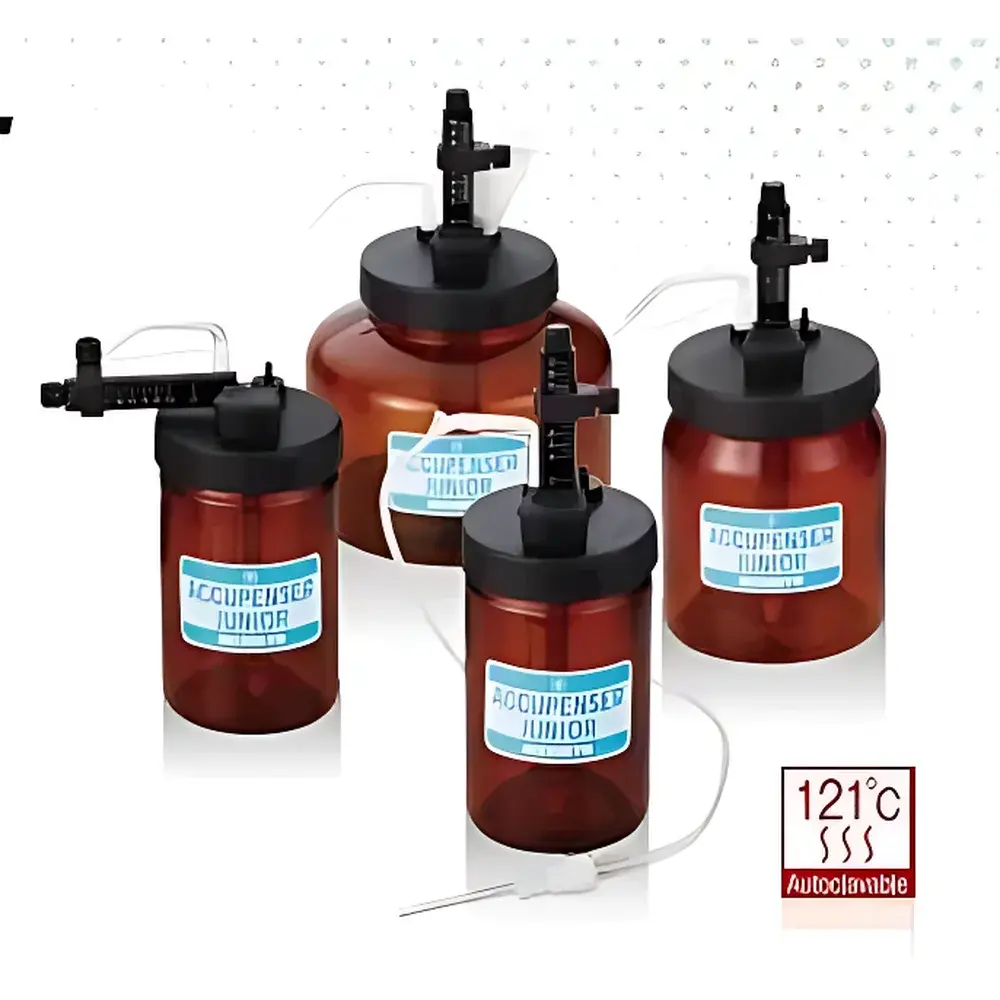
Nichiryo ACCUPENSER JR Adjustable Liquid Dispenser
| Brand | Nichiryo |
|---|---|
| Origin | Japan |
| Model | ACCUPENSER JR |
| Instrument Type | Manual Adjustable Bottle-top Dispenser |
| Automation Level | Manual |
| Volume Range Options | 0.2–10 mL (AJ-1), 0.4–20 mL (AJ-2), 1–50 mL (AJ-5), 2–100 mL (AJ-10) |
| Minimum Increment | 0.05 mL (AJ-1), 0.1 mL (AJ-2 & AJ-5), 0.25 mL (AJ-10) |
| Coefficient of Variation (CV) | ≤0.1% |
| Bottle Compatibility | Standard 500 mL and 1 L reagent bottles (neck dimensions identical) |
| Bottle Dimensions (W × H, mm) | 75 × 210 (165), 100 × 210 (165), 146 × 210 (165) — values in parentheses indicate collapsed height when vernier head is folded |
| Materials in Contact with Liquids | Chemically resistant polymers |
| Sterilization | Autoclavable at 121°C for 20 minutes |
| Compliance | Designed to support GLP-compliant workflows |
Overview
The Nichiryo ACCUPENSER JR is a precision-engineered, manually operated bottle-top liquid dispenser designed for repeatable, contamination-minimized dispensing in analytical, quality control, and research laboratories. Unlike conventional pipettes or syringe-based systems, the ACCUPENSER JR operates on a positive displacement principle via a calibrated piston-driven mechanism housed entirely within the reagent bottle cap assembly. Its modular architecture separates mechanical actuation from liquid contact zones—ensuring long-term metrological stability while minimizing carryover and evaporation risks. The device is optimized for routine use with aqueous buffers, standard reagents, and moderately aggressive solutions, and supports traceable volume delivery across four calibrated models (AJ-1, AJ-2, AJ-5, AJ-10), each covering distinct volumetric ranges and resolution profiles. Its design reflects Japanese engineering rigor in dimensional control, ergonomics, and chemical compatibility—making it suitable for ISO/IEC 17025-accredited testing environments where procedural consistency and audit readiness are critical.
Key Features
- Vernier-adjustable volume setting with tactile feedback and visual scale alignment—enabling rapid, tool-free recalibration between dispense volumes without disassembly.
- Foldable upper vernier head module reduces vertical footprint by up to 50%: collapsed heights range from 165 mm (AJ-1/AJ-2/AJ-5) to 220 mm (AJ-30, not listed but referenced in original spec)—ideal for storage in refrigerated cabinets or crowded laminar flow hoods.
- Entire precision piston assembly resides inside the bottle, isolated from ambient lab conditions—reducing thermal drift, particulate ingress, and operator-induced variability.
- Liquid-path components constructed from high-purity, chemically inert polymers compliant with USP Class VI requirements; optional PTFE fluoropolymer kits available for extended service life with hydrochloric acid, nitric acid, acetone, chloroform, and other halogenated solvents.
- Modular accessory interface accepts refill tubes for in-bottle replenishment—eliminating open decanting and reducing exposure to volatile compounds or moisture-sensitive reagents.
- Autoclavable at 121°C for 20 minutes per ISO 17665-1, supporting sterilization cycles required for microbiological assay preparation and cleanroom applications.
Sample Compatibility & Compliance
The ACCUPENSER JR accommodates standard laboratory reagent bottles (500 mL and 1 L) with identical neck geometry—enabling cross-model interchangeability without adapter changes. All wetted materials meet FDA 21 CFR §177.2470 (plastics for food-contact use) and EU Regulation (EC) No. 1935/2004 standards. When used with certified reference materials and validated calibration protocols, the dispenser satisfies volume accuracy requirements outlined in ISO 8655-3:2022 (Piston-operated volumetric apparatus — Part 3: Dispensers). Its mechanical repeatability (CV ≤0.1%) aligns with internal QC thresholds for Tier-2 analytical procedures under CLIA and CAP guidelines. For regulated pharmaceutical environments, the device supports GMP-aligned documentation through integration into instrument logbooks and maintenance records.
Software & Data Management
As a manual mechanical dispenser, the ACCUPENSER JR does not incorporate embedded electronics or digital interfaces. However, its design facilitates full traceability within paper-based or electronic laboratory notebook (ELN) systems. Each unit carries a unique serial number etched on the base housing, enabling linkage to calibration certificates, usage logs, and preventive maintenance schedules. Laboratories implementing 21 CFR Part 11 compliance may assign digital identifiers to individual units and record dispensing events—including volume setpoint, date/time stamp, operator ID, and batch lot—within validated ELN platforms such as LabArchives or Benchling. Calibration data can be archived alongside uncertainty budgets per ISO/IEC 17025 Clause 7.7.
Applications
- Preparation of calibration standards and QC samples in environmental testing (e.g., EPA Method 200.8, ISO 11885).
- Accurate dispensing of titrants, indicators, and buffer stocks in wet chemistry labs operating under ASTM E29 or ISO 5725-2 precision criteria.
- Reagent distribution for ELISA, PCR setup, and cell culture media formulation where low CV and minimal aerosol generation are essential.
- Controlled addition of catalysts or initiators in polymer synthesis workflows requiring sub-milliliter reproducibility.
- Support of ISO/IEC 17025 method validation studies where intermediate precision (within-lab reproducibility) must be demonstrated across multiple operators and days.
FAQ
Is the ACCUPENSER JR compatible with narrow-neck or non-standard reagent bottles?
No—it is engineered exclusively for standard wide-mouth laboratory bottles (DIN 11626 or ASTM D2593 neck specifications) with matching thread pitch and sealing interface. Custom adapters are not supplied or validated by Nichiryo.
Can the PTFE kit be autoclaved repeatedly?
PTFE components exhibit gradual embrittlement after repeated steam sterilization cycles; Nichiryo recommends replacement after 10 autoclave exposures or upon visible surface cracking or loss of seal integrity.
What calibration documentation is provided with purchase?
Each unit ships with a factory-issued conformity statement referencing ISO 8655-3 tolerances. Full metrological calibration certificates (with uncertainty budget) are available as an optional add-on service through authorized Nichiryo calibration centers in Japan, Germany, and the United States.
Does the folded-head configuration affect volumetric accuracy?
No—volume setting is mechanically locked prior to folding; the vernier mechanism retains positional fidelity independent of orientation. Accuracy remains within stated ±1.0% tolerance regardless of storage position.
How frequently should maintenance be performed?
Routine inspection (seal integrity, piston smoothness, absence of residue buildup) is recommended after every 500 dispense cycles or weekly in high-throughput settings. Full disassembly and cleaning per Nichiryo Technical Bulletin TB-JR-2023 is advised quarterly or after handling viscous or precipitating solutions.



