
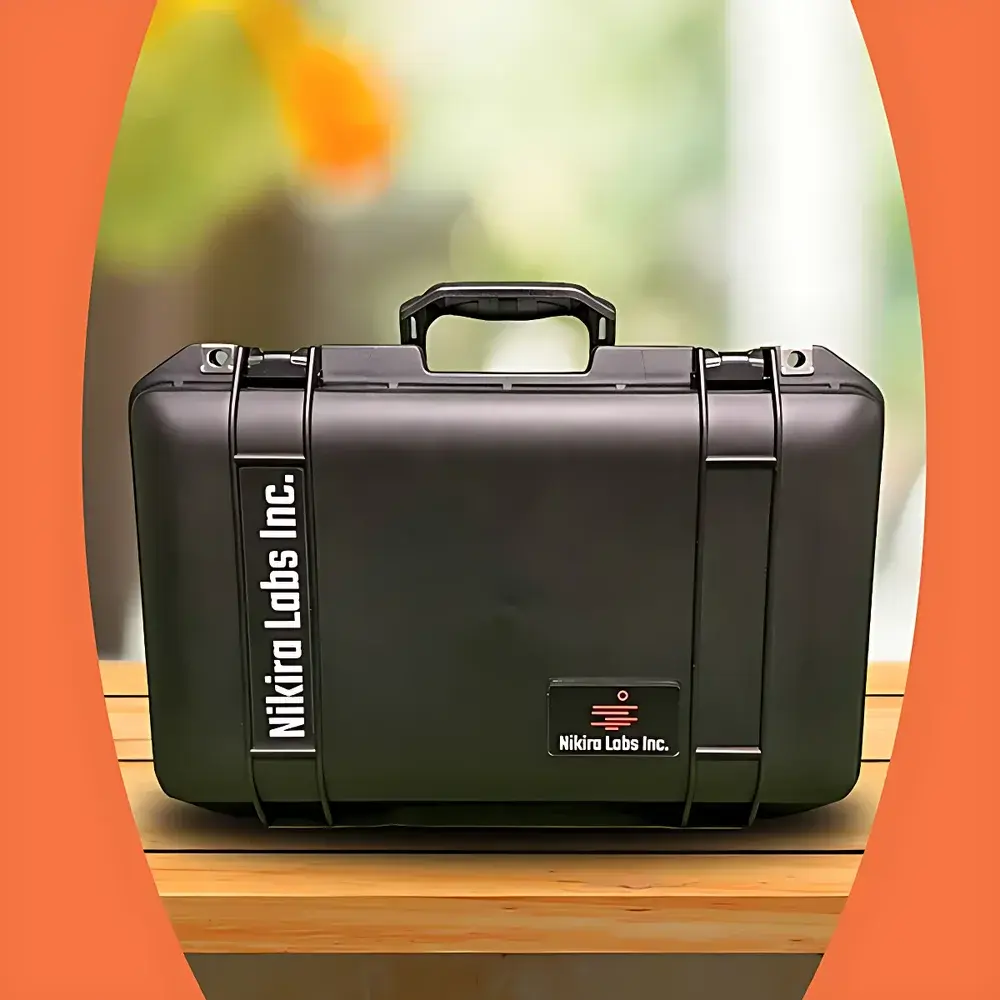
Nikira OEA-532 Open-Path Optical Extinction Analyzer
| Brand | Nikira |
|---|---|
| Origin | USA |
| Manufacturer Type | Authorized Distributor |
| Origin Category | Imported |
| Model | OEA-532 |
| Instrument Type | Aerosol Detector |
| Wavelength | 532 nm |
| Dynamic Range | 0 to >3000 Mm⁻¹ |
| Accuracy | ±1 Mm⁻¹ (nominal) |
| Data Rate | 1 s |
| Measurement Principle | Open-Path Cavity Ring-Down Spectroscopy (CRDS) |
| Calibration | Autonomous in-situ self-calibration |
| Consumables | None |
| Operating Temperature | −5 to +50 °C |
| Relative Humidity | 0–99 % RH (non-condensing) |
| Dimensions | 49 cm × 33 cm × 18 cm |
| Weight | 7.7 kg |
| Power Consumption | 35 W |
| Onboard Memory | >1 million readings (≥2 years continuous at 1 Hz) |
Overview
The Nikira OEA-532 Open-Path Optical Extinction Analyzer is a research-grade, field-deployable instrument engineered for the direct, absolute, and real-time measurement of aerosol optical extinction coefficient (units: Mm⁻¹) and derived meteorological visibility. Unlike traditional nephelometers or filter-based absorption photometers, the OEA-532 employs open-path cavity ring-down spectroscopy (CRDS)—a first-principles optical technique that quantifies total light loss (scattering + absorption) within an unconfined atmospheric volume. This eliminates sampling artifacts inherent to inlet-dependent systems, including particle losses due to inertial impaction, diffusion, or hygroscopic growth suppression during extraction. The instrument operates at a fixed, temperature-stabilized 532 nm laser wavelength—optimal for detecting fine-mode urban, biomass-burning, and secondary organic aerosols—while maintaining traceability to fundamental physical constants via high-finesse optical cavity decay time measurement.
Key Features
- True open-path architecture: No inlet tubing, no pump, no flow control—ambient air passes freely through the optical cavity, preserving native particle size distribution and phase state.
- Autonomous in-situ calibration: Implements NOAA-patented reference cavity modulation and zero-air drift correction algorithms; requires no calibration gases, manual intervention, or scheduled maintenance.
- Drift-free long-term stability: Achieves <±0.5 Mm⁻¹ baseline drift over 30 days under field conditions, validated against co-located CAPS PMex and integrating nephelometer references.
- Low-power, dual-mode operation: Draws only 35 W; compatible with 12 V DC (battery/solar) or 100–240 V AC input; supports continuous logging at 1 Hz for >2 years on internal flash memory (>1 million data points).
- Robust environmental tolerance: Rated for operation from −5 °C to +50 °C and 0–99 % RH (non-condensing); housed in IP65-rated aluminum enclosure with passive thermal management.
- Multi-wavelength scalability: While the OEA-532 is optimized for 532 nm, the platform architecture supports modular retrofitting to other wavelengths (e.g., 450 nm, 850 nm, 1650 nm) for spectral extinction profiling.
Sample Compatibility & Compliance
The OEA-532 measures extinction across the full ambient aerosol size distribution—from sub-10 nm nucleation-mode particles to super-micron dust and sea salt—without size-selective bias. Its open-path design inherently captures hygroscopically swollen particles under humid conditions, avoiding the systematic underestimation of extinction common in closed-path instruments. The analyzer complies with EPA Reference Method EQOA-01 for optical extinction validation and meets ISO 9060:2018 Class A spectral responsivity requirements for broadband radiometric equivalence. Data output adheres to CF Standard Names v77 and NetCDF-4/HDF5 conventions, supporting integration into EPA AQS, EEA AirBase, and ACTRIS metadata frameworks. Audit trails, time-stamped raw decay fits, and calibration event logs are stored onboard to satisfy GLP/GMP and FDA 21 CFR Part 11 electronic record integrity requirements.
Software & Data Management
Instrument control, real-time visualization, and data export are managed via Nikira’s web-based OEA Control Suite (v3.2+), accessible via Ethernet, USB-C, or LTE cellular modem (optional). The suite provides live cavity decay curve fitting diagnostics, automated flagging of optical misalignment or condensation events, and configurable averaging intervals (1 s to 1 hr). All raw ring-down time series, fitted extinction values, temperature/pressure/humidity metadata, and calibration logs are stored in compressed, timestamped NetCDF files. Batch export supports CSV, JSON, and MATLAB-compatible formats. Remote firmware updates, secure SSH access, and TLS 1.3 encrypted data transmission ensure compliance with NIST SP 800-53 Rev. 5 security controls for federal environmental monitoring networks.
Applications
- Airport and aviation safety: Real-time Runway Visual Range (RVR) estimation per ICAO Annex 3 and FAA Advisory Circular 150/5200-32B.
- Transportation infrastructure: Fog and haze monitoring on low-visibility highways, tunnels, and mountain passes.
- National and regional air quality networks: Long-term trend analysis of anthropogenic vs. natural aerosol loading; validation of chemical transport models (e.g., CMAQ, GEOS-Chem).
- Climate-relevant field campaigns: In situ closure studies linking extinction to composition (AMS, SP-AMS), morphology (TEM), and hygroscopicity (HTDMA).
- Specialized environments: Volcanic plume characterization, desert dust transport, boreal wildfire smoke tracking, and clean-room particulate surveillance in semiconductor fabrication facilities.
- Ecosystem and health research: Correlation of extinction-derived PM2.5 surrogates with respiratory morbidity endpoints in longitudinal cohort studies.
FAQ
Does the OEA-532 require periodic calibration with certified gas standards?
No. It performs autonomous in-situ self-calibration using internal reference cavity modulation and zero-air baseline verification—no external gases, span checks, or manual intervention required.
Can it operate unattended in remote locations for extended periods?
Yes. With onboard memory supporting >2 years of 1 Hz data and dual power options (12 V DC or AC), it is designed for autonomous deployment in off-grid observatories, mountaintop stations, or marine buoys.
How does it handle precipitation or fog?
The optical path is protected by hydrophobic-coated windows and active purge airflow; liquid water droplets on optics trigger automatic data flagging and resume measurement once cleared—no hardware damage or recalibration needed.
Is the 532 nm wavelength suitable for black carbon quantification?
While optimized for total extinction, the 532 nm channel provides strong sensitivity to light-absorbing carbonaceous aerosols; for speciated absorption, pairing with a 850 nm or 1065 nm OEA unit enables Ångström exponent derivation.
What level of technical support and software updates does Nikira provide?
Nikira offers lifetime firmware and software updates, remote diagnostic support, and application engineering consultation for network integration—backed by ISO 9001-certified service workflows.
Related Products







