
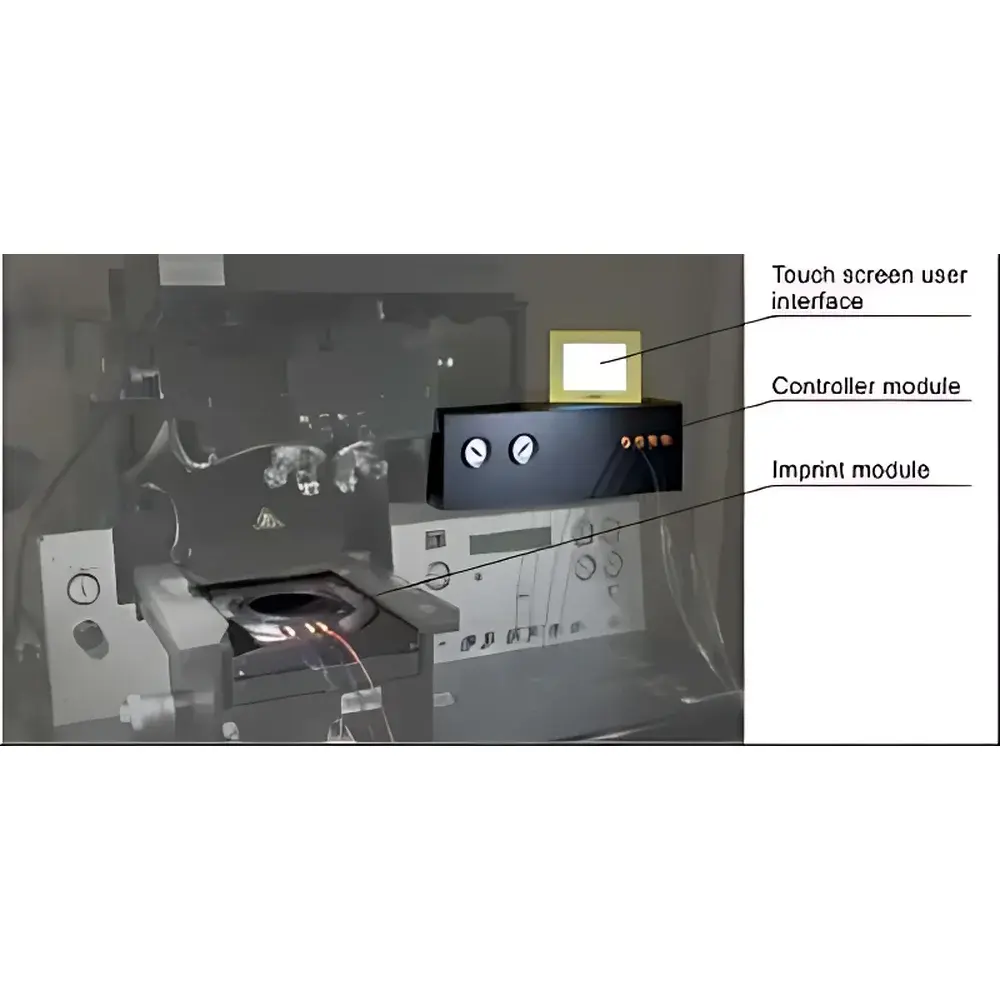
NIL Nanoimprint Lithography System NIL-4i
| Brand | NIL |
|---|---|
| Origin | Denmark |
| Manufacturer Type | Authorized Distributor |
| Origin Category | Imported |
| Model | NIL-4i |
| Pricing | Contact for Quotation |
| Wafer Size | 4 in |
| Imprintable Area | 2 in diameter |
| Imprint Pressure Range | 0–25 PSI (upgradable to 100 PSI) |
| Mold Substrate Dimensions | 5 × 0.090 in |
| Typical Throughput | < 5 min/wafer |
| Controller Platform Dimensions | 5.8 × 16.5 × 12 in |
| Main Platform Dimensions | 17 × 16 × 15 in |
| Weight (Controller) | 18.5 lb |
| Weight (Main Unit) | 45 lb |
| Operating Temperature | 10–35 °C |
| Relative Humidity | ≤65% RH |
| Compressed Air Supply | Filtered, 70–100 PSI |
| Vacuum Source | ≤−14 PSI |
| Power Input | 110–220 VAC, 2 A, 50/60 Hz |
| Cleanroom Class | ISO Class 6 (Class 1000) or better |
Overview
The NIL Nanoimprint Lithography System NIL-4i is a compact, benchtop-scale thermal and UV-curable nanoimprint lithography (NIL) platform engineered for high-resolution pattern transfer in academic research labs, microfabrication pilot lines, and R&D environments requiring rapid prototyping of nanoscale features. Unlike conventional photolithography, which relies on optical diffraction limits, NIL achieves sub-50 nm feature resolution through direct mechanical contact between a rigid mold (typically quartz or silicon) and a UV-curable resist-coated substrate—enabling replication fidelity independent of wavelength constraints. The NIL-4i implements a hybrid imprint architecture: precise vacuum-assisted alignment and clamping, programmable pressure control, and integrated UV LED exposure (365 nm) synchronized with force application. Its design emphasizes repeatability, process transparency, and compatibility with standard cleanroom workflows and existing photolithography infrastructure—including resist formulations compliant with industry-standard spin-coating and development protocols.
Key Features
- Programmable PLC-based control system with intuitive 7-inch capacitive touch interface for full parameter customization (pressure ramp rate, dwell time, UV dose, vacuum sequence)
- Vacuum chucks for both wafer (4-inch) and mold substrates ensure uniform contact and minimal distortion during imprinting
- UV-curable imprint resist compatibility—validated with common acrylate-based resists (e.g., Optool, NTT-Advanced Technology resists) and fully compatible with standard photomask alignment tools and wet development stations
- Modular pressure actuation system with factory-calibrated 0–25 PSI range; optional upgrade path to 100 PSI for high-aspect-ratio or low-surface-energy mold release applications
- Built-in environmental monitoring (temperature, humidity) with data logging via USB export for GLP-compliant recordkeeping
- ISO Class 6 (Class 1000) cleanroom-ready footprint—no external vibration isolation required; operates within standard laboratory HVAC conditions
Sample Compatibility & Compliance
The NIL-4i supports 4-inch silicon, fused silica, or III-V compound wafers with native oxide or thin-film coatings (SiO₂, SiNₓ, TiO₂). Mold substrates up to 5 × 0.090 inches accommodate custom quartz or silicon masters fabricated via e-beam lithography or DRIE. All wet chemical handling (resist spin-coating, developer rinse, DI water drying) occurs externally, preserving internal chamber integrity. The system complies with IEC 61000-6-2 (EMC immunity) and IEC 61000-6-4 (EMC emission) standards. Process documentation and audit trails meet GLP and pre-GMP requirements; optional firmware enables 21 CFR Part 11–compliant electronic signatures and user access controls when paired with validated networked storage.
Software & Data Management
Control software runs on embedded Linux OS with real-time kernel scheduling for deterministic timing of UV exposure and pressure application. Each imprint cycle generates a timestamped .csv log file containing pressure vs. time, UV intensity profile, vacuum status, and temperature readings. Logs are exportable via USB 2.0 or Ethernet (optional). No proprietary drivers required—data files open natively in Excel, Python (pandas), or MATLAB. Firmware updates are delivered as signed binary packages with SHA-256 checksum verification. Remote diagnostics support is available via secure SSH tunnel upon customer authorization.
Applications
- Development of plasmonic metasurfaces and photonic crystal slabs for sensing and optical filtering
- Rapid fabrication of master stamps for roll-to-roll nanoimprint processes
- Prototyping of diffractive optical elements (DOEs) and micro-lens arrays for AR/VR waveguides
- Low-cost fabrication of biosensor substrates with controlled nanotopography for cell adhesion studies
- Hybrid integration of nanoimprinted alignment marks with conventional CMOS back-end-of-line (BEOL) processing
- Materials research on UV-curable polymer rheology under confined compression and photo-crosslinking kinetics
FAQ
What wafer sizes does the NIL-4i support?
The system is configured for 4-inch wafers with a maximum imprintable area of 2 inches in diameter. Custom chucks for 2-inch or 3-inch substrates are available as accessories.
Is the UV source replaceable, and what is its spectral output?
Yes—the integrated 365 nm UV-LED module has a rated lifetime of ≥10,000 hours and narrow spectral bandwidth (FWHM < 10 nm). Replacement modules are field-swappable without recalibration.
Can the NIL-4i be integrated into automated cluster tools?
While the NIL-4i is a standalone unit, it includes RS-232 and digital I/O ports for handshake signaling with load-lock systems or robotic handlers. Full SECS/GEM integration requires third-party middleware and is supported under extended service agreements.
Does the system require special exhaust or ozone abatement?
No. The 365 nm UV source generates negligible ozone; standard lab ventilation meets all safety requirements per ANSI Z136.1.
How is mold alignment performed?
Manual alignment is supported via integrated dual-microscope viewing (5× and 20× magnification) with XYZ translation stages. Optional motorized alignment stage with vision-based auto-alignment (sub-micron accuracy) is available as an upgrade.



