
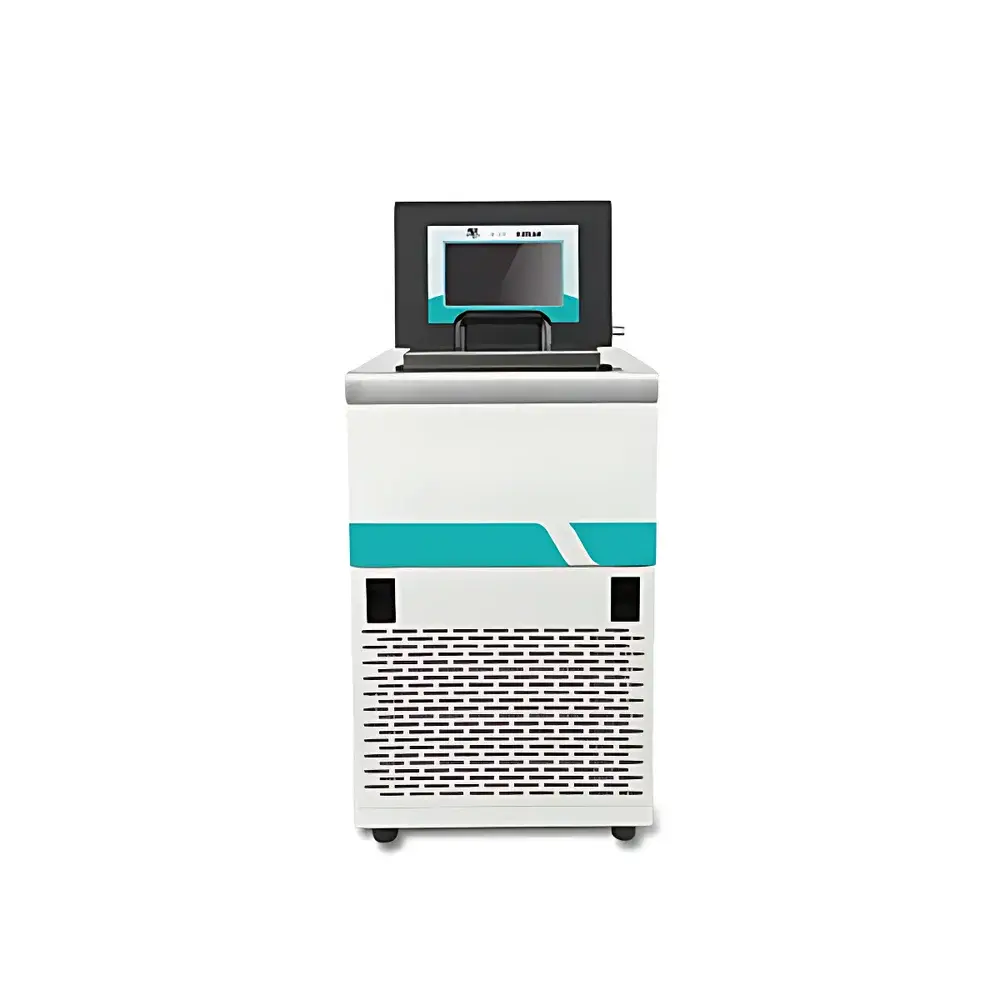
Ningbo Scientz DC-4015 Low-Temperature Circulating Bath (Heating & Cooling)
| Brand | Ningbo Scientz |
|---|---|
| Origin | Zhejiang, China |
| Manufacturer Type | Direct Manufacturer |
| Country of Origin | China |
| Model | DC-4015 |
| Instrument Type | Circulating Temperature Bath |
| Circulation Mode | Internal & External Loop |
| Temperature Control | Dual-mode (Heating & Refrigeration) |
| Bath Chamber Dimensions (L×W×H) | 300 × 250 × 200 mm |
| Temperature Range | −40 °C to +100 °C |
| Temperature Stability | ±0.1 °C |
Overview
The Ningbo Scientz DC-4015 Low-Temperature Circulating Bath is an engineered thermal management system designed for precise, stable, and bidirectional temperature control of external experimental apparatus or internal bath media. Utilizing a closed-loop refrigeration cycle based on vapor-compression thermodynamics—integrated with Peltier-assisted fine-tuning in select operating zones—the DC-4015 delivers accurate thermal regulation across a wide operational span from −40 °C to +100 °C. Its dual-mode capability enables seamless transition between active cooling and resistive heating, making it suitable for applications requiring both cryogenic stabilization and elevated-temperature conditioning. The unit features a stainless-steel bath chamber (300 × 250 × 200 mm), rated for water, silicone oil, ethylene glycol–water mixtures, and other non-corrosive heat-transfer fluids. Designed for laboratory integration, the DC-4015 serves as a primary thermal source for externally connected devices—including rotary evaporator condensers, ultrasonic probe systems, jacketed reactors, and semiconductor test fixtures—while maintaining high thermal uniformity (±0.1 °C stability) and minimal drift under dynamic load conditions.
Key Features
- High-efficiency sealed compressor (Secop, Germany) with low acoustic emission (<52 dB[A] at 1 m), ensuring quiet operation in shared lab environments.
- Environmentally compliant refrigerant (R-404A or R-507 alternative, per regional regulations), meeting current EU F-Gas and EPA SNAP requirements.
- 7-inch capacitive touchscreen interface with ergonomic tilt design; supports real-time display of setpoint, actual bath temperature, circulation pressure, elapsed time, and alarm status.
- PID-based digital temperature controller with auto-tuning function and programmable ramp/soak profiles (up to 10 segments).
- Dual-circulation architecture: user-selectable internal recirculation (for bath homogeneity) or external loop mode (max. head pressure 0.3 MPa, flow rate adjustable 0–20 L/min).
- Intelligent power recovery logic: retains all parameter settings after power interruption; configurable auto-restart or standby-on-power-up behavior.
- Comprehensive safety suite: compressor overheat protection, motor overload cutoff, low-level fluid sensor, dry-run prevention, and high-temperature cutout (110 °C max).
Sample Compatibility & Compliance
The DC-4015 accommodates a broad range of compatible heat-transfer media, including deionized water, 30–60% aqueous ethylene glycol solutions, and silicone oils (viscosity ≤ 50 cSt). It is not intended for use with flammable, highly viscous, or corrosive solvents (e.g., acetone, concentrated acids, or chlorinated hydrocarbons). The unit complies with IEC 61010-1:2010 (Safety Requirements for Electrical Equipment for Measurement, Control, and Laboratory Use) and meets CE marking requirements for EMC (EN 61326-1) and low-voltage directives. While not certified for ISO/IEC 17025 calibration laboratories out-of-the-box, its ±0.1 °C stability and traceable sensor architecture support integration into GLP/GMP workflows when paired with third-party temperature validation protocols (e.g., ASTM E2251–22 for liquid-bath uniformity assessment).
Software & Data Management
The DC-4015 operates autonomously via embedded firmware but supports optional RS485 (Modbus RTU) or USB-to-serial communication for remote monitoring and control. When integrated with Scientz’s LabLink Pro software (Windows-compatible), users can log temperature trajectories, export CSV-formatted datasets with timestamps, configure multi-step temperature programs, and generate audit-ready reports. The system records event logs—including alarm triggers, power cycles, and parameter modifications—with timestamped entries that satisfy basic FDA 21 CFR Part 11 data integrity expectations (electronic signatures and audit trails require supplementary software licensing and IT validation).
Applications
- Condenser cooling for rotary evaporation systems, enabling efficient solvent recovery at sub-ambient temperatures.
- Thermal regulation of non-contact ultrasonic homogenizers and sonoreactors during cell lysis or nanoparticle synthesis.
- Temperature control of jacketed glass reactors during exothermic/endothermic chemical synthesis (e.g., Grignard reactions, polymerization).
- Stabilization of biological samples (enzymes, antibodies, nucleic acids) during long-duration assays or storage preconditioning.
- Thermal testing of electronic components, PCBs, and semiconductor packages under controlled cold/hot bias conditions.
- Calibration of temperature-sensitive sensors (RTDs, thermistors, IR cameras) using NIST-traceable reference baths.
FAQ
What is the maximum external loop pressure the DC-4015 can sustain?
The pump delivers up to 0.3 MPa (3 bar) static pressure at zero flow; recommended maximum backpressure in continuous external circulation is 0.2 MPa.
Can the DC-4015 be used with silicone oil at 100 °C?
Yes—provided the selected oil grade has a flash point >120 °C and viscosity remains below 50 cSt at operating temperature; verify compatibility with manufacturer datasheets prior to use.
Is the temperature sensor calibrated and traceable to national standards?
The PT100 sensor is factory-calibrated; full NIST-traceable calibration certificates are available as an optional add-on service (order code CAL-DC4015-NIST).
Does the unit support 24/7 unattended operation?
Yes—when configured with timer-based shutdown, thermal limit safeguards, and stable utility supply; periodic visual inspection of fluid level and pump performance is recommended per maintenance schedule.
How often should the refrigerant circuit be serviced?
Under normal laboratory conditions, no routine refrigerant servicing is required; annual inspection of condenser coil cleanliness and compressor performance is advised per Scientz Maintenance Guide Rev. 3.2.



