
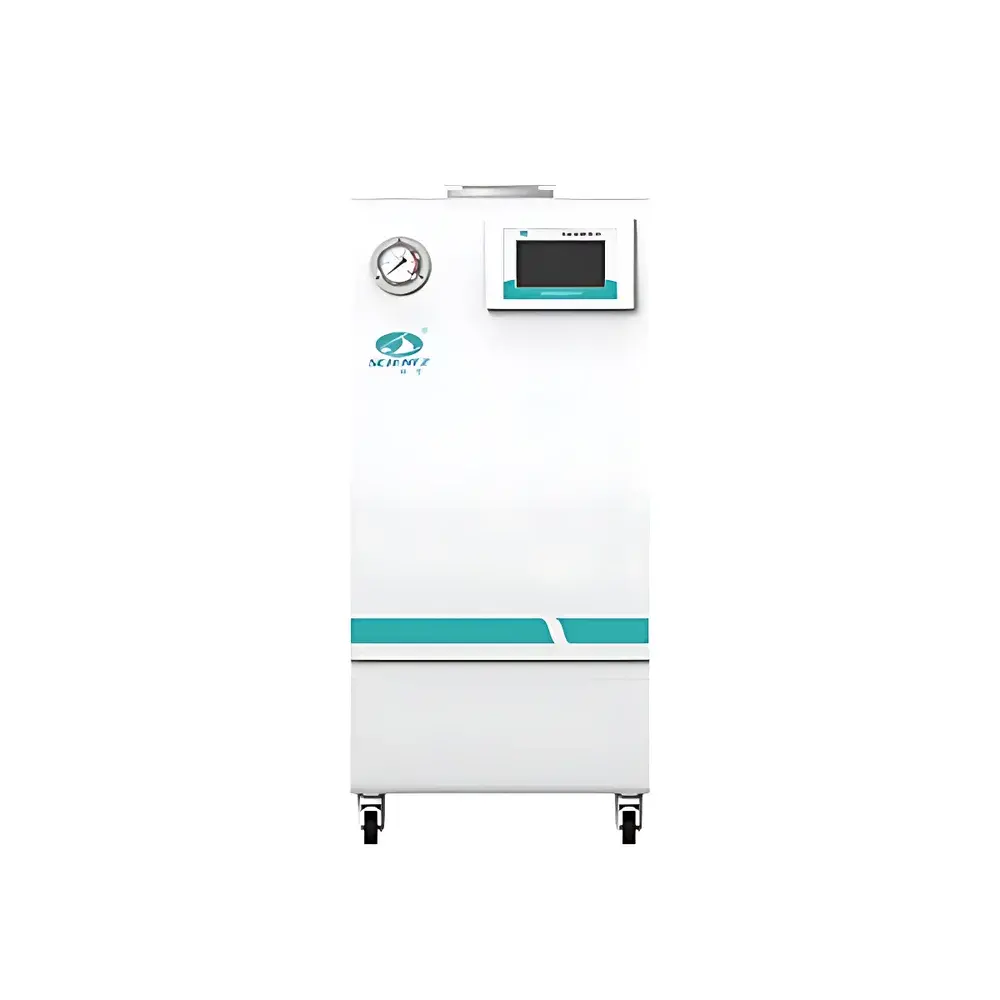
Ningbo Scientz DLK-2020 Low-Temperature Circulating Chiller
| Brand | Ningbo Scientz |
|---|---|
| Origin | Zhejiang, China |
| Manufacturer Type | Direct Manufacturer |
| Country of Origin | China |
| Model | DLK-2020 |
| Pricing | Available Upon Request |
Overview
The Ningbo Scientz DLK-2020 Low-Temperature Circulating Chiller is a precision-engineered temperature control system designed for laboratory-scale thermal management of external equipment and internal baths. It operates on a closed-loop refrigeration cycle using an environmentally compliant refrigerant (R-410A or equivalent, compliant with Montreal Protocol phase-out schedules), delivering stable, programmable cooling capacity across a wide operating range. The unit integrates a high-efficiency hermetic compressor—sourced from Panasonic or Tecumseh—and a microprocessor-based PID temperature controller to maintain setpoint accuracy within ±0.1 °C under steady-state conditions. Unlike open-loop tap-water cooling systems, the DLK-2020 eliminates dependency on municipal water supply, ambient humidity, or seasonal temperature fluctuations—ensuring reproducible condensation temperatures in rotary evaporation, consistent thermal loading for atomic absorption spectrometry graphite furnace coolers, and precise bath uniformity for calorimetric or reaction kinetics studies.
Key Features
- 7-inch angled capacitive touchscreen interface with real-time display of bath temperature, elapsed time, setpoint, pump pressure, and system status
- Programmable timer function enabling automatic shutdown after user-defined operational duration
- High-pressure circulation pump (up to 2.5 bar) supporting both internal bath circulation and external load cooling via dual-mode flow routing (internal/external loop switchable)
- Compact footprint (W × D × H ≈ 450 × 500 × 800 mm) optimized for benchtop integration in space-constrained analytical laboratories
- Compressor-level safety protections including overheat cutoff, current overload detection, and high-pressure lockout
- Power-loss recovery mode: retains last configuration and supports configurable auto-restart behavior (standby cooling activation or idle state upon power restoration)
- Low-noise operation (<58 dB(A) at 1 m) enabled by vibration-damped mounting and fully enclosed refrigeration architecture
Sample Compatibility & Compliance
The DLK-2020 is compatible with a broad spectrum of laboratory instrumentation requiring regulated coolant delivery, including rotary evaporators (1–4 units simultaneously at 40 °C evaporation temperature), atomic absorption spectrometers (graphite furnace and flame atomizer cooling circuits), Soxhlet extractors, and calorimeters. Its fluid path is constructed from corrosion-resistant stainless steel and fluoropolymer-lined components, ensuring compatibility with aqueous, ethanolic, and mildly acidic or basic heat-transfer fluids (e.g., 30% ethylene glycol/water mixtures). The unit complies with IEC 61010-1:2010 for electrical safety in laboratory equipment and meets CE marking requirements for electromagnetic compatibility (EN 61326-1) and low-voltage directive (2014/35/EU). While not certified to FDA 21 CFR Part 11, its parameter logging capability supports GLP-compliant documentation when integrated with validated third-party data acquisition software.
Software & Data Management
The onboard controller stores up to 100 runtime logs—including timestamped temperature profiles, pump pressure readings, and compressor duty cycles—with export via USB flash drive in CSV format. No proprietary software installation is required; raw data files are natively readable in Excel, MATLAB, or LabVIEW. Optional RS-485 Modbus RTU interface enables integration into centralized building management systems (BMS) or LIMS platforms for remote monitoring and alarm notification. Audit trail functionality records all parameter modifications, user logins (via optional password protection), and system fault events—supporting traceability requirements in ISO/IEC 17025-accredited testing laboratories.
Applications
- Rotary Evaporation: Provides consistent condenser cooling at ≤10 °C regardless of ambient conditions, improving solvent recovery yield and reducing bumping during low-boiling-point compound isolation
- Soxhlet Extraction: Delivers repeatable cold trap temperatures for fat and lipid quantification in AOAC 991.36 and ISO 1443-compliant food, feed, and dairy analysis workflows
- Atomic Absorption Spectroscopy: Supplies regulated coolant flow to graphite furnace assemblies and premix burners, maintaining thermal stability critical for ng/mL-level metal detection sensitivity
- Reaction Calorimetry: Serves as a constant-temperature heat sink for RC1 or EasyMax-type reactors, enabling accurate ΔH measurement under isothermal or adiabatic modes
- Material Testing: Supports controlled-temperature tensile, rheological, or dielectric property measurements per ASTM D618, ISO 293, or IEC 60250 protocols
FAQ
What is the minimum achievable bath temperature at ambient 25 °C?
The DLK-2020 achieves a stable setpoint of –20 °C in internal bath mode under standard laboratory conditions (25 °C, 50% RH), with full cooling capacity maintained down to –15 °C in external load mode.
Can it operate continuously for 72 hours or longer?
Yes—the unit is rated for continuous duty (IEC 60034-1 S1 rating) with thermal management features including condenser fan speed modulation and compressor cycling logic to prevent overheating.
Is the circulation pump compatible with silicone oil or other non-aqueous heat transfer fluids?
The pump and wetted materials are compatible with water-glycol mixtures and mineral oils; silicone oil requires verification of viscosity (<100 cSt at operating temperature) and chemical inertness against EPDM seals.
Does the system support external PT100 probe input for remote temperature feedback?
No—the DLK-2020 relies exclusively on its integrated Pt100 sensor located in the reservoir; external probe integration is not supported in firmware v3.2.
What maintenance intervals are recommended for long-term reliability?
Compressor oil and refrigerant levels require inspection every 24 months; condenser coil cleaning is advised quarterly in dust-prone environments; pump impeller integrity should be verified annually per manufacturer service bulletin SB-DLK-2020-07.



